
Beta engine heat exchanger.

If you screw the end caps, 'o' rings and the stack together outside the casing you will see how the 'o' ring is supposed to work. It should be squeezed by the chamfers on the end cap and stack which forces it out to also squeeze against the casing. A smear of silicone grease on the 'o' ring assists.
 
If you screw the end caps, 'o' rings and the stack together outside the casing you will see how the 'o' ring is supposed to work. It should be squeezed by the chamfers on the end cap and stack which forces it out to also squeeze against the casing. A smear of silicone grease on the 'o' ring assists.

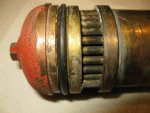
To illustrate:
http://www.ybw.com/forums/images/attach/jpg.gif
Also note that the o-rings for the newer engines (three bolt for the each end cap) are a different size and/or diameter.
 

Attachments

  • exch o-ring.jpg
    exch o-ring.jpg
    84.7 KB · Views: 11
Thanks for the suggestions but it still leaks seawater. Is the size [not diameter] of the O ring critical.

Sorry to read that you've still got a problem. The last 4 posts should help – and with regard to sailorman’s point, if it’s like mine you should find a ‘gap’ of about 1mm or so (that’s IIRC, and very roughly) between the edge of the widest part of each end cap and the outer faces of the exchanger when all is right and tight.

You might think it doesn’t look right with that gap, but it is. If your O-rings are too thin, you could get the end caps bang up against the housing without each O-ring compressing to seal between the chamfered faces of the cap and stack end.

If you’ve got O-rings for the right engine from Beta, that should not happen. If you have doubts about their thickness being correct, I would contact Beta and get new ones.
 
Yep, the matrix floats in the middle and the end caps pull the O rings onto the housing.

I should run a finger around the mating surface of the housing, near the weep (probably at the back), and check for roughness, encrustation or corrosion. Take any out with fine emery. There was once a photo posted of a neglected engine with terminal corrosion in this area. If it is pitted, a repair is possible with quality, hard bodging compound of choice. In extremis, assembly with silicone would no doubt solve it, messy though.

I have observed the contents of the heat exchanger over the years and never found even as much in there as post 4. So I am with the others and will only look at the thing on the three year cycle. Water resistant grease on the close fitting flanges of the matrix helps to prevent problems of removal.
 
Yep, the matrix floats in the middle and the end caps pull the O rings onto the housing.

I should run a finger around the mating surface of the housing, near the weep (probably at the back. ...

Not an external weep, I believe - at least not in the OP - but a cross connection between the circuits inside the HE?
 
Ah, I see.

Sounds a bit rum. I think this original design was aiming to be simple, intuitive and difficult to get wrong. So, with the best intentions, it probably missed it's mark.
 
I've had issues with the daft design of the heat exchanger. Didn't seem to manage to properly seal up the caps last season and ended up with a fair bit of corrosion around the area.

Make sure you keep an eye on the engine anode! Mine vanished in no time and I didn't realise, leading to some nasty corrosion, though fortunately not terminal. The main symptom that I should've paid more attention to was the fluctuating fresh water level.
 
shot in the dark - have you replaced the sealing washers under the heads of the clamping bolts? I had trouble with weeps when reusing the copper ones. The yard foreman let me have a couple of 'Dowty' washers (aluminum housing with rubber insets) which worked a treat.
 
I'll try some newer O rings, my spares bag had a few of differing sizes, and seemed to fit correctly. Silicone grease also to be applied as it needed a hefty thump with a mallet to get the end caps off.
 
Hi Mudisox :)
I just stumbled over this old thread because I´m experiencing the exact same problem of water coming out the overflow hose (Nanni 2.14)...
Did you ever solve this - and if so, how? Thank you!!!
 
Another problem I had with the Beta heat exchanger single central retaining screw - this screw corrodes and one of mine failed after 12yrs, fortunately I had just started the engine after launch and the hatch was open - the end fell off and water poured into the engine straight over the alternator. Got 2 new screws from Beta next day and they recommended that these screws are renewed every 10 yrs.
The later engines are different with 3 holding screws.
 
Hi Mudisox :)
I just stumbled over this old thread because I´m experiencing the exact same problem of water coming out the overflow hose (Nanni 2.14)...
Did you ever solve this - and if so, how? Thank you!!!

If water is coming out the overflow it could be that you are over filling it, or that you need a new radiator cap.
 
We always get new o rings from beta , only cheap , so why wouldnt you? Service recommends cleaning , anode replacement etc either yrly or every other yr ,,,can't remember , but I try do it every yr , it's easier to get it in bits that way , replace , re grease etc ,, no big deal, 09 engine , all fine ,crossed fingers..
 
Hi & thanks to all the answers,
the pre owner had indeed installed the smaller O-rings & I did exchange them for the thicker ones now. I will have to do another test run now - maybe it really was just an overflow from coolant expansion... From all the experience I get from this forum I will check the exhaust elbow and possibly exchange the radiator cap (small dent visible) next. Funny thing is that there is no provision for any sort of anode on my setup... Does yours sit on the exhaust elbow or the end cap?
 
Top