
Bestevaer 49

Congratulations she looks the business! I have been following the posts and I know how much thought and work you have put in.

+1.

Just shows how difficult it is to know the sheer attention to detail that has gone into a design, just from looking at a boat.

I wish there was a way to discover this detail to appreciate why some boats are better designed/more expensive. I guess it comes from years of experience of using boats and the problems you experience. In my case most of the things I look for are to do with comfort, because so many designs are just not comfortable - berths/seats to narrow, curved seating areas that you can't wedge yourself in, cockpit seats not long enough to lay on etc.
 
>Good for you. And why do you think this has any relevance to the fixed keel Bestevaer?

There is an option for a lifting keel. Bestevaer 49ST. Yard: KM Yachtbuilders. Designer: Options: Carbon rigging, lift keel, water ballast, tiller or wheel.
 
+1.

Just shows how difficult it is to know the sheer attention to detail that has gone into a design, just from looking at a boat.

I wish there was a way to discover this detail to appreciate why some boats are better designed/more expensive. I guess it comes from years of experience of using boats and the problems you experience. In my case most of the things I look for are to do with comfort, because so many designs are just not comfortable - berths/seats to narrow, curved seating areas that you can't wedge yourself in, cockpit seats not long enough to lay on etc.

Many, most, yachts are built to a very tight budget, competition is fierce. Many, most, buyers are not prepared to pay - 'over the odds'. Most volume production builders do not encourage any, much, individuality - because they are geared for volume. Sometimes that volume is dictated by the charter market - and - the point you raise, charter parties will live with a bit of discomfort, for a week.

If you want a custom built yacht in which individual attention to detail is positively encouraged - expect to pay for it. The base price will be higher, to start with - because the production runs are short, maybe not much different to a single custom built yacht, and the individual options/changes - again, being one off, cost significantly extra.

This does not mean you do not get value for money - but most people simply cannot justify the costs (they have other priorities) - which is why you do not see many ocean going seaworthy yachts - over which you can drool. And why most endure, often smaller, AWBs. But then few yachts are built with a focus, say on high latitude sailing - because owners do not have that time nor inclination. Most would be happy to think they could even explore the Western Isles or the Med.

It would not do if we were all the same. It is refreshing when people step outside the norm.

Jonathan
 
Last edited:
This is why we go cruising:
tzxdVtt.jpg]
 
Rainwater collection:

We have not fitted (or even purchased) our watermaker yet, but as a back up to the watermaker we have installed a deck rainwater collection system.

We had this on our previous yacht and it could collect water in heavy rain. On the new boat the collection area is larger and there is less opportunity for water to escape. It has proven to be very effective. Significant water can be collected in even very light drizzle.


Fundamental to the system is the bulwark or high toe rail that is part of the Bestevaer design. The main purpose of this is to provide a secure grip. It significantly adds to safety on deck, but as well as its primary purpose, it allows the deck to be used for collecting rainwater with only slight modifications.

To collect the rainwater the deck drains are plugged and a small sandbag added. This allows the water to rise above the level of the tank fill.

The rainwater can be diverted into any of the three water tanks, but is normally fed into our “multipurpose” water tank. The multipurpose tank was conceived with a few potential uses in mind. Its primary purpose is to serve as an intermediate tank to store rainwater that can then be checked, filtered and if suitable pumped into one of the main water tanks. If the water is not suitable it can be used for washing or simply pumped out. The multipurpose tank can also be used as additional water storage capacity, supplementing the main tanks, or storage of shore water that may be OK but not ideal for drinking.

The tank has also been plumbed as a potential grey water tank. Discharge regulations are becoming much stricter and the mandatory use of a grey water tank is possible (likely ?) in the future.

Using the tank as a grey water tank obviously prevents its use as a conventional water tank at least without a very thorough clean (it is removable for steam cleaning). This is not the tank’s normal function, but all the plumbing is in place so by opening a few valves the tank’s function can be changed. Rainwater can still be collected directly to the main tanks if this was the case.

We started cruising before even blackwater tanks were common. Many boats had difficulty conforming to the new and retrospective regulations. These days no new cruising boat would be sold without a blackwater tank, but history may be repeated with future legislation requiring grey water tanks so it is sensible to have this option incorporated into a new boat build. The “multipurpose” tank solves the problem of a grey water tank that would otherwise just take up space.

All of this effort is just a backup to our (future) watermaker. We found the watermaker on our previous boat reliable, but there is nothing sadder than a cruising boat and crew in port waiting for repairs/spares. This happens surprisingly often. So KISS where viable or at least have backups for anything vital. A watermaker, reasonable freshwater tank size with tanks where water of various quality can be isolated, and a super efficient rainwater collection system means we hopefully have all the possibilities covered.

El90eMX.jpg
 
Good ideas there for rainwater collection - much easier with the high bulwarks - but how does it work when you are on passage or do you have collection points on both beams? You mention checking quality, presumably the contamination from the deck - how are you going to define/measure this (and/or clean the water). Being fresh water it would pass through the desalinator?

I would agree grey water tank will be the next stage, particularly in sensitive areas (which is where many people like to sail).


Off topic - 3 question from your photo

The bow cleats, not cleats - not sure of the name - there is no fairlead (as you need the continuous bulwarks) - how do you get the mooring line, tow rope, snubber etc outboard without chafe.

The chain has a long run, no sign of the windlass - how far aft is the windlass and chain locker and as these item are so far aft what fills that space in the bow (where the chain locker might normally be located)

Really an extension of the fairlead question - with the high bulwarks it will be slightly more difficult to retrieve an MOB. MOB is a common thread topic here - what arrangement have you got in place to retrieve, get back on deck, an unconscious MOB.

Jonathan
 
We also have high bulwarks, and coincidentally also have an arrangement to collect rain water. I have never tried it when underway, only at anchor. I wash the deck thoroughly with the deckwash hose, and then after enough rain to flush away the salt, deploy my high tech water collecting device. It is a duster contained in a poly bag, held in place with a lead fishing weight, placed on deck immediately aft of the water deck filling cap.

When anchored, and looking out at miserable wet weather, at least I can say that I'm busy.
 
I can understand water collection would be easier if you are at anchor and the decks flat - except if you are at anchor there might be water (streams, burns, rivers, taps) nearby. If you are crossing oceans (some of which are quite large) you don't have access to run off from land (or taps) and its then (when crossing oceans) that water management and collection comes into its own. Obviously de-salination can part fill gaps - but it would be most annoying to have a clever water collection system, that cannot be used, because you are on port tack.

We use dasalination, we have no bulwarks (not even a toe rail) and the best we can do is scrub the deck down when it rains - but we do try to live in the 21st Century and offer 2 navy, showers a day and wash the laundry in fresh water (or the granddaughters would never join us).

Jonathan
 
The bow cleats, not cleats - not sure of the name

Bitts, I suppose.

The chain has a long run, no sign of the windlass

Shifting topic further, I do like the "devil's claw" (at least, that's what we called the equivalent fitting on Stavros) to snug the anchor home and hold it securely. I wanted to fit one on Ariam, but don't have the space between the anchor and windlass.

with the high bulwarks it will be slightly more difficult to retrieve an MOB.

I can't imagine an extra 4" making the slightest difference.

Pete
 
We use a conventional, but galvanised, lifting claw on a short dyneema strop as back up to our bridle (snubbers), if the anchor is well set and to secure the anchor at sea. I've been the item, Lewmar? Maxwell?, that Noelex seems to have - but the version I have seen are quite long (you can make a dyneema strop as long or as short as you want)

Depends how you retrieve the MOB but dragging someone by hand over a bulwark, rather than a low toe rail 'seems' more difficult - especially with high topsides. I wondered if Noelex had a dedicated lifting system. We would retrieve onto our transom platform which is about 100mm off sea level and about 1.5m long (and the body could be hauled up the transom steps, straight into the cockpit, using a sheet winch).

The long flat, sea level transom platform sees most use to discharge the dinghy and land (and clean) tuna, mahi mahi etc. We hope never to need use if to land an MOB.
 
Last edited:
Good ideas there for rainwater collection - much easier with the high bulwarks - but how does it work when you are on passage or do you have collection points on both beams?
Providing there was enough rain to rinse away the accumulated salt spray, it would be possible to use the system offshore although we have not yet tried this. The best tactic would be to heave to while the collection was done. There are collection points on both sides for the main water tanks, but collection for the prefered “multipurpose” tank is only on the port side.

The bow cleats, not cleats - not sure of the name - there is no fairlead (as you need the continuous bulwarks) - how do you get the mooring line, tow rope, snubber etc outboard without chafe.
The round continuous bar on top the bulwark acts as a fairlead with the advantage the rope can exit at any any angle without any chafe on vertical edges, so it is ideal for spring lines. It also means the rope does not have to fed through the fairlead and there us no chance of the rope jumping out. It has been used on all the Bestevaer models and together with the double bollards that provide plenty of room for multiple thick docklines it is a great system. The one area where we could not make this work was at the stern around the davits/solar arch. So here there are two conventional but very sturdy (33mm thick solid aluminium) panama style leads in the transom.

The chain has a long run, no sign of the windlass - how far aft is the windlass and chain locker and as these item are so far aft what fills that space in the bow (where the chain locker might normally be located)
The chain locker and windlass are a long way back from the bow. This keeps the chain weight more central. It allows the fitting of lots of chain for deep anchorages, a large heavy duty windlass, and large anchor all without a lot of impact on the bow weight. You might suspect with anchoring almost full time, as we do, that this was a special request, but the Bestevaer series have been designed as long distance cruising boats and most have been built this way.

The front area, as well as serving to store the chain locker, is used for storage of fenders, ropes and other items that would not be suitable to store inside the cabin. Most cruising boats have a distinct lack of this type of storage. This storage area has full standing headroom so there is plenty of room to organise items. It also creates a separate watertight area that can house the transducers and bow thruster so failure of the watertight integrity of these systems will not flood the main cabin. Downwind sails can also be stored and launched from this area. There is a retractable bowsprit.

Really an extension of the fairlead question - with the high bulwarks it will be slightly more difficult to retrieve an MOB. MOB is a common thread topic here - what arrangement have you got in place to retrieve, get back on deck, an unconscious MOB.
The best MOB tactic is not to fall overboard :), so this always the focus. In addition to the important high bulwark/toerail, the deck has handholds running almost the entire length and together with the deep cockpit and doghouse behind the pilot house, it gives a great sense of security. It is hard to imagine being washed out of the cockpit even in a knockdown.
The rear transom folds down to form a swim platform. The davit system on the solar arch is easily strong enough to winch up a survivor using the nearby cockpit winches (this is how we raise the dinghy normally).
 
Last edited:
Thanks Noelex,

I do recall you mentioned your windlass in an earlier post, much earlier, and it was a hefty bit of kit (but forget what! - Maxwell??).

With the 'bow' locker so far aft, or not so far forward, does this not impinge on potential accomodation? It one of the benefit of the modern cat - huge bow lockers that will swallow all that deck gear.

I agree - don't fall off the yacht - it is easily the best way of ensuring an MOB is not dramatic! But accepting anything is possible - what have you arranged for jackstays? But if the davit has lifted the dinghy and is still holding the dinghy - how do you use the davit to lift the MOB - or is the intent an inflatable that will be packed away.

I know someone with a big Moody who had a single davit, in addition to dinghy davits, for MOB and hoist the outboard on deck (though when I last heard it had never been used for the former!)

Jonathan
 
I do recall you mentioned your windlass in an earlier post, much earlier, and it was a hefty bit of kit (but forget what! - Maxwell??).

The anchor windlass is a Maxwell 4000. It is one size up from the windlass we used on a previous boat (which was a Muir 3500), but I was surprised in the substantial difference in size, especially of the of the motor and gearbox given the relatively small increase in pulling power, which is less than 15%.

Anchor windlasses 3500 lbs and below are listed by Muir and Maxwell as “pleasure boat models”, whereas those above 3500 belong to the commercial line. I wonder if they apply different standards and engineer the products for a tougher life?

Anyway, the windlass gives confidence that it has plenty of power to do things like kedge the boat off a grounding, or still haul up the anchor even if it caught under the chain of an old mooring.

Where possible, oversizing vital equipment like this is also helpful in improving the reliability. The makers of anchor winches simply do not design their products to be used by someone that anchors over 300 days year after year in all conditions.

This is a photo before installation with a hand to give a perspective of size:

RCp1kik.jpg


With the 'bow' locker so far aft, or not so far forward, does this not impinge on potential accomodation? It one of the benefit of the modern cat - huge bow lockers that will swallow all that deck gear.

Of course external storage does reduce the internal volume, but the space at the bow is hard to do much with. By the time you add internal walls and ceiling there is not much room left. The ideal application for this area is a bathroom, but this needs access, which means fitting a corridor through the forward bed area which results in two singles or a double pushed to one side.

By making this area storage you keep the bow light, add external storage, which is very valuable in a cruising boat, and have the facility to carry decent ground tackle without concern. By situating the front bed a little further back it becomes more practical and much wider at the head.

I wish we could say we thought of these ideas, but after looking at other Bestevears in the flesh, most owners have duplicated this type of bow arrangement. KM custom build the interior layout of Bestevears to suit each owner. There is no perfect answer that suits everyone so if you have other priorities anything is possible. Hopefully an explanation of our decision process will at least help others planning on building or modifying their yacht, even if they don't agree with our choices.
 
Last edited:
Did you consider a hydraulic windlass? They have the distinct advantage over electric in that they can maintain a predetermined pull, set by a relief valve, for ever, without any overload risk.
 
Personally I don't think the number of days a year you anchor really come into an equation on windlass size (or any other equation). The windlass should be sized (+ some extra) for the size of yacht and the size of its ground tackle. The cabling and power available should then reflect the size of the power draw + . I do agree with the idea of oversizing the windlass as the extra costs (and weight, if it is important) are usually pretty insignificant but having the extra power might, one day, be valuable. I cannot see how number of times you anchor in any way dictates size - it would dictate how often the gear box oil needs to be checked (and any servicing conducted). On Maxwell's smaller windlass they have a sightglass on the gearbox, allowing you to check the gearbox oil 'in situ' - except that windlass are so inaccessible it is sometimes impossible to see the sightglass! Windlass on production yacht appear to be installed with the ease of installation being paramount - servicing seem to be well down the priority list.

If we were kedging off I suspect we would be using our spare rode and a spare anchor and wouldn't be using the windlass but a sheet winch. I would not want to overstress the windlass, its not designed to pull a yacht off the rocks. I don't believe you will, damage the shaft - they seem pretty bullet proof. The weak link are the bearings/mechanical seals that keep the water (and mud/sand) out of the gear box.

No yacht we have ever had would justify hydraulics, anywhere, - an area about which I know nothing.

Jonathan
 
No yacht we have ever had would justify hydraulics, anywhere, - an area about which I know nothing.

Jonathan

I have some hydraulic systems on board and would like more as its quite easy to distribute power around the vessel and easy to prevent overload when a stall of the drive happens.

Yous also don't get duty cycle issues with electric motors and other power electrics like bow thrusters, electric winches and a windlass.
 
Did you consider a hydraulic windlass?

Yes, we did consider hydraulics. It has a lot of advantages as you and Roger (nice new yacht BTW Roger) have indicated.

When I was back in Australia on a recent trip I spent several days cruising on a friend’s 41 foot yacht. The hydraulic anchor windlass and bow thruster installation was beautifully done, and the windlass in particular was very powerful and simple.

In the end with the new boat we went for electric, although we upgraded to 24v, which removes some of the drawbacks. The reasons were:

1.I have spent a lifetime mucking about with electrics and electronics with much of this being boat equipment so I understand how it works and how to fix it. Hydraulics, while fundamentally simple, is much more of mystery.

2.We have no generator. I prefer to keep the main engine as simple as possible as this helps reliability. Adding an hydraulic pump is a complication that is not ideal, particularly given the point above.
 
Wireless anchor winch remote.

This is something I have added myself.

On our previous boat I used one of the very popular eBay wireless remote controls. These are incredibly cheap at only about $20 (or less) and most people report great success with these units.

However, I found they were less than reliable. I don’t know if they did not last long simply because we anchor almost 365 days a year, or if the switching mechanism could not cope with the higher current of the solenoid on our larger than typical anchor winch, or perhaps I was just unlucky, but I had several units fail and gave up in the end.

There were also some other minor shortcomings. Even a very brief short button press would operate the windlass for long enough to pull up a foot of chain. Not ideal when trying to “park” the anchor, or flip the anchor on the bow roller. The batteries for the remote were also an unsual size, hard to find, and expensive. Finally the range was a little poor if the receiver was installed under the deck (this is on an aluminium boat, which acts as a Faraday cage).

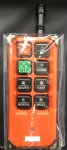
There are some (presumably better) proper marine wireless remotes, but with wired remotes I have found the industrial crane switches more reliable than marine units. A quick seach showed some wireless industrial crane remotes, so this is what I installed.

The unit was about $120 USD.

Initial impressions are very favourable. A short button press only retrieves a few links of chain. It will work anywhere on the boat even though I have installed the receiver below decks in a nice dry space. It takes normal AA batteries.

The big test will be if the durability and reliability are OK. The unit is obviously much more rugged and better built than the cheaper remotes, although the build quality would best be described as OK rather than a premium, quality product.

The smallest unit I could find has several channels. I suspect I will keep it simple and use this unit just for the anchor winch, but the same remote could also be used to control the bow thruster and even other functions such as deck lights.
 

Attachments

  • FB12AAF7-20D9-42EF-8DA8-5A1478986479.jpeg
    FB12AAF7-20D9-42EF-8DA8-5A1478986479.jpeg
    152.7 KB · Views: 0
The other modification that I hope will be useful is to attach an old mobile phone to the back of the remote. The chartplotter output can be displayed by the phone via wifi. This means while at the bow the person dropping the anchor has access to depth, charts, and even a fish finder display (to make sure they don’t drop the anchor on an isolated rock or old mooring block) and radar (to check the distance from shore or other boats).

Isn’t technology wonderful :).

My old phone has a rather poor resolution display and a small screen, which will limit the usefulness of the information, but I expect as I update my phone the older models will relegated to anchor winch duty.

The winch control comes with a clear plastic cover designed to make it rainproof and the phone neatly slips under this cover.

( will load a photo showing the phone display when possible with my poor internet)
 
Top