Bestevaer 49

Noelex - a couple of questions: is the non slip painted on? Also, what's the standing rigging - is it fibre?

Thx

Yes, the non skid is painted.

Touching up, or even completely repainting large sections is relatively easy and quick. The rough non skid texture tends to hide imperfections such as brush marks. The difficult part is sanding off the old paint so for this reason we left a gap between the paint and any corners or fittings. Thus the old paint can be quickly removed with an electric sander. When removing the old paint the sander can overlap on the raw aluminium outside the painted line without any problems. The sanded aluminium will be a little shinier for a short time, but this quickly fades. This makes preparation, which normally takes all the time, much simpler.

The most common alternative is stick on vinyl. When new this looks almost the same as paint. The vinyl is perhaps a little more durable at the edge. Paint does not stick well to aluminium. However, refinishing the vinyl usually needs a professional to make up a new panel and small touch ups from, for example, a dropped winch handle are not possible. There are also many other options for example teak or the artificial surfaces such as Esthec or Treadmaster.

The lifelines are Dyneema, but all the standing ringing is Dyform (or sometimes known as compact) stainless steel wire.
 
Last edited:
What's going on with the jib sheets? I assume the lashing to the guardrail stanchion is just for stowage, but I can't see what for. Also the sheet seems to be led between the cap shroud and the lower?

Pete
 
The normal rudder has been made immensely strong. The rudder shaft has been enlarged to a diameter of 130mm. I think an enormously strong spade rudder like this is a better choice than a skeg rudder. The yacht designer Bob Perry once quipped that on many skeg rudders the rudder is supporting the skeg, rather than the other way around :).

The late great Philippe Harlé said that if a skeg were damaged it could block the rudder. However even if a spade rudder stock were bent there would be a good chance it could still function.
 
I’m just delving into the wonderful world of oversized vital equipment for our refit. I was actually shocked to see the dissipation on most is undersized even for their size. I was thinking Hydraulic. There’s an argument against and I see you partake.

Henri Amel was asked if he had considered the use of hydraulics on board his boats. He said that if something went wrong with hydraulics you needed a specialist engineer who might be difficult to find in the back of beyond. However everyone knows how to repair or replace an electric motor.

I'm not sure if this is still Amel's position.
 
Did you investigate hydro? The first generation Watt&Sea's produced a lot of power quietly and with no measurable drag - but they were a real eyesore and ecumbrement on the transom. However, they have now introduced a new version "POD 600" which sits entirely out of sight under the hull.

https://www.wattandsea.com/en/products/cruising-hydrogenerators/pod-600

I would want to make a retractable installation so that it can be cleaned and serviced without haul-out, but that should not be impossible on an aluminium yacht. Though lack of a transom skirt on the Bestevaer might reduce options a little.

There is also a water generator which sits under the boat and which is reversible ie it can provide electric propulsion for eg harbour manoeuvres. It is also orientable but it costs a packet £20k - £30k IIRC.
 
The lifelines are Dyneema, but all the standing ringing is Dyform (or sometimes known as compact) stainless steel wire.

We have had dyneema lifelines for a number of years, replacing the original covered stainless lifelines. I noted that ISAF withdrew permission to use dyneema as there had been an issue, I think on Comanche, where spinnaker sheets cut through (melted) the lifelines. I'm not up to date on whether views have changed - but I was not so concerned as we do not use a spinnaker and our screecher sheets do not foul the lifelines.

Jonathan
 
Is that anchor ball really high enough?

Yes it too low. The anchor ball has only been rigged temporarily. There are still many systems to sort out. It need some clips so that it is easy to attach and something to stop it spinning, as they tend to self destruct in stronger wind.
 
We need to carry a rather voluminous buoy for our regulation crayfish pot (which we deploy in places no yacht can get near). The buoy is polystyrene, so not heavy (just big). We use the buoy as an 'I'm at anchor' buoy (which leaves us unmarked if we deploy the cray pot) but we only fish for cray in one location in Tasmania. We like equipment that has dual use. Its light and we hoist up the inner forestay using the storm jib halyard and tie down also to the foredeck (so that its relatively stationary and does not clatter on anything). We use the same system to hoist our anchor light - which sits under the buoy (so that it lights the foredeck).

Most of these 'little things' take a bit of tuning to achieve as near perfection as possible.

I noted, or did not note :), you did not appear to have snubber deployed - but maybe it was hidden, it was difficult clearly see the bow.

Jonathan
 
What's going on with the jib sheets? I assume the lashing to the guardrail stanchion is just for stowage, but I can't see what for. Also the sheet seems to be led between the cap shroud and the lower?

Pete
Yes, the jib sheet is clipped on the guardrail with a soft shackle. We have done this either on the guardrail or bulwark with a few lines when at anchor for several years. If the lines are kept off the deck and away from the mast it eliminates the noise of slapping and reduces chafe. In addition the lines don’t get as dirty, especially with grubby rain from the Sahara. It also makes it easier to clean the deck.

Before sailing it only takes a few seconds to release. The soft shackles are left in place to clip back the lines when next we are at anchor.

We are still experimenting with sheet leads. The boat is cutter rigged so the front sail is a Yankee rather than a genoa.
 
We use cheap, thin bungee to tie off halyards (away from the mast, or sheets to the stanchions/lifelines). We cow hitch the centre of the length of bungee (about 300mm) to, whatever, and then simply tie off with a reef knot. If we need a sheet - immediately - that we have not freed up, simply take tension and the bungee snaps. Tying off halyard from the mast engenders a quiet night and sheets off the deck keeps the deck clean, and clear (as you suggest).

We also use, heavier duty, bungee to keep furling lines taut and to lift lazy sheets so they do not catch under clutches and mast based winches.

Jonathan
 
Fridge:

Fridge problems are unfortunately common on long distance cruising boats and together with generator troubles are a frequent reason for sitting in port awaiting repairs. This is something we want to avoid as much as possible. Some sailors even supplement their cruising budget by carrying the equipment and having the expertise to repair fridge problems. They comment that in busy anchorages there is always at least one boat with fridge problems.

To be fair, fridge systems seem to have become more reliable in the last decade, but for a boat like ours that rarely ties up, fridge system repair is often not a DIY proposition and can be a real nuisance.

Our solution is to use self contained “car fridges”. There are many manufacturers of these products such as the common Engle and Waeco models. There are also small specialised companies such as Norcoast. They are designed for four wheel drive applications. This is one of few uses that is more severe than boating. Vibration and high internal car temperatures are expected. Warm beer is major crisis . On 4WD forums the topic of which fridge is the best causes more angst than anchor discussions on sailing forums . Consequently, the fridge companies live and die by their reputation for reliability. As 4WDs have at most a single 80 AHr house bank, low power consumption is also a key requirement.

The major advantage, compared to typical boat fridge systems, is that they are self contained and cheap enough to be disposable. So if they break down you throw them away and buy another model. If you do want to repair the unit, it can be taken ashore and left with a technician while you continue cruising.

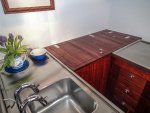
Many yachts use these fridges , typically sitting on bench, which works well but starting from scratch we could adopt a more “built in” approach, with sensible ducting to draw in cold bilge air and for the hot air to escape. So we specified an under bench area of the kitchen where the “car fridge” could be used but would be recessed and function like a normal boat fridge. We wanted an area that could comfortably hold a number of different models of fridge, so we not limited to one brand or model in the event replacement was needed. In practice, this is not difficult as extra room can be used for additional insulation, or food or drink storage to replenish the fridge. There are many brands of a roughly similar size.

I think eventually we will install a second car fridge in the technical area to provide redundancy and to function as a freezer. The car fridges can be used as a fridge or a freezer depending on the setting and some of the larger models can do both at the same time.

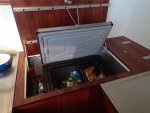
The area in the galley is designed to accomodate multiple sized units. We have a stainless steel National Luna model. It sits under the Bubinga bench top and is configured so that when the wooden bench top is lifted the fridge lid also lifts. At the moment this coupling of lids is a dyneema loop which was initially only temporary, but this simple solution is actually working well.

The compressor draws air directly from the bilge (I will probably install a small computer fan for tropical conditions) and there is plenty of room for extra insulation, although the unit is power efficient as it is.

The limitation of this approach is that the fridge area is reasonably small: 40 litres with one unit or 80 litres with two. This smaller size helps reduce power consumption and having cruised for many years on smaller boats without refrigeration, techniques for preserving food without refrigeration are not unusual for us. This helps provide plenty of volume for the all important cold drinks at sundown .

So our fridge solution is not for everyone, but is an option worth considering if simple and reliable are high on your priority list.
 

Attachments

  • E06465A4-DEEB-4360-81A2-AFBB0C3BD45E.jpg
    E06465A4-DEEB-4360-81A2-AFBB0C3BD45E.jpg
    479.5 KB · Views: 1
  • 82C878BB-EB00-4842-8DB6-53A9033FC58A.jpg
    82C878BB-EB00-4842-8DB6-53A9033FC58A.jpg
    493.3 KB · Views: 1
Last edited:
We duct air from a bow locker into the area where the compressor is housed and suck using a computer fan, we also exhaust the warm out of the compartment using another computer fan, both are wired into the fan included with the compressor - so are on when the compression fan is on. The fresh incoming air is focussed at the compressor. Extra power usage is negligible, 0.2 amp from memory. We have a separate 'under galley sole' deep freeze (with all round 150mm insulation) which uses similar ducting and vents into the engine bay. This uses an Engel compressor. The original fridge lasted 17 years We regassed once (the old Danfoss unit), professionally, - not something you can do yourself - and the deep freeze is still going strong, after nearly 20 years. Both units are about the same size 80l.. The new fridge is a Waeco unit - identical in size to the old unit.

We don't see that cruising should need to necessitate sacrificing good food and we have not found, with decent solar and wind/towed water gen, that their power usage is a major issue. We once caught 13 crayfish, all in the one cray pot session and regularly catch tuna and eel - we would not want to sacrifice good food because our fridge/freezer was too small and 40l would not allow storing of our catch of the day!

Personally I cannot sand ice in drinks and prefer to chill the drink itself - we simply decant a day sized portion and cool that, rather than make ice or chill a whole 1l bottle of spirits (and we don't drink on passage - ever). We do make room for white wine in the fridge.

Jonathan
 
I presume the main disadvantage of using a self contained fridge is that it won't have as much insulation as one that is built in to the boat. The other advantages are quite compelling, though.
Of course as I am in Scotland I have little need for a fridge...
 
Our 'off the shelf' fridge has one side, the rear and base and part of the other side housed against foam bulkheadss, which increases insulation from that of the original carcass. The unit is also well boxed in. The major issue is that the when you open the front opening door all the cold air 'falls out'. This is offset if its a sensible size as if it was top opening you would need to rummage about to find anything. With a small unit, of course, this is not a problem. The skill with fridges is planning, keep the unit full, just add more wine, and there is less space for cold air so losses are smaller.

Jonathan
 
Fuel:

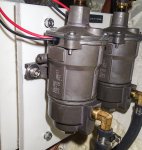
Here you can see the Walbro fuel polishing and transfer pumps. The transfer pump’s main job is to deliver fuel to the day tank, but it can also be used to move fuel between the two main diesel tanks.

The fuel polishing and fuel transfer pumps are the same: Walbro FRB -23 pumps.

This helps redundancy. Only one spare is needed. If no spare is available, if the transfer pump fails it can be quickly swapped for the less important polishing pump.

The principle of keeping components the same where possible has been followed throughout the boat. So, for example, the manual bilge pumps are identical to the Lavac toilet pump.

The polishing system has a pick up at the very bottom of the tank and then runs to its own seperate Racor 900 filter, before returning to the tank. There is a seperate Racor 900 filter that feeds the day tank and from here it is gravity fed to has another Racor 900 filter and the engine. Did someone mention clean fuel is important :)? If there is a problem with the day tank, the engine can be fed from one of the two main fuel tanks.

Unfortunately, fuel pumps can be reasonably noisy. A good solution to reduce the noise is to mount them on a seperate board isolated from the structure with a soft mounting system. Before doing this, with all pumps consider if the noise is perhaps helpful to identify when the pump is running.

However, for pumps such as the polishing system that is often run for many hours, reducing noise is important. I left out details of isolation from the specifications, as it is something that easy to add and I planned on installing this for the watermaker pumps, which I am fitting myself.

I was pleasantly surprised to see KM have already installed an isolation system. Small details like this show the builder cares about the end product.
 

Attachments

  • C4CBB2DC-FF29-4F33-9A0F-5A769DA78363.jpg
    C4CBB2DC-FF29-4F33-9A0F-5A769DA78363.jpg
    460.8 KB · Views: 1
We would have to agree that pumps are extremely noisy, like a machine gun not too far away. Ours might be more noisy because of the foam core construction. Our worst one is the water pump which, as you suggest, we have mounted on a soft mount. We did the same with the 2 pumps for the desalinator unit when we installed it though they were not so noisy (though run for quite long periods but the unit is mounted under the cabin sole and noise is dampened. Its a really simple fix.

One other way to reduce the noise from the dasalination unit is to only make water when at sea - which has the advantage of ensuring you are only using the freshest water and the noise is less intrusive being masked by the noises of the yacht on passage.
 
I prefer the main water pump to be noisy enough to reliably hear. That way if a tap is accidentally left on, or a leak develops, we will be alerted before losing a significant amount of water. We have a couple of outside taps for deck washing so the potential for a dripping tap to go unoticed is increased. On a long offshore passage the water supply is an important commodity that needs to be protected.

We have foot pumps that we prefer anyway. They allow better control of water flow with both hands free. There are three foot pumps for the main galley sinks. One feeds from the main water tanks, one supplies salt water and the third is fed from a small stainless steel day water tank that provides the best drinking water.

If you don’t have manual foot pumps it is probably better to isolate the main water pump to make it as quiet as possible. When sleeping the noise of the main water pump running is annoying and can be enough to wake other crew members.

It is also helpful if the bilge pumps are noisy enough to hear, at least if you have a normally dry boat. Unfortunately, the pumps are often reasonably quiet when buried under the floorboards. We have five seperate watertight areas that require seperate pumps rather than one centrally mounted unit so the problem is compounded. An alarm panel with a buzzer to warn if a bilge pump is running with lights to indicate which pump is operating has been fitted.

So we have systems to make some pumps quiet and systems to make other pumps noisy.
 
Last edited:
It would be interesting to know how Noelex has achieved comparative silence, where necessary.

We took a 20mm thick slab of rubber offcut from a wholesaler in Sydney and drilled out 'plugs' with a 20mm hole saw. We mounted the pumps on marine ply panels with long M6 bolts with the rubber plugs as spacers and then mounted the boards to the fibreglass/foam bulkheads with more spacers. I don't know if stainless bolts are the best solution and maybe nylon bolts would have been better (less noise?)

Our bilges are clean and dry but when/if the bilge pumps run we have piezo electric alarms and warning lights on each. We only have 2 bilge pumps as they operate in that part of each hull with seawater inlets - the rest of the hulls have no hull fittings and the individual sealed areas would only take water if we had a significant accident (and we would not need the noise of a pump to warn us we had a serious issue). (The manual bilge pump, of last resort, reaches to all of the extremes of both hulls).

Our freshwater pump serves the galley (where we also have a saltwater tap - also using a common pump) toilet (or head if you prefer) vanity sinks (2 off) and the shower (incorporating gas fired hot water boiler). The saltwater pump serves the bow wash (anchor and chain) an outlet in the port aft engine room (accessible to one transom) and the galley sink. We have operate salt water pumps for the desalinator (all three salt water pumps housed together). We do have a manual salt water pump at the galley (as well as the more convenient electric pump).

We do not have a manual freshwater pump, which would be a mistake if the pump freshwater pump failed (but we carry a spare) but though the pump (Jabsco) has collected debris in the valves they have been reliable over 20 years of heavy use.
 
We took a 20mm thick slab of rubber offcut from a wholesaler in Sydney and drilled out 'plugs' with a 20mm hole saw. We mounted the pumps on marine ply panels with long M6 bolts with the rubber plugs as spacers and then mounted the boards to the fibreglass/foam bulkheads with more spacers. I don't know if stainless bolts are the best solution and maybe nylon bolts would have been better (less noise?)

I imagine the rubber pads threaded over the bolts help a bit, but what jumps out at me is the rigid transmission path of the stainless straight through them. You need part of the connection to be rubber only, not metal, to break the vibration path.

Engine mounts like this might look like the threaded rod passes right through, but it doesn't:

10x10xM4-stud-rubber-motor-mounts-generator-isolator.jpg_350x350.jpg


You've made something which looks like the above mount but has a continuous rod.

The separation is clearer with eg these Yanmar mounts:

s-l300.jpg


Pete
 
Top