Bestevaer 49

We have had our Lightwave catamaran for 20 years now, done 40,000nm. We have had green water over the cabin roof (its 3m off the waterline) - not something we have planned for. Boringly we have only cruised upto the Whitsundays or through Bass Strait and down through the edge of the Southern Ocean to SW Tasmania - so hardly adventurous and maybe not taxing (of equipment).

We have 6 'off the shelf' Moonlight hatches installed as standard. Not one leak, no drama. We installed 2 standard Gebo port lights after about 5 years (as we wanted more ventilation in the bridge deck berths), so amateur installation, not one leak - no drama.

Jonathan
 
Shower:

We wanted a dedicated shower. It is constructed simply as a waterproof aluminium tub with a high lip on the door. The aluminium walls are welded, so they function as very deep ribs just in front of the chainplates. Bulkheads on aluminium boats are non structural, but by making these bulkheads aluminium it means they add some bonus rigidity.

There is full standing headroom in the shower, but it is helpful to have a seat in a boat shower. Our seat is anodised aluminium and is hinged with three laundry sized sinks below. Above the seat a very stout, removable anodised rail can be positioned at a couple of heights. The rail can be used to wedge yourself into the shower, like the safety bar that is used on some amusement rides. This leaves both hands free if you want to use the facility in rough offshore conditions, especially on the "wrong" tack. The rail is also for ease of wringing washing, allowing it to dry more quickly. As well it functions as a long, sturdy hanging spot where wet weather gear can be left to dry with the water dripping into the tubs.

We have a washing machine installed in the toilet area, but these devices receive mixed reviews from cruisers (we have never owned a boat with one so it will be a new experience for us). Having good facilities for washing clothes by hand is a nice back up. Large sinks are always useful on a boat and in a shower are a better use of space under the seat than storage, which is very hard to keep dry and mould free in this area. Of course, items such as shampoo etc can stored in one of the laundry sinks.

The shower is fed from the main water supply, but there is also a seperate pump and shower rose that functions differently. The supply to this feeds from one of the sinks rather than the main water tanks. The technique is to pour hot water into one of the sinks then add some cold until the shower water is exactly the desired temperature and use the inbuilt pump to shower with this water. It is a showering method that we have used for many years and it works very well on a boat. No water is wasted while you adjust the temperature. The water can be heated from any source or mixture of sources such as solar (just leave a black container on deck) , the Reflex diesel heater or the propane stove. The temperature can be mixed so it is exactly correct and you can shower anytime even if the engine has not been run for several days. I am fussy about shower water temperature. Lukewarm showers in cold climates. Yuk. It is also possible to shower with different water from that stored in the main tank, which can be useful if there is ready supply of water of questionable quality. We will have a water maker, but a back up plan is always a good idea.

Most boats fit a mini version of a household bathroom, I suspect because this is what the boat buying public are familar with. This looks attractive, but is not enormously practical. The area can be difficult to use in rough conditions without spilling water in places where it is difficult to clean, especially when the space is out of necessity small. Even getting undressed out of wet weather pants while heeling over without a few bruises can be a challenge. On many boats spilled water from the area can also find its way into the general bilge and unfortunately grey water tends to be a bit smelly after some time.

Our shower is a little different. The concept was to construct an area that was simple, functional, waterproof and easy to clean. It was inspired by the type of shower that may be seen on a workboat, such as a modern fishing trawler. Surprisingly, with the plain white walls anodised aluminium and the beautiful timber on the door, KM have managed to make the area attractive.

This space is difficult to photograph, but here you can see the anodised shower seat and removable rail in one of its positions. There are large laundry sinks below this.

x2chY1e.jpg
 
It looks as if you have been able to copy a shower cubicle from a standard catamaran (or re-invented same). Ours, 20 years old now, is a separate, dedicated, fibreglass pod (easy clean) and as with yours, seating on 2 sides (though catamarans do have the advantage of not heeling (or not much). We have full standing head room and a small opening hatch in the roof/ceiling (which, as it is perfectly located, we have used for one of those black plastic bags you leave in the sun to 'make' hot water).. It has a 200mm lip at the door and would need more water than we would care to waste before it overflows to the rest of that hull. Most catamarans today have similar units - cheap, as they can be made en masse. Like a decent Australian domestic shower there is sufficient room for 2 in comfort, if you enjoy company and/or have the need to share water (save water, have a shower with a friend) The sump is stand alone and is not connected to the bilges. The sump was emptied with a dedicated pump with float switch. We, or I, found cleaning the float switch something of a burden and as the sump is large enough we dispensed with the float switch and simply switch the sump pump on at the completion of each shower. Heating is from a gas boiler (that supplies all our hot water) but it means if it is a bit chilly we, as you suggest, do not need to run an engine. We went for a simple acrylic door, easy to clean and no varnish to suffer. Usage needs a bit of practice as fresh water is scarce and cold water unpleasant (as you reach the age of maturity) and we collect the initial litre or or so of cold water retained in the plumbing, and use it to wash the dishes (fresh rinse at completion). We have added a grab bar at about chin height over one of our bench seats - which makes a good location to hang one towel, we have separate towel racks outside in the other half of the toilet/shower area. The shower incorporates a neat shelf with lip along one wall, all part of the moulding, for soap, shampoo etc. The shower has a false floor - which allows easy access to clean the sump.

If you want ideas on modern yacht showers - just go to any boat show and have a look at a few multihulls - commonly the showers are bigger than any I recall from a UK home! (though maybe showers have grown since I lived there).

We installed our automatic washing machine in one of the engine rooms, as we have plenty of spare space. The big skill is finding one that minimises use of water for washing but has sufficient for rinsing. The best machines are those that allow manual over rides so that you can introduce extra wash or rinse cycles easily, Its 240v and cold water fill. If you are away from civilisation for any length of time cleaning sheets or towels are not so easy by hand but there are a number of suitable machines now - ours was one marketed to the RV/Caravan market. I note Aldi have one this week in Oz! (though how good it might be - no idea!) The machine is plumbed into the domestic water circuit and the used water pumped overboard (at sea) or to a grey tank and we have the facility to, sometime, collect the water and use it to wash the decks.. We have a full sized domestic kitchen sink, with small sink alongside - which gives more than adequate space for most domestic laundry washing, should the automatic machine become 'un-automatic'.

On the subject of bilges - ours are flow coated white, remain white and the only water they collect is when I'm servicing an engine. Our bilges are interconnected, but can be sealed, and flow to a common sump in each hull.

Vety little of this is as result of anything we did or suggested - it was a standard fitting in our Lightwave and is similarly standard in Lagoons, Seawinds etc. I think ours might be the only one with a grab/towel rail - and gas hot water boiler.

I don't have picture of ours, but there is an image here of a more recent version, slightly different layout.

https://www.lightwaveyachts.com/sail-38/

and if you scroll through here for a Lagoon 38

http://tmglagoon.com/lagoon-380/

Jonathan
 
The interior is just about finished and is looking gorgeous.

The table has been fitted and is solid Bubinga, as is the rest of the interior woodwork.

The table is bolted down (but can be removed for access to the hull structure underneath). There is an additional seat under the table that can be pulled out. The seat (with its cushion removed) also serves as a fiddle table for the pilothouse. The grain in the table is superb, but does not really show up well in a still photo.

The seat is held in position with a couple of stainless steel pins, but also has a couple of bolts for rough offshore passages.

One of our requirements was that nothing in the boat could come loose in the event of a severe knockdown or even rollover. This sounds like a simple requirement, but there are lot of components to secure: floorboards, locker lids, table, seat, oven, Reflex, washing machine etc etc. To survive hanging inverted, all this gear needs to be bolted down rather than just held with a couple of machine screws. Let's hope we never test this :).

A maritime photographer is coming today so KM suggested we added a few of our own possessions to add a personal touch.


rGcEOrR.jpg
 
Having sailed a lifting keel boat I wouldn't buy one the keels are too small, with 20knots upwind it was heeling with the toe rail near the water. A normal keel will be nowhere near that.

Yes indeed because obviously all lifting keel boats behave identically to the one you sailed and hull form, form stability, ratio of ballast between internal, external stub keel, and lifting keel, and other factors like sail plan, make no difference whatsoever...
 
Yes indeed because obviously all lifting keel boats behave identically to the one you sailed and hull form, form stability, ratio of ballast between internal, external stub keel, and lifting keel, and other factors like sail plan, make no difference whatsoever...

And clearly Skip Novak and all the other experienced Arctic and Antarctic sailors who choose lifting keels are idiots.

But what any of this has to do with NoElex's boat is a mystery anyway :)

Pete
 
Autopilot:

A reliable means of self steering is vital for a short handed long distance cruising boat. Wind vanes have some advantages, but my preference is to fit the biggest and best underdeck autopilot, and preferably a back up unit as well.

Our old boat had Raymarine linear drives. These have a great reputation, but unfortunately they are too small for the new boat. The drive units chosen for this boat are the Jefa DD3 units. These are very solidly built autopilot drives. They are designed with a clever gear system so they achieve high power without the complication of hydraulic units. I think just the motors of the DD3 units probably weigh more than the whole Raymarine linear drives.

The DD3 units are rated up to a 70 foot boat so are one to two sizes over that required. The sentiment about anchors; “If your anchor is large enough that people at the marina are laughing, then it is about the correct size”, also applies to autopilots :).

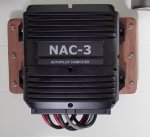
The computer unit is the NAC 3. Any piece of electronics that can process a continuous 30A current @24v (the intermittent rating is 50A) needs some serious heat dissipation for a reasonable life, although at 24v the Jefa drive only demands a maximum of 8.5A at full torque, so the NAC 3 should have an easy time. The NAC 3 has an aluminium heatsink at the back, the front is largely plastic. The heatsink is only given a few mm air gap with the standard mounting feet. I have installed the NAC 3 on some wooden trim. This allows the wires to enter from behind (it may as well look neat, even in a technical/workshop area), but it also provides a larger air gap, helping the heat sink’s efficiency.

Unfortunately, manufacturers of consumer boating equipment imagine it will he used for few weekends each year under fairly benign conditions. Often the construction details are designed to provide a reasonable life for this sort of intended usage. If long distance, full time cruising is the goal, anything that can be done to help extend the capabilities, such as oversizing, installing in a dry location and providing good ventilation is beneficial, especially with vital equipment such as the autopilot.
 

Attachments

  • BFCA08E4-6049-4361-82DE-BEC65723DB5F.jpg
    BFCA08E4-6049-4361-82DE-BEC65723DB5F.jpg
    472 KB · Views: 0
Autopilot:

A reliable means of self steering is vital for a short handed long distance cruising boat. Wind vanes have some advantages, but my preference is to fit the biggest and best underdeck autopilot, and preferably a back up unit as well.

Our old boat had Raymarine linear drives. These have a great reputation, but unfortunately they are too small for the new boat. The drive units chosen for this boat are the Jefa DD3 units. These are very solidly built autopilot drives. They are designed with a clever gear system so they achieve high power without the complication of hydraulic units. I think just the motors of the DD3 units probably weigh more than the whole Raymarine linear drives.

The DD3 units are rated up to a 70 foot boat so are one to two sizes over that required. The sentiment about anchors; “If your anchor is large enough that people at the marina are laughing, then it is about the correct size”, also applies to autopilots :).

The computer unit is the NAC 3. Any piece of electronics that can process a continuous 30A current @24v (the intermittent rating is 50A) needs some serious heat dissipation for a reasonable life, although at 24v the Jefa drive only demands a maximum of 8.5A at full torque, so the NAC 3 should have an easy time. The NAC 3 has an aluminium heatsink at the back, the front is largely plastic. The heatsink is only given a few mm air gap with the standard mounting feet. I have installed the NAC 3 on some wooden trim. This allows the wires to enter from behind (it may as well look neat, even in a technical/workshop area), but it also provides a larger air gap, helping the heat sink’s efficiency.

Unfortunately, manufacturers of consumer boating equipment imagine it will he used for few weekends each year under fairly benign conditions. Often the construction details are designed to provide a reasonable life for this sort of intended usage. If long distance, full time cruising is the goal, anything that can be done to help extend the capabilities, such as oversizing, installing in a dry location and providing good ventilation is beneficial, especially with vital equipment such as the autopilot.

I’m just delving into the wonderful world of oversized vital equipment for our refit. I was actually shocked to see the dissipation on most is undersized even for their size. I was thinking Hydraulic. There’s an argument against and I see you partake.
Were looking into gear for a 50-footer when it comes to size (33 “heavy displacement) and I’m tempted to go up to 60 as oversize. Which only goes to show the manufacturers are making equipment for floating caravans and day sailors instead of open water vessels.
Were also going probably with Maretron because they use standard NMEA 2000 instead of a proprietor one that creates added levels of complications and compatibility which is always fun to sort out in remote exotic locations when you get sent a text message with a link telling you to download this and that driver over carrier pigeon net speeds or satellite phone air time.

Looks like you’re building a great boat. +1
 
The normal rudder has been made immensely strong. The rudder shaft has been enlarged to a diameter of 130mm. I think an enormously strong spade rudder like this is a better choice than a skeg rudder. The yacht designer Bob Perry once quipped that on many skeg rudders the rudder is supporting the skeg, rather than the other way around :).
As well as hydrodynamic advantages, a spade rudder is less likely to jam if bent than a skeg rudder, and can often be repaired or even dropped out of the boat while still in the water. It is a pity that some boat builders construct marginal spade rudders that are not ideal for cruising. As the strength and resistance to bending rises enormously as the rudder shaft diameter is increased, even a marginal increase has a significant impact.
It is imprtant with a super strong rudder such as this, that the hull support is even stronger, so the rudder will be damaged before the hull.
In addition, the rudder mechanism is separated from the rest of the boat with a wateright bulkhead, so any damage cannot sink the boat.
However, nothing is foolproof and we have a philosophy of “belt and braces” for vital systems. No system, other than hull integrity, is more important than maintaining a viable steering system. So we asked KM to supply an emergancy rudder.
This is steered with a rope system that leads to the aft cockpit winches.
A similar system was used on the original Bestevear II and apparently works well. Boats that are designed to cruise remote polar waters such as the Bestevar range, have already considered these sort of extreme emergency measures. It has application not only for hitting ice, but also for encounters with shipping containers, whales, or debris such as logs. The multiple watertight bulkheads and reinforced aluminium construction give some chance of surviving these encounters and a strong rudder, combined with an emergency steering mechanism, provide some hope of recovery from a severe situation.
The fold down swim platform has been lowered in the photo, but this would normally be raised when sailing.
The emergency rudder:
TwguWBt.jpg]
 
Wow .... somehow, I've managed to only just stumble across this thread.

What a fantasic project: what a sublimely fantastic boat.

No, no ....... I'm not at all jealous!
 
Anyone blue water sailing will have spare rudder, and tiller - and be able to instal both as they will have modelled their safety gear on Cat 1 requirements. Your emergency steering mechanism is quite conventional and would be perfect for a racing yacht - as you have crew when racing to manage the steering on a continuous basis. Unless you intend taking crew then using your system is going to be a nightmare in the Southern Ocean (or any ocean) if you are short handed. When you try your system out in the sea - you will soon find out - as your system demands being outside of the shelter of the cabin on a continuous basis and it does not lend itself to steering in big seas - great for flat water and sunshine but not much use in an ocean - it is simply too cumbersome and insensitive. Just imagine being turned beam on in any sea.

We carry a spare tiller pilot - just in case, but have not had need to use it yet.

I would not have thought it would add anything significant to cost to add this arrangement so that it can be 'somehow' incorporated into the existing, hydraulic?, steering system.

If its worth doing, and it is worth doing if you are going to sail 'blue water', - its worth doing properly.

Twin rudders are ideal (except they lack protection from the keel but can be otherwise protected) - as commonly you would be able to disconnect the damaged rudder (assuming you did not destroy both) and continue using the complete steering system (I know because we took out one of our rudders and had to sail about 1000nm to replace it - because of our experience I would always consider twin rudders for a bluewater yacht with an ability to incorporate any emergency system into the autopilot.).

Jonathan
 
Last edited:
Swan neck:

We wanted a boat as waterproof as possible. Luxury afloat is often thought of in terms of how many gadgets are installed, but a dry boat is the first requirement. Surprisingly few boats are dry when offshore sailing. Saltwater down below, especially in bedding or upholstery is the pits. Even with extensive freshwater rinses, the salt seems to remain and attracts moisture and mould in the future.

So we specified no deck penetrations at all in the living areas. For example, the jib track which normally has multiple stainless bolts that rely on sealant, is simply welded in place on our boat.

However, wires need to penetrate the deck to enter the mast for the radar and anchor lights etc. It is also nice to have an exit where additional wires can be easily added. Here we adopted an old, but effective “swan neck”. Traditionally, the swan neck is only attached at one end, but a pipe that is welded at both ends (but with a large hole for the wire exit) is as waterproof, but stronger. This allows the swan neck to be used for other purposes such as halyard tie down or to support the whisker pole.

KODdRR8.jpg
 
Our wiring from the mast enters the deck via a swan neck in a central locker. Any rain or seawater drains straight to sea. Obviously very niche - as central lockers just forward of the mast are only common in multihulls where keeping wiring restricted to entry though central lockers is commonplace - Obviously an ability to weld track to the deck is restricted to metal yachts which few of us own and in ignorance I'd have thought easier to weld the track than use individual bolts anyway. The central locker for multihulls also offers the opportunity to locate the chain storage and windlass - at the mast.

The greatest opportunity for leaks is through deck hatches - and you cannot cater for forgetfulness of the guests - unless they sleep in the dinghy.

Our deck and accomodation mouldings incorporated aluminium reinforcing, over marine ply and the bolts that hold our sail tracks and winches tap into the aluminium - none are through bolted into the interior. Again its commonplace and standard procedure for good designers to do this though sadly possibly not something that would be economic for many AWBs.

It is very difficult to have a deck without some holes in it.

A windlass needs controls, which are commonly wired to foot switches - in the deck. Some have controls on cables, you could use a remote control. An electric windlass has the same issue - commonly the electric motor is under the deck with the controls alongside. All you can do is minimise the issues.

After almost 20 years on the water - we have no deck leaks (or leaks at all). I don't think our builder was exceptional, or I hope not - leaks are not obligatory.


Referring to post #232 - you rightly have had the rudder built to be robust. I hope its more robust than the emergency rudder. I think it will be a nightmare to use, if you are a long way from 'support' and in big seas. On reflection it does not look as robust as I would like if its to replace an overly robust component (as the conditions causing the original to become defective may still exist). A decent stock hung of more robust attachments on the transom would allow a tiller to be attached, giving sensitive steering and an ability to attach a tiller pilot (and those rope controls if you so desire). But as it is most unlikely you will take my word for it - make a 24 hour passage in the North Sea using the emergency steering, without crew, and enter a slightly complicated anchorage and then decide - keep you fingers crossed the rudder does not hit a bit of wood, sunfish etc.

Jonathan
 
Last edited:
Swan neck:


KODdRR8.jpg


Very :cool:

And idea stolen, thank you:)

And very much agree, getting a long distance cruising boat really waterproof long term is no mean feat, I'm dong the same now on a steel boat - every fastener possible getting taken off and the every hole welded up. Probably get rid of the jib tracks as well & go for low friction rings. Simpler the better.

That goose neck idea looks great for mast and stern, but what about solar off the guard rails? Still to figure out how to get those cables inside.

Your boat looks just fantastic!!
 
She looks pretty delightful in the setting sun - sets the aluminium off beautifully. Nice beefy preventer.

Is that anchor ball really high enough?

Weather looks just right for a decent sail.

Jonathan
 
Top