Bestevaer 49

Whether or not CopperCoat is compatible, resale needs to be considered also. There’s an aluminium boat in North Wales, that been for sale for donkeys, that had been Coppercoated. I spoke to the broker about it last year and he said the owner was planning to remove the CopperCoat over the winter. One can only assume that they felt it was an impediment to a sale.

Maybe if there was an awareness that CopperCoat does work then he would not need to remove it.

Whereas the theory suggests it does not work there is enough evidence to suggest it is actually successful, and the fears are wrong. There is nothing wrong with the theory - but theory and practice are obviously different suggesting the wrong theory is being applied - and misused.

Sadly there are lots of similar examples where opportunity is missed because the wrong theory is applied. The 'theory' is reiterated and made more true by the repetition (and the internet is a fertile ground). No-one takes the trouble to investigate but blindly repeats.

7075 alloy is frowned upon because it is not as corrosion resistant as 5083. But neither are actually used on a yacht in a 'salt spray booth' environment. If used carefully 7075 is quite acceptable (and 5083 corrodes in a salt spray booth as well, anyway).

Other examples catenary (people still swear by it, but there are options), climbing rope as snubbers (most say they do not work, people who use them swear by them), Swivels will release the twists in a chain due to change of tide - absolute rubbish. I am sure many can add to the list.

Jonathan
 
Well I'm +1 to believe your opinion (which matches my own internet research though I am not a metallurgist).
 
Last edited:
A bit of drift

I cannot understand why Saildrives are aluminium in the first place, or why they are aluminium now. It causes all sorts of issues - and its the only bit of alloy in the water on most yachts. Investment casting, in China, is cheap as chips so why not steel that is then galvanised. Why not bronze, why not an exotic fibre in resin? Its not as if Saildrives are particularly cheap.

We have tried Propspeed and Prop Gold, Trilux 33 and Velox. They all work, to a greater or lessor extent, for about 6 months and then we are constantly cleaning (guess what we are doing next week - the tides are right). Our AF now lasts 2 years. We cannot sensibly replace the coating on the sail drives between tides so we either constantly clean or pay to slip - simply to service the Saildrive. So to apply a few dollars worth of paint we need to pay a large number of dollars to slip - daft! Admittedly we can change the anodes - but that is easy to do between tides.

We will be trying CopperCoat next but we will eke out the Velox till we need to replace the AF which will be back end of 2018. Don't expect results quickly! In the meantime I'm hoping Vyv's electro copper plating of the prop is reported as we would try that, as well, or apply CopperCoat to the prop instead (of plating).

Jonathan
 
I cannot understand why Saildrives are aluminium in the first place [...] Why not bronze, why not an exotic fibre in resin? Its not as if Saildrives are particularly cheap.

Now there's a thought - carbon-epoxy saildrives :)

Could the bottom-end gears be made of bronze, do you think, and permitted to run in a water/oil mix so that the shaft seals are no longer critical?

Pete
 
Companionway washboards:

These are just about finished and are a rather unusual design.

The first difference from most yachts is that there no horizontal sliding hatch. The pilothouse floor is only a little below cockpit floor level so exiting involves stepping rather than climbing out, making a horizontal hatch less necessary. Importantly, this means there is no possibility of leaks and the roof is stronger without a large hole.

We mocked this up before going ahead with the design and in practice it works wonderfully well. Entry and exit is easy even for someone tall like me.

The washboards slide down and disappear into a recess so there no need to lift them out or find storage. The actual washboards are underneath the pilothouse overhang so there is no possibility of leaks. Because of the overhang they can even be left open in moderate rain. Each layer can be locked from both inside and out with a much more substantial locking devices than are normal for a yacht. The resulting system is much more functional than traditional washboards, which are a rather primitive design.

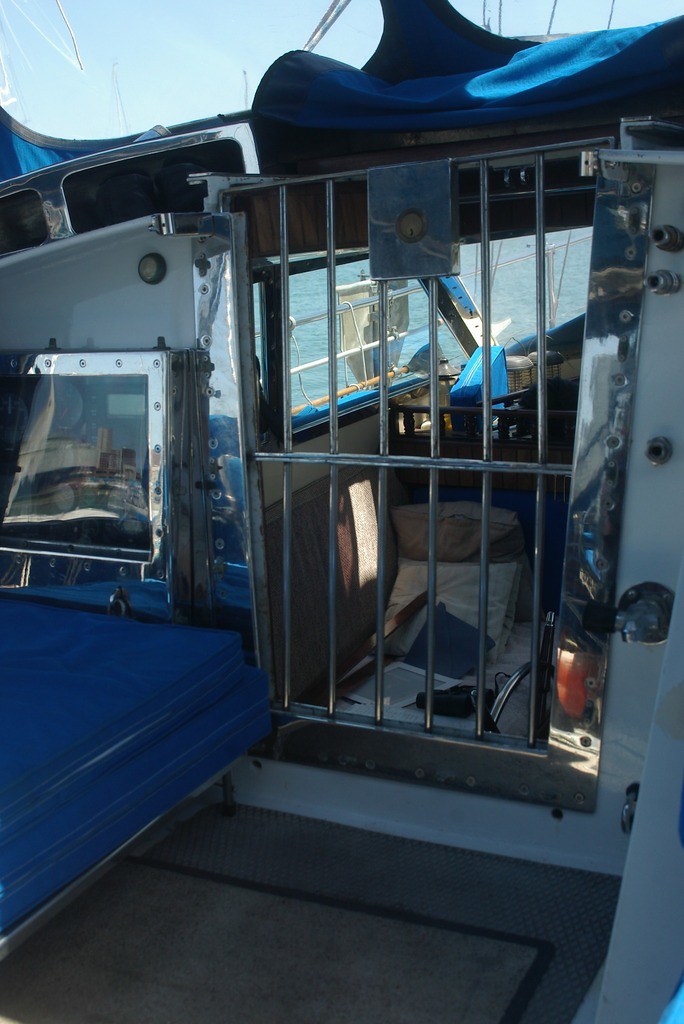
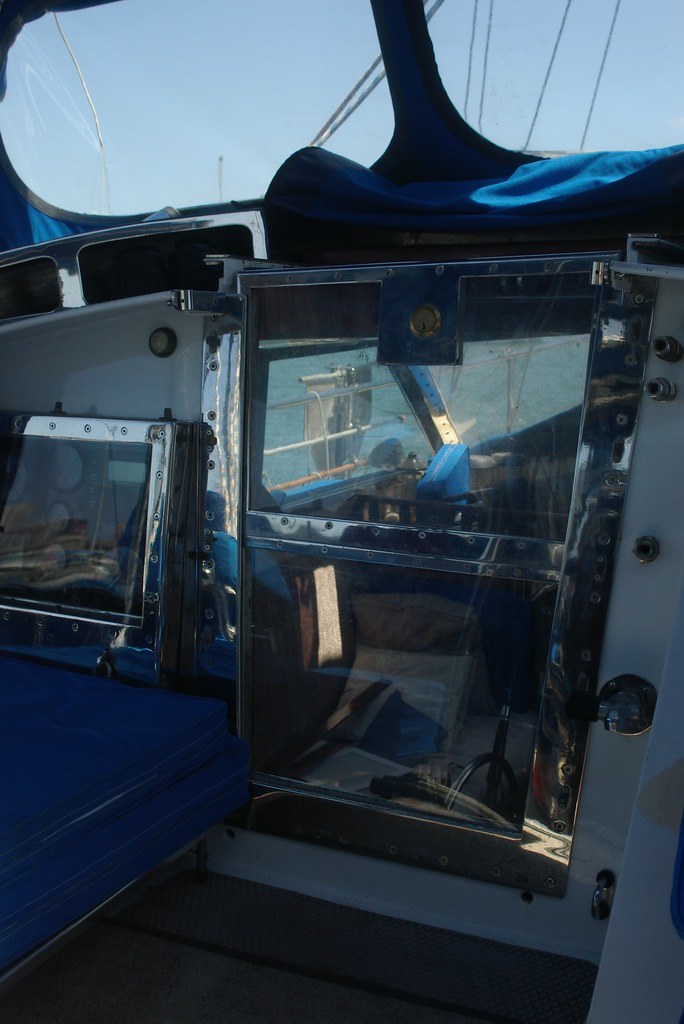
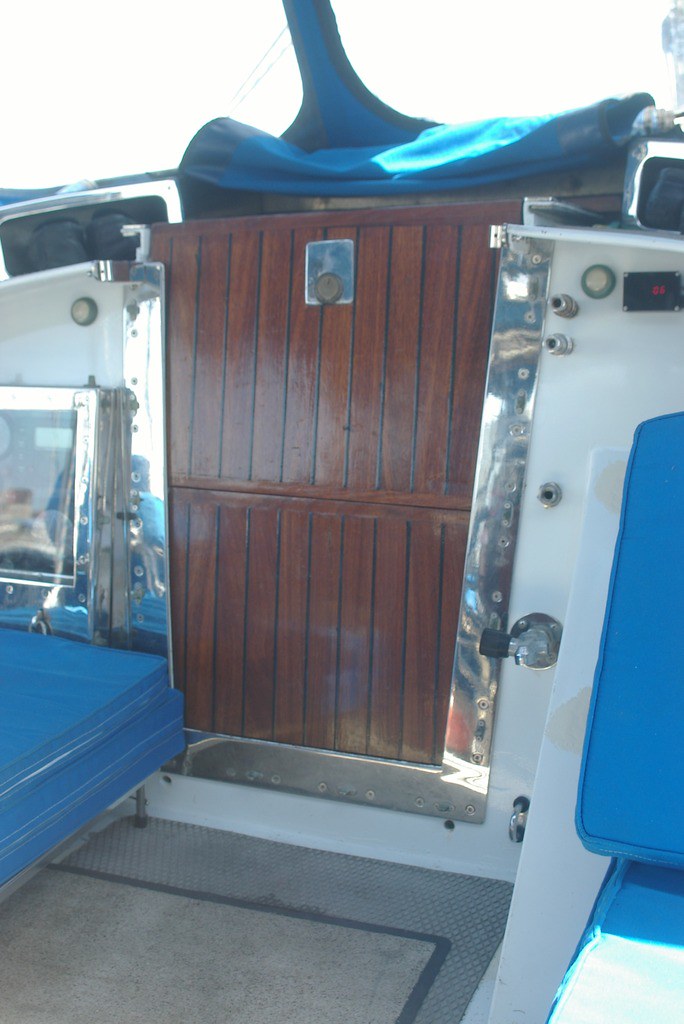
There are three separate components: plexiglass main hatch (the only plastic window on the boat), stainless steel bars, and separate flyscreen.


Stainless bars. These provide security with ventilation when leaving the boat for a short time such as visiting a restaurant ashore. In high risk areas the layers can be locked (still with plenty of ventilation if needed) from inside to prevent thevies entering when sleeping:

AqYlRu3.jpg


Stainless bars plus plexiglass. If leaving the boat for long time the combination will be difficult to enter and hopefully any potential thieves will pick an easier target. The plexiglass is conterweighted so requires little force to lift:

b1Ylhxg.jpg


Fly screen. This can be used on its own, or added to the security bars. Yacht designers who do not incorporate a fly screen need to experience their product on a hot night with mosquitoes until they correct their oversight :):

rwW8x1h.jpg


In addition, the interior waterproof door separating the main bedroom from the living area can be locked with a very secure system from the inside if necessary that would be difficult to penetrate. Each of the overhead hatches also has removable security bars.

Most boats have very poor security and can be entered with a screwdriver almost as quickly as using the key. Locking the boat unfortunately can eliminate most ventilation. Given the minimal security offered by the locks some boat owners leave their companionway and hatches open and unlocked when going ashore in hot climates, but many insurance companies require evidence of "forced entry". So an unlocked boat can invalidate insurance.

It is a puzzle why most boats cannot be locked at all from inside and when unattended are so much easier to break into than a typical house or car. A determined thief given enough time can break into almost anything but hopefully the steps we have taken will encourage thieves to move on to an easier target.
 
The reason many yachts have a step to enter the cabin from the cockpit is to ensure that if they take a big sea - it stays in the cockpit, and then drains, and does not overflow into the cabin. This becomes less of an issue on bigger yachts - except that bigger yachts are commonly taken to places with bigger seas, oceans for example (where smaller yachts are less common). This is why cockpit drains have become larger and larger, are now huge and open transoms popular.

When we did, Cat 1 ocean races in questionable weather on our X99 (not allowed to do such races now) we never took the lower wash board out (and quite often had both in). But the X99 was a very wet yacht. We quite often had seas breaking over, knocking crew to the leeward side and half filling the cockpit

A determined thief will now be equipped with a battery driven angle grinder. We have aluminium patio type doors with reinforced glass, a good lock, stainless steel bars across the door retained by 'U' bolts and a large padlock at each end. They cut the 'U' bolts with bolt croppers and jemmied the door. The loss of items was insignificant, kettle, knife block etc, just domestic stuff - the remedial work cost thousands.

There is a very limited market for marine equipment but a ready market, down at the pub - or its South American equivalent, for domestic items.

There is an argument that being locked up like Fort Knox suggests there is something inside worth stealing and that the yacht next door, so easy to break into, is not worth the effort. This makes the investment in the battery angle grinder (maybe removed from a previous successful theft) worth while. In our mooring field I know the owners of the yachts nearby but further way?? - if I hear an angle grinder (or hack saw) during daylight hours I assume its an owner. If I see a different tender I assume its a contractor, especially if he is brazenly using an angle grinder!

Jonathan
 
Stainless bars. These provide security with ventilation when leaving the boat for a short time such as visiting a restaurant ashore. In high risk areas the layers can be locked (still with plenty of ventilation if needed) from inside to prevent thevies entering when sleeping:

.
It is a puzzle why most boats cannot be locked at all from inside and when unattended are so much easier to break into than a typical house or car. A determined thief given enough time can break into almost anything but hopefully the steps we have taken will encourage thieves to move on to an easier target.

Love the bars! :cool:

And yes, most boats don't have great security, but then most aren't designed for cruising far and wide,

Anything on the hatches?

Been thinking of welding up something similar for a few years now after peacefully sleeping through getting robbed at anchor. Might actually get round to it after seeing your design. :encouragement:
 
This is my setup

open solid bar setup
36086398735_91caae7a99_b.jpg


Polycarbonate in a stainless frame.

36086400735_2697e22752_b.jpg


Solid Ply wiy wood plank covering.

35953421501_ff80e499e1_b.jpg


My fly screen has a folding aluminium frame for easy storage with protection of the screen material.
 
Been thinking of welding up something similar for a few years now after peacefully sleeping through getting robbed at anchor.

Your situation was quite scary. I think it is probably best that you did not wake up and confront the thieves.

I don't think we need to become overly concerned though. In most areas of the world the risk of problems is minimal. However, long distance cruising boats often need to at least travel through some of the less secure areas where theft and worse is more common.

Many boats offer almost no security and may as well be left unlocked. There is often not even token provision for locking the boat at night when sleeping, especially when some ventilation is needed.

The good news is that most boats are so badly secured that even some simple measures can make your boat better than most and encourage thieves to leave your boat alone in favour of a softer target.

Anything on the hatches?
I will try and post some detail about the hatches.
 
Your situation was quite scary. I think it is probably best that you did not wake up and confront the thieves.

I don't think we need to become overly concerned though. In most areas of the world the risk of problems is minimal. However, long distance cruising boats often need to at least travel through some of the less secure areas where theft and worse is more common.

Many boats offer almost no security and may as well be left unlocked. There is often not even token provision for locking the boat at night when sleeping, especially when some ventilation is needed.

The good news is that most boats are so badly secured that even some simple measures can make your boat better than most and encourage thieves to leave your boat alone in favour of a softer target.


I will try and post some detail about the hatches.

Agree with all that, I was done on a less popular Cap Verde island known for light fingered night time swimmers so a lot my own fault really dog tired after a solo offshore passage, and yes, don't take much to make a big difference even just to piece of mind if you end up catching some sleep in an out of the way anchorage. I'm tinkering with the idea of some loud siren & bright strobing LEDs in the cockpit some time as well, but we digress into threa rift. Crime is reassuringly rare around the world considering we're parking up in many areas where most people can't imaging the wealth and luxury we live in. Good job people tend to be so nice :cool:

Great idea though having some way of keeping the more inquisitive out from down below without creating an oven, even just for checking in tied up to some rickety customs quay.

Your boat looks stunning, must be exciting! Looks like a boat well suited to high latitudes.... any plans heading closer to the poles?
 
Solar installation:

Solar will be the primary means of electrical power generation. The reliable, quiet power that solar produces is hard to beat.

Our first yacht only had 46w of solar and we happily cruised for many trips over a month with this as our main means of power generation. In those early days solar panels were very expensive and the only solar controllers were those that you made yourself. We could have never ever imagined having over 1000w with multiple MPPT controllers.

Our new system is three Sunpower panels controlled by three speperate Victron 100/20 regulators feeding a 600 Ahr 24v battery bank. The reasoning behind the controller choice can be see in post #90

The controller installation is in the technical area/workshop. It is great to have a workshop on a cruising boat, but the other advantage is equipment such as the solar regulators, autopilot, inverter etc etc can be mounted in this area. As it is not part of the regular interior, the equipment does not need to be hidden away or flush mounted. Wiring can be exposed without looking out of place.

This makes for easy installation and troubleshooting. Equipment can be easily replaced by simply bolting it in place and if the new model is a slightly different size the discrepancy is not a problem. As the equipment does not have to tucked away in cupboards or under benches, ventilation as well as access is improved.

This is the solar controller installation:

Many people install MPPT contollers with little considerion of the heat they generate. Particarly with models without any active fan cooling (such as the Victron units) this can have have an effect on reliability. As a general rule, rigid solar panels are incrediably reliable, but MPPT controllers are a common failure point. Having three controllers helps redundancy, especially as the controllers are deliberately underated so that one controller could service two panels if a failure were to occur.

Underating the controllers also helps the units run cool, which is helpful for reliability. I have installed the controllers a reasonable distance apart and mounted them on a aluminium profile. The aluminium profile primarily allows the wires to be fitted behind the units to fit neatly, but is also adds some extra space for airflow underneath the heatsink of the controller. I added some thermal conductive paste to the joint between the aluminium profile and the heatsink of the solar controller, so the profile should add to the heatsink surface area.

The two electrical boxes above the controller house three double pole circuit breakers for inlet. 60v side on the right and the 24v outlet side on the left. Circuit protection on the inlet side is recommended by the solar manufacturers. It can be argued that the current on the inlet side is self limiting so circuit protection here is unnecessary, but it is nice to have the ability to isolate the inlet side of the solar input, especially when this is 60v. It is easy to underestimate the dangers of the high DC voltages.

The central black box is part of the Pico battery monitoring system. The black box wilł report the output of each of the solar panels to the battery monitor.

vAfv3jk.jpg
 
Solar installation:

Solar will be the primary means of electrical power generation.

Did you investigate hydro? The first generation Watt&Sea's produced a lot of power quietly and with no measurable drag - but they were a real eyesore and ecumbrement on the transom. However, they have now introduced a new version "POD 600" which sits entirely out of sight under the hull.

https://www.wattandsea.com/en/products/cruising-hydrogenerators/pod-600

I would want to make a retractable installation so that it can be cleaned and serviced without haul-out, but that should not be impossible on an aluminium yacht. Though lack of a transom skirt on the Bestevaer might reduce options a little.
 
Did you investigate hydro?
Thanks for the link.

The Watt and Sea units are popular. There were some initial reliability problems, but these seem to have been largely overcome.

The advantage of rigid solar panels is that they are incredibly reliable and fuss free. Even with no maintenance, when well installed they will still perform almost as new 10 or 20 years later. The drawbacks are that installation is difficult and expensive, but the integrated solar arch has been part of the design on our yacht from the beginning.

We have lived full time on boats with much less solar power than our current 1000+ watts so we are confident that the solar panels alone will provide adequate power for our needs.

We considered wind and hydro power, but there are lot of advantages in keeping things simple. Anything with parts that move will require maintenance in a salt water environment. We have three separate solar panel systems, and combined with a large battery bank and two large engine alternators I think we have reasonable redundancy, especially for our modest electrical needs.
 
Last edited:
I presume you have a very beefy battery system to absorb 1000W+ on a sunny day, and provide enough capacity for 3-4 overcast days? (apologies if already discussed earlier in the thread). I find my (first generation) hydro really essential on a passage because without it, I only need to suffer 2 overcast days before I am running out at night and having to economise or (as real ghastly last resort) use engine charging. The hydro means I can get away with less battery weight/cost, and less panel windage on the rear arch.

I agree that wind-generation is becoming less attractive these days due to cost, windage, weigh aloft, noise. I still have wind-generation but am keeping a log of how much it really provides me on a cruise with a view to getting rid of it.
 
Last edited:
We have wind or hydro and certainly on passage hydro wins as it can run every thing on the yacht as long as we are making about 8 knots and it will generate that power night and day. Its obviously useless at anchor and then solar and wind offer the reliable alternative. As you say days of less sun, more rare in Australia, mean you really need a big solar bank or some form of alternative and wind offers 'something' Our regret was that we did not invest in a bigger wind gen and we have talked of buying a second unit.

I'd have said there is no 'one' answer - especially if you want to venture into higher latitudes and sail oceans - so it will be interesting to learn how Noelex' option works out.
 
Having said I am looking at getting rid of my wind-generator, I am currently sitting at anchor in pitch blackness but my wind generator is buzzing away wildly producing a healthy output. It is probably the least useful of my four sources, but sometimes it does come in handy, like tonight!

The overall energy design of a yacht does depend a lot on boat, consumption, cruising areas, and only Noelex knows his plans. But for a passage-making yacht, I think hydro is now sufficiently reliable, cheap, low-drag, low-maintenance and quiet that it pays for the reduced battery weight/cost and solar windage/cost.

I wouldn't want one of those large semi permanently mounted encumbrances that dominate the entire transom of a boat, and are so big storage when dismounted is a problem, but the Watt&Sea POD 600 does have the huge advantage that it is tiny and could be mounted discretely out of sight, just behind the rudder. On an aluminium boat, it should be possible to make retractable for maintenance.

My current first generation hydro is an Aqua4Gen, but I have mounted it in a custom stainless steel frame with pegs which hook into discrete tubes on the rear transom so that I can simply mount it on passages and dismount it when in port. When dismounted it is reasonably compact and fits easily into the lazarette in the transom.

I think we're still at the infancy of hyrdogeneration on sailing boats, and there are new offerings on the market all the time. I have seen some designs where a NACA inlet is inserted just in front of the keel/hull intersection (where turbulence and parasitic drag is high) and the feed is then led through a turbine above the waterline (where it can be easily maintained) and then led back out under the waterline at the rear of the keel. The interference drag between the hull/keel interface is thus reduced and the potential loss converted to electrical energy.
 
Last edited:
Yours is the same hydro and wind as ours, the Aqua4Aerogen, one generator + 1 fan and 1 impeller (though yours might be the independent unit). We wish we had bought the Aero6gen and the Aqua4gen. Because we see the value of hydro on passages we would not be without it and hanker after one of the Watt and Sea units, if you are retrofitting they are the obvious - and if good enough for the Vendee good enough for us! And like you yesterday we were at anchor and the windgen was running like the clappers - and it was overcast yesterday and similar today. Solar obviously suffers on overcast days and unless you build real estate on the transom they will be shaded, at some time or other, and possibly all at the wrong angle to the sun when on passage.

Its a compromise.
 
Hatches:

Boat hatches have several seals that need to stay intact to maintain watertight integrity.

There is the seal between the hatch frame and the deck. The seal between the hatch frame and rim of the hatch lid. There is a seal between the perspex and the rim of the hatch lid and also there is the seal between the hatch handles and the perspex.

Multiply this by say 10 hatches and there are many potentials for leakage. Salt water inside the boat, especially if can soak into the foam of bedding or cushions, is the pits. Even if you can dry out the foam, the salt remains and bedding feels constantly damp and musty.

The seals can be replaced, but our experience is that you only discover a leaking hatch when offshore with green water over the deck.

The second problem is that perspex hatch lenses degrade, especially in areas of high UV exposure. Replacing the perspex is surprising expensive and is a time consuming job.

KM accepted the challenge of building a hatch that would be waterproof even under considerable water pressure and would retain that watertight integrity over the long term.

We wanted submarine hatches :).

The solution involved a solid aluminium hatch, which has much less flex than a normal marine hatch. The hatch handles are thick stainless steel rather than plastic. There are 4 handles per hatch, together with two adjustable hinges that allow for high and even pressure on the seal, especially when combined with the thick aluminium. The hatch base is welded onto the deck, reducing another potential leak source.

The hatches have been raised 50mm above deck to reduce the pressure of green water on the seal.

A bonus is that the hatches are insulated, reducing condensation. Most of the hatches are solid aluminium with an insulated interior. They do not let in any light other than when open, but the large pilothouse design lets in plenty of natural light.

In the owners' cabin we wanted a view above our heads to see the night sky. This area is far enough away from the pilothouse to need some natural light. Rather than a perspex insert, hardened glass has been used. Crazing in areas of high UV, and significant scratching are largely eliminated with the use of thick glass rather than perspex. The clear insert requires a seperate seal, but this has been engineered to be much sturdier and more leakproof than a normal hatch seal.

Combined with a deck that has no penetrations into the living spaces (everything is welded in place or tapped into reinforcing plates), our goal was to achieve a boat that is truely leakproof even in rough offshore conditions. Time will tell if KM have been successful.

The hatches have also been fitted with removable security bars. These enable the hatches to left open with some security on those hot nights when going ashore for dinner or visiting another boat. For the ultimate security, when closed the solid aluminium hatch and stainless steel handles make forcing open the hatch much more difficult than on most boats, and hopefully discourage the bad guys.

KM produce some wonderful engineering. At the recent Düsseldorf boat they displayed a completely retractable hydraulic drive that has been made for a 24m yacht. The yacht is designed for polar exploration, and could freeze in the ice, potentially damaging a conventional propellor system. I think they considered our custom "submarine" hatches an easy challenge by comparison.


dlLwk2w.jpg
 
Top