Best batteries for Dynastart...

Will-1952

New Member
Joined
26 Aug 2022
Messages
12
Visit site
Hi, I'm looking for advice please and hope someone will have the answer. My Westerly Centaur has a Volvo Penta MD2B engine which uses a Dynastart. I have replaced the original Dynastart with a new one and have been trying for some time now to find out the ideal size (Ah) for the starter battery and also for the leisure battery. I am utterly confused with the conflicting advice I've had from battery suppliers - and read online - about types of battery too. I've read about AGM batteries, Sealed lead Acid batteries, Gel batteries, Wet Cell batteries and VRLA batteries and have no idea which would be best. The company which supplied the new Dynastart told me I could use any size (AH) of battery yet I was told by a very helpful person at Optima Batteries that their AGM (Absorbed Glass Mat) batteries would be too powerful for the Dynastart and may damage it. I'd be very grateful for any help. Many thanks! Will.
 
If the Dynastart and batteries are both nominal 12v, then it is hard to see how damage can be caused, except..

The most likely scenario is that with a big battery system, say about 200Ah, and some heavy usage of onboard power, the Dynastart may not be able to keep up the charge to the V level required to maintain the batteries' health.

Can I first check that you have bought an alternator from Dynastart, or a renovated dynamo. The model type and number will tell you which.

Secondly, do you have a rough idea of how much power you use on board in a typical day ? A 'normal' set up for a Centaur size boat is an engine starter battery of about 80Ahr, and for the domestic services about 2 x 100Ahr 'leisure' batteries. The starter battery does need to be designed for engines, so a car battery is perfectly OK.

The key to battery user happiness is keeping the batteries properly charged and not running them low. There are alternator gadgets and systems, e.g. Balmer and Merlin , and many other makes of VSRs, split charging units, battery monitors, 1-2-Both switches.

Unless you want to spend a lot of money on clever AGM or lithium (which will need special charging protocols) , then standard lead acid batteries of good quality, e.g. Yuasa Silver, will last a long time if you keep the charge up. A solar panel, even a small 20W one, is most helpful when the boat is not in use.
 
Welcome.

Two different requirements. I assume you have 2 separate circuits, one for engine start and one for domestics with split charging. The engine start can be a simple FLA of around 5-60Ah of the type used on small diesel cars. For domestics which have a different cycle of operation the size will depend on the demands you put on it, but typical for that size boat would be a bank of between 100-200Ah. You can use FLAs, most commonly what are termed "leisure" batteries which have a reasonable life and modest cost at around £90 per 100Ah or AGMS which typically last up to twice as long for a 40% premium in initial cost.

However this assumes that you have adequate charging capacity and suspect that the Dynastart will cope OK with the engine start, but be limited in how much charge it can put into a house bank. Remember these engines were made when electrics on boats were very basic and you may well have to consider additional means of charging if you want to use modern things like electronics, autopilot, fridge etc.
 
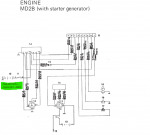
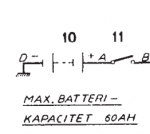
In tiny print next to the wiring diagram for a MD2B with starter-generator in your owners manual it says " MAX,BATTERY CAPACITY 60Ah"

If your domestic power requirements need a large domestic battery adding an alternator would be a good idea to charge that .......... item 13 in the wiring diagram.

1661511202150.png

1661510492779.png
 
Last edited:
Dynastart ..... brings me back to days of Vire .....

As Tranona says - Dynastart hails from the days of limited demand on electrics. So they were actually poor on charging. The average Centaur in those days would potter along with one or maybe two modest standard Lead Acid batterys ....
I assume the boat still has the 1 - Both - 2 - OFF switch ? If so then I honestly wouldn't waste money on fancy batterys ... a couple of reasonable Lead Acids of 80 A/hr or more each is good. Its no good going too high on capacity as the Dynastart is usually not capable of fast / high rate charging.

The name Dynastart is an amalgam of the two words : Dynamo and Starter. That should give you a clue as to the vintage of such a device.

I know people who have relegated the Dynastart to start only function and modified engine to have a dedicated alternator - a much better solution.
 
Dynastart is a trading name, and they supply alternators under that name as well as the low-power dynamo-starter. Which is why I asked OP to identify what he had.

I have Dynastart on a Stuart Turner 5hp, and it can scarcely pull the skin off a rice pudding.
 
We used to have a dynastart on a Vega, with an MD6A engine, we had the 1-2 both switch, the boat came with 2 leisure batteries, 100amp each, one was used for starting, we used an autohelm one day in a big following sea for six hours, it flattened the batteries completely, but the volvo could be hand started, i tested it one day, i think the most output was 7 amps, not enough on its own, some people managed to fit an alternator (but keeping the Dynastart), we sold so never investigated further, but a means of solar top up would be advisable.
 
We used to have a dynastart on a Vega, with an MD6A engine, we had the 1-2 both switch, the boat came with 2 leisure batteries, 100amp each, one was used for starting, we used an autohelm one day in a big following sea for six hours, it flattened the batteries completely, but the volvo could be hand started, i tested it one day, i think the most output was 7 amps, not enough on its own, some people managed to fit an alternator (but keeping the Dynastart), we sold so never investigated further, but a means of solar top up would be advisable.
There was an alternator kit available at one time but very few of the major components are still available. It would be very much a DIY job now unless second-hand parts could be found.
 
Dynastart is a trading name, and they supply alternators under that name as well as the low-power dynamo-starter. Which is why I asked OP to identify what he had.

I have Dynastart on a Stuart Turner 5hp, and it can scarcely pull the skin off a rice pudding.

Dyna Start is a trading co who sell Alternators and Starters from various brands :

Cars - Dynastart.

The OP is asking about a Dynastart unit ... not quite same ....
 
Dyna Start is a trading co who sell Alternators and Starters from various brands :

Cars - Dynastart.

The OP is asking about a Dynastart unit ... not quite same ....
See post#4 which shows the original unit fitted to the OPs engine and it is indeed a starter/dynamo. The question is whether the replacement was like for like. If it is then the comments about lack of charging power to support a large battery bank is valid.
 
See post#4 which shows the original unit fitted to the OPs engine and it is indeed a starter/dynamo. The question is whether the replacement was like for like. If it is then the comments about lack of charging power to support a large battery bank is valid.


Well aware of OP's unit .. and is why my posts reflect that. Maybe my posts are not readable ??
 
Hi, I'm looking for advice please and hope someone will have the answer. My Westerly Centaur has a Volvo Penta MD2B engine which uses a Dynastart. I have replaced the original Dynastart with a new one and have been trying for some time now to find out the ideal size (Ah) for the starter battery and also for the leisure battery. I am utterly confused with the conflicting advice I've had from battery suppliers - and read online - about types of battery too. I've read about AGM batteries, Sealed lead Acid batteries, Gel batteries, Wet Cell batteries and VRLA batteries and have no idea which would be best. The company which supplied the new Dynastart told me I could use any size (AH) of battery yet I was told by a very helpful person at Optima Batteries that their AGM (Absorbed Glass Mat) batteries would be too powerful for the Dynastart and may damage it. I'd be very grateful for any help. Many thanks! Will.
Keep the Dynastart with a standard starter battery of around 60AH as VicS said, then add an Alternator to charge the ships batteries (leisure) , 3 to 1 step up from crank,almost any Alternator will be a big improvement.
Jim
 
Well aware of OP's unit .. and is why my posts reflect that. Maybe my posts are not readable ??
Yes, but post#9 does not make sense because it is just repeating what is already known and does not help answer either of the 2 main questions.
 
Many people with Dynastarts on old Volvos and simuilar now-vintage engines spun the engine up on the Dynastart then once the huge flywheel was spinning dropped in the decompressor lever or levers. I treated my Volvo's Dynastart as highly convenient in saving having to hand crank. It was always pretty rubbish at battery charging, but I was not running lots of electronics or a fridge.

I don't think any 12v battery can be "too powerful" for a Dynastart. A battery could though be too high AH capacity to be effectively charged in typical low engine hours of a sailing yacht.
 
Yes, but post#9 does not make sense because it is just repeating what is already known and does not help answer either of the 2 main questions.

The reason for post 9 is obvious .... 'Sarabande' made a post that was incorrect. Why you think it makes no sense - is strange.

Considering that I had already answered the OP .... I find this conversation rather 'tedious'.
 
I can't imagine why the schematic that Vic kindly put up says max 50AH battery. A battery that is much bigger might provide more voltage under load to starter so might over heat it. ie starters are usually made to run on about 9volts. (the 12v battery volts under large load) wheras a big battery might supply 12v under large starter load. But I doubt that is the reason.
When charging from low current charge source a large battery might never reach optimal charge % so might end up with shorter life compared to a smaller battery. However that larger battery will take much more of the available charge current from dynamo so resulting in a greater total charge available for domestics. This greater charge load might reduce the life of commutator and brushes. but of course if large battery can be supplementally charged by solar or shore power then that negates that concern.
So I think OP should choose a battery to meet his discharge requirements. In any case fit an amp meter to charging to see exactly what dynastart is doing. If these are beyond the capabilities of the dynastart then he might need to consider adding an alternator. Here bracketry and pulleys for belt drive become the main problems. ol'will
 
I can't imagine why the schematic that Vic kindly put up says max 50AH battery. A battery that is much bigger might provide more voltage under load to starter so might over heat it. ie starters are usually made to run on about 9volts. (the 12v battery volts under large load) wheras a big battery might supply 12v under large starter load. But I doubt that is the reason.
When charging from low current charge source a large battery might never reach optimal charge % so might end up with shorter life compared to a smaller battery. However that larger battery will take much more of the available charge current from dynamo so resulting in a greater total charge available for domestics. This greater charge load might reduce the life of commutator and brushes. but of course if large battery can be supplementally charged by solar or shore power then that negates that concern.
So I think OP should choose a battery to meet his discharge requirements. In any case fit an amp meter to charging to see exactly what dynastart is doing. If these are beyond the capabilities of the dynastart then he might need to consider adding an alternator. Here bracketry and pulleys for belt drive become the main problems. ol'will

60Ah max is also stated in the Technical Data section of the manual ... I did not see that at first.

It is usual to find max battery capacities specified in the manuals for older VP engines, even when fitted with a decent sized alternator, but I don't know why. I was thinking perhaps to limit the current in the stalled condition rather than when actually cranking .

Mounting components are among those parts of the optional alternator kit that are NLA. I guess a mounting bracket would not be difficult to fabricate but the additional belt pulley might be more of a challenge
 
I can't imagine why the schematic that Vic kindly put up says max 50AH battery. A battery that is much bigger might provide more voltage under load to starter so might over heat it. ie starters are usually made to run on about 9volts. (the 12v battery volts under large load) wheras a big battery might supply 12v under large starter load. But I doubt that is the reason.
When charging from low current charge source a large battery might never reach optimal charge % so might end up with shorter life compared to a smaller battery. However that larger battery will take much more of the available charge current from dynamo so resulting in a greater total charge available for domestics. This greater charge load might reduce the life of commutator and brushes. but of course if large battery can be supplementally charged by solar or shore power then that negates that concern.
So I think OP should choose a battery to meet his discharge requirements. In any case fit an amp meter to charging to see exactly what dynastart is doing. If these are beyond the capabilities of the dynastart then he might need to consider adding an alternator. Here bracketry and pulleys for belt drive become the main problems. ol'will

I would imagine some 'engineer' in those days considered the medium sized car battery as typical .... plus the low charge rate a Dynastart has. - put the recc'd in the manual
The Dynastart was replaced by alternator and separate starter basically because of that poor charge rate ...

I know when I had one - it rarely actually achieved near full charged battery.
 
If the Dynastart and batteries are both nominal 12v, then it is hard to see how damage can be caused, except..

The most likely scenario is that with a big battery system, say about 200Ah, and some heavy usage of onboard power, the Dynastart may not be able to keep up the charge to the V level required to maintain the batteries' health.

Can I first check that you have bought an alternator from Dynastart, or a renovated dynamo. The model type and number will tell you which.

Secondly, do you have a rough idea of how much power you use on board in a typical day ? A 'normal' set up for a Centaur size boat is an engine starter battery of about 80Ahr, and for the domestic services about 2 x 100Ahr 'leisure' batteries. The starter battery does need to be designed for engines, so a car battery is perfectly OK.

The key to battery user happiness is keeping the batteries properly charged and not running them low. There are alternator gadgets and systems, e.g. Balmer and Merlin , and many other makes of VSRs, split charging units, battery monitors, 1-2-Both switches.

Unless you want to spend a lot of money on clever AGM or lithium (which will need special charging protocols) , then standard lead acid batteries of good quality, e.g. Yuasa Silver, will last a long time if you keep the charge up. A solar panel, even a small 20W one, is most helpful when the boat is not in use.
Many thanks for all this information…very helpful. It’s a dynastart unit I have, a combined dynamo and starter. I only need the leisure battery for lights and phone charging and have now bought Yuasa Silver batteries, 60Ah for the starter (which another poster pointed out should be the maximum Ah) and an 80Ah for the leisure. This will ensure that the dynastart will manage to fully charge the batteries. Thanks again.
 
Welcome.

Two different requirements. I assume you have 2 separate circuits, one for engine start and one for domestics with split charging. The engine start can be a simple FLA of around 5-60Ah of the type used on small diesel cars. For domestics which have a different cycle of operation the size will depend on the demands you put on it, but typical for that size boat would be a bank of between 100-200Ah. You can use FLAs, most commonly what are termed "leisure" batteries which have a reasonable life and modest cost at around £90 per 100Ah or AGMS which typically last up to twice as long for a 40% premium in initial cost.

However this assumes that you have adequate charging capacity and suspect that the Dynastart will cope OK with the engine start, but be limited in how much charge it can put into a house bank. Remember these engines were made when electrics on boats were very basic and you may well have to consider additional means of charging if you want to use modern things like electronics, autopilot, fridge etc.
Many thanks for this information, much appreciated. Please see me reply to Sarabande detailing what I’ve now done based on your advice and that of other posters.
 
Top