
Best basic electronics for dinghy/mini-cruiser - GPS, VHF etc

Please enlighten me, which models of iPhone or iPad are waterproof? I've never seen one.
Neither have I seen a sunlight viewable iPad or iPhone. A photo would settle the disagreement.
I maintain a phone is totally useless offshore, no matter how close to land. Signal blind spots are everywhere. You don't know you're in one until you need to make a call.

Read my original post properly where I mention waterproofing options and signal. An iPhone/iPad does not need mobile reception for apps to work. It also does not need mobile reception to work as a GPS, it just needs GPS reception like any other dedicated GPS device. Someone on here mentioned they'd gone across the Atlantic with one and it worked fine.

Sunlight viewable...erm these are devices designed in sunny California and used by millions if not billions of people worldwide. I've never not been able to use my phone, for whatever purpose, outside on a sunny day, not is it known generally known as a major drawback of the mobile phone. In fact, I'd go the other way...you cannot dim the screens enough for night use, however I propose to use a piece of car window tint film or smoked perspex on a simple piece of Velcro or similar to sort this...one day!

In terms of waterproofing, here is my my lifeproof equipped iPad 2 happily showing Navionics half submerged in a bath, whilst my similarly equipped iPhone 5 is giving tidal info on Portsmouth from the bottom of a basin. Neither of them are dedicated boat-only devices, I use them all day every day for work and play (typing this from the iPad now having taken the pictures on the devices and uploaded to Flickr) so they aren't a boat luxury, they are just ruggedised versions of everyday devices running cheap, but superb, software. IMHO a solution that offers the best value.
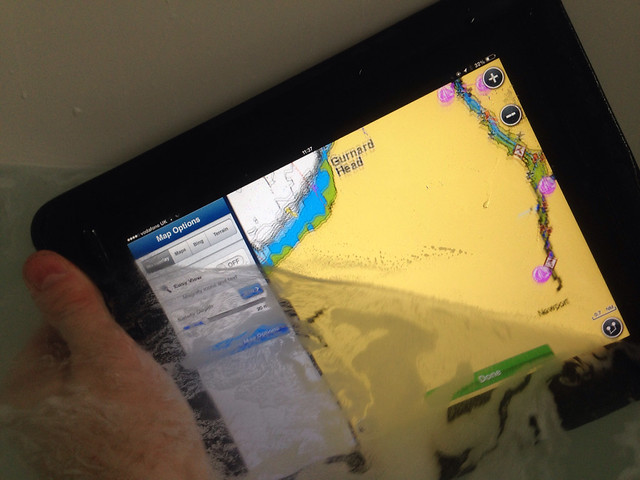
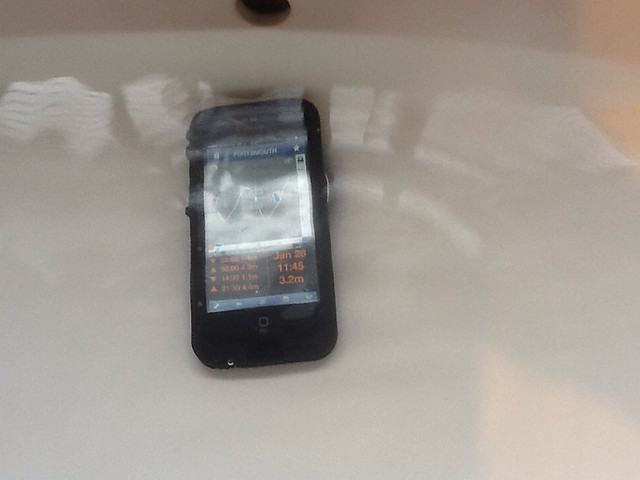
12187663875_615d20412a_z.jpg


12188282246_0b4d78d172_z.jpg


Floating "Lifejackets" are available for both devices too if you are worried about actually dropping them in the drink...

1037_-_lifestyle_1_4.jpg
 
Last edited:
A chum has an I-Pad 3 which is indeed waterproof and sunlight viewable, I've sailed with him using it, seems a spiffing bit of kit but then it's £800.

I don't know if it was any special model, but wasn't in a casing.
 
There's (unfortunately) no such thing as a waterproof iPad made by Apple. Either your mate had a case or he was using another kind of tablet (or mistakenly thinks his iPad is waterproof - surely not).

The iPad is pretty good in sunlight - I use one as my primary chart plotter, in the cockpit. The Lifeproof Nuud waterproof case is excellent but costs £100.

Agreed that people should read and understand the whole of the thread before wading in with bluster about things being "dangerous".
 
Last edited:
iPads are not waterproof from the factory...it will need some kind of case or box. I think Sony do one which is waterproof? £800 seems high too...are you sure it was an iPad?

iPads aren't cheap but I don't think they are that much. However for Dan's purposes, all he needs is a 3G enabled, older generation ipad, which can now be had second hand for a couple of hundred.

(Edit...beaten too it by MrMing!)
 
iPods may not be waterproof 'out the box' but (despite the marketing hype to the contrary) there are alternative products out there which are, indeed, waterproof.
As others have pointed out, there ARE phones cheaply available which are - waterproof, shockproof, sunlight viewable and GPS aware which can be loaded with !INEXPENSIVE! charting software (which does NOT need a phone signal to act as a plotter).

But although Elton''s concerns don't exist, I would still say that battery life and screen size are a pain with a phone (although tablets/phablets remedy the latter).
 
Yep battery life is the biggest problem imo. The lifeproof case is waterproof but not if you have to open the door to fit a charger. At the chart table this is not a problem obviously. I have a handheld Garmin as a backup when on longer trips, but the iPad lasts a day out racing without issue.
 
Thanks for all this persuasive to-and-fro. I'm afraid my budgetary restrictions limit the hi-tech fun I'm prepared (or interested enough) to indulge in. Given my humble level of sailing, I'll really be quite content with an occasional confirmation of my position; colour big-screen plotters may be the standard today, but they're not why I want to go sailing.

I've no doubt that dedicated systems are superb, and designed to be secure against rough and tumble at sea. But when they cost almost as much as my whole boat, I'm strongly inclined towards finding a cheap upgrade that'll allow me to make better, highly-effective use of something I already own.

Granted the Osprey won't leave me time to take considerate care of an unwaterproofed bit of kit...so the phone'll need a cover and some judgement about when to pause and look at it. But surely it needn't be switched on continuously, to calculate a fix? I was imagining a quick glance once every 45 minutes or so, to see how I'm progressing.

Ashore too...in Dorset & Cornwall and in France I routinely find my phone is completely lost - or, as I now understand it, it can't place my position against a backdrop of mapping.

So, I'll pay to download basic maps and enjoy the glory of GPS. I doubt I'll be sailing anywhere without poring over the paper chart in advance, so I'll have an idea of local hazards.

Dan: your Samsung Galaxy S2 should be able to run Navionics Marine Europe, a chart-plotter app with built-in charts for the whole of Europe, available from the aforementioned Google Play Store. It's 35€ so not cheap (but much cheaper than a Garmin).

That sounds fantastic. Although, I'm due a new phone already...I'm used to the Samsung, but I'd change to an iPhone if consensus sees it as the best choice for navigation.
 
Ravi, the "marketing hype" was a scam. Some nasty little individual making a very "official" looking advert and sending it out there, claiming that an upgrade to IOS7 included a feature where the device would know it was in contact with water and power down instantly...


WRT the battery life, the battery on the iPhone 5 is very good indeed. We're almost back to where we were with Nokia 10 years ago...progress eh?! :encouragement: For the ipad, the battery life isn't as good, however tucked up under my sprayhood on the cockpit bulkhead its pretty well protected anyway, so I just tend to leave it plugged in and running unless it's seriously foul weather...the current draw is very low.
 
Dancrance -:

No, it won't need to be switched on continuously to get a fix. it should pick one up within a few seconds of you turning it on.

It sounds like your phone will do the job but, if you ar looking for something more water friendly here are two possible answers to your question - if you can stretch to about £100 ....

1. Pick up a ?cheap? handheld plotter. This should already have charts on it although they are unlikely to be up to date. The one that I am familiar with is the Garmin 72c. (errmmm.. For those so inclined, the Garmin world maps have been hacked so, world charts are available.)

2. Get a suitable smartphone. I have an old one. http://www.ebay.co.uk/itm/Sony-Eric...20986?pt=UK_Mobile_Phones&hash=item486030433a Waterproof, inbuilt GPS, inbuilt barometer!, shockproof, etc. There are newer models available (?Sony Xperia Z3?) but they are probably more expensive. I chose mine because I liked the smaller size and particularly because I love the fact that it has a lanyard attachment.

Either one will tell you exactly where you are when you are on the water - (or when you are in the water if you are on an Osprey!).

They both have the same size screens. The Garmin has the benefit of days of battery life (and the ability to pop AAs in.) The phone has obvious the benefit of being something that will be useful when you are not sailing. The Garmin has the benefit of being able to plan a passage on the PC and download teh course to the device and uplload your tracks back to the PC so you can spend the winter months looking at where yo put in that crash jibe to avoid the ferry.

I am not an expert and I am sure others can recommend alternative devices. But I have used these devices on dinghies and yachts and they do the job.

BTW - I love the Osprey. Surely there can't be a non keel boat more graceful through the water. There are a few on Kielder Water where I dinghy sail. I even owned one for long enough to improve my swimming. ;-) I am fascinated that it sounds like you are cruising across the channel in it. All the best.
 
No doubt the iFad is water resistant when encased within a waterproof plastic box :rolleyes:

However I strongly disagree with suggestions, either explicit or implied, that a mobile telephone is in any way a substitute for a VHF radio. The notion is as absurd as it is dangerous.
 
No doubt the iFad is water resistant when encased within a waterproof plastic box :rolleyes:

However I strongly disagree with suggestions, either explicit or implied, that a mobile telephone is in any way a substitute for a VHF radio. The notion is as absurd as it is dangerous.

Well that gives the game away. Ever used one?

As for phone v VHF, has anyone on this thread even hinted at using the phone for coms? If so please show me.


and for the OP:

Here is a HH VHF with mapping. http://www.uniden.com/marine-electronics/full-vhfgps-mapping-handheld-marine-radio/invt/mysticg
 
However I strongly disagree with suggestions, either explicit or implied, that a mobile telephone is in any way a substitute for a VHF radio. The notion is as absurd as it is dangerous.

A mobile is a superb substitute for a VHF radio for almost all purposes. That's why we can't do link calls any more. Every single harbour or marina I ever visit is easier to contact by mobile phone than by VHF. Of course a VHF has its uses too, but as mobile phone coverage gets better and better, the times when a VHF is useful or necessary are getting fewer and fewer. Grumbling about that is like grumbling that people aren't learning semaphore any more.
 
A mobile is a superb substitute for a VHF radio for almost all purposes. .

Now, you are just stirring it! ;) ;) ;)

Yes, a mobile phone is incredibly useful and so cheap that it would be daft not to have one but .... until the day when yachts have a mobile phone number painted on their hull and sails, a VHF on Ch 16 is quite handy.

When you can get a VHF for under £50 and everyone has a phone, anyway, it is not really an issue.
 
Well that gives the game away. Ever used one?
Yes I've used an iPhone and an iPad.
I have a Samsung Android phone and tablet. Great toys.
I would never use any of them for navigation at sea, and to depend on a phone for comms is just clueless.

As for phone v VHF, has anyone on this thread even hinted at using the phone for coms? If so please show me.
http://www.ybw.com/forums/showthread.php?385538-Best-basic-electronics-for-dinghy-mini-cruiser-GPS-VHF-etc&p=4585338#post4585338
 
Last edited:
Some nice thread drift here. Dan sails on a tight budget in a dinghy. He has struggled how to work out how to use his phone with apps. I admit I don't like tablets or mobiles although use both a bit. But on a budget surely no i pad in a waterproof case in a dinghy.... and I think a dose of cruising the Solent is prescribed before Dan crosses the channel :)
 
Top