
Beneteau skin fittings

mrplastic

Well-Known Member
Joined
2 Nov 2002
Messages
277
Location
Algarve
Visit site
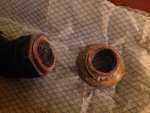
I bought Jupiter a 2001 Beneteau 331 Oceanis at the tail end of last year and am working through a list of upgrades and service items. After reading the PBO article about dodgy skin fittings I decided to replace all of them whilst she is out of the water being blasted and copper coated. I was only interested in the metal fittings at or below the waterline of which there are six in total, I managed to remove 5 of them and they were all standard brass fittings with brass valves and hosetails, they came out easily and although a bit pink I did wonder if they really needed replacing. The heads outlet was pretty inaccessible and the tools I had to hand were not man enough to undo it which meant I had to leave it at that time. I went back today armed with a proper sized adjustable spanner and the attached picture shows the result. One good firm pull and the skin fitting snapped clean off. Again, a standard brass fitting and ball valve that was very stiff to turn, it could have just has easily broken when operating the valve. I now feel fully justified in my decision to replace them all and seriously recommend fellow owners of these boats to consider doing the same! I am of course replacing them with either Bronze or DZR fittings, does anyone have any recommendations?
 

Attachments

  • image.jpg
    image.jpg
    95.9 KB · Views: 34
I bought Jupiter a 2001 Beneteau 331 Oceanis at the tail end of last year and am working through a list of upgrades and service items. After reading the PBO article about dodgy skin fittings I decided to replace all of them whilst she is out of the water being blasted and copper coated. I was only interested in the metal fittings at or below the waterline of which there are six in total, I managed to remove 5 of them and they were all standard brass fittings with brass valves and hosetails, they came out easily and although a bit pink I did wonder if they really needed replacing. The heads outlet was pretty inaccessible and the tools I had to hand were not man enough to undo it which meant I had to leave it at that time. I went back today armed with a proper sized adjustable spanner and the attached picture shows the result. One good firm pull and the skin fitting snapped clean off. Again, a standard brass fitting and ball valve that was very stiff to turn, it could have just has easily broken when operating the valve. I now feel fully justified in my decision to replace them all and seriously recommend fellow owners of these boats to consider doing the same! I am of course replacing them with either Bronze or DZR fittings, does anyone have any recommendations?

What on earth do you do with 6 of them? I came up with:

heads
heads sink
galley sink
engine intake

I'm assuming on a 331 you only have a single heads, and any cockpit drains ought to be above waterline on that size AWB? Your wording implies that there may be a load more non metal or above waterline holes too and my (small boat) brain can't work out what all these holes do!
 
Our Benny is now eight years old and I will be replacing the below waterline stuff with Marelon in the spring when I do other out of water stuff. They actually don't look bad but you never know, also replacing the Volvo shaft seal for the first time, three years later than VP recommend:eek: Fortunately access is as good as it could possibly be for all of them.
 
What on earth do you do with 6 of them? I came up with:

heads
heads sink
galley sink
engine intake

I'm assuming on a 331 you only have a single heads, and any cockpit drains ought to be above waterline on that size AWB? Your wording implies that there may be a load more non metal or above waterline holes too and my (small boat) brain can't work out what all these holes do!

I don't know his boat, but our Beneteau has:

heads water inlet,
heads outlet
shower outlet
heads sink outlet
galley sink outlet
galley sink sea water inlet
deck wash pump inlet

there's also a drain for the freezer, but I think that comes out above the water line
 
Hi David, Changing the seal is the easy bit 20mins work, getting the 41mm locking not from the inside of the shaft coupling is the killer,had to borrow 3/4 inch drive socket set took over 2 hours to remove,you will also have to enlarge hole in the bulkhead ply wood that the shaft passes through as its to small for the seal.good luck.
 
Hi David, Changing the seal is the easy bit 20mins work, getting the 41mm locking not from the inside of the shaft coupling is the killer,had to borrow 3/4 inch drive socket set took over 2 hours to remove,you will also have to enlarge hole in the bulkhead ply wood that the shaft passes through as its to small for the seal.good luck.

Thanks a lot, was that on an A9 with a Volvo D4? my seal is well aft of the bulkhead, my major concern is dropping the rudder to pull the shaft back far enough as it looks like I will have to remove the skeg, I will use an electric impact wrench to undo the nut, the "other trades" in South Dock have one I can set up the loan of in advance now you've given me the heads up.
Apologies to the OP for Fred Drift poking his nose in.
 
What on earth do you do with 6 of them? I came up with:

heads
heads sink
galley sink
engine intake

I'm assuming on a 331 you only have a single heads, and any cockpit drains ought to be above waterline on that size AWB? Your wording implies that there may be a load more non metal or above waterline holes too and my (small boat) brain can't work out what all these holes do!

Stern tube inlet
Engine intake
Galley sink outlet
Heads flush inlet
Heads outlet
Heads sink outlet (just above waterline)

All the others such as depth, log and vents are all plastic or composite.

The other valves that came away intact all looked ok and were definitely original as the valves carried beneteau logistics but this was the largest of them all with the greatest wall thickness and its completely de-zinctified which does not bode well for the smaller fittings!

Get em changed!
 
Last edited:
I'm starting to be glad I have a little boat. Three holes, two of which are cockpit drains and the other a sink which I'm thinking of glassing over in favour of a washing up bowl :) Oh who am I trying to kid, I want all that stuff that needs holes! You'd think someone would at the very least think up a solution that's easier to replace than the current ones. If it was a simple operation I suspect more people would replace them more often.
 
I am of course replacing them with either Bronze or DZR fittings, does anyone have any recommendations?
ASAP Supplies have DZR valves and fittings. DZR fittings are not so widely available elsewhere. but bronze skin fittings and hose tails are, but more expensive. As you have discovered it is the fittings that are the problem, not necessarily the valves. You can reduce problems with sticking valves, particularly the 1 3/4" one by operating it frequently to prevent build up of crud.
 
I'm starting to be glad I have a little boat. Three holes, two of which are cockpit drains and the other a sink which I'm thinking of glassing over in favour of a washing up bowl :) Oh who am I trying to kid, I want all that stuff that needs holes! You'd think someone would at the very least think up a solution that's easier to replace than the current ones. If it was a simple operation I suspect more people would replace them more often.

If builders and others would move to the 21st century and fit Marelon there would be no issue, most boats are plastic so why not the fittings? the bronze age ended 3000 years ago, what are we thinking of?
 
If builders and others would move to the 21st century and fit Marelon there would be no issue, most boats are plastic so why not the fittings? the bronze age ended 3000 years ago, what are we thinking of?

If you go to the US or down under you will find plastic is more common, mainly because DZR is not freely available and bronze is very expensive. As the article referred to explains, plastic valves are not necessarily trouble free, are much bulkier and do not have the range of fittings to cope with a wide range of applications. You will also find they are not always a direct replacement and you will probably need to do some work to get them to fit.

It is only the recent rash of some builders fitting plain brass that has raised the issue, and although there have been failures, it is clearly not an epidemic, otherwise insurance companies would insist on changing them.
 
I think it depends if the valves are below the waterline, if they are brass then they are constantly under attack from salt water and have the same potential to fail but I agree they are less likely to do so. When I started looking for replacements I was amazed at how often I came across online suppliers who should know better selling standard brass fittings for marine use.
 
I think it depends if the valves are below the waterline, if they are brass then they are constantly under attack from salt water and have the same potential to fail but I agree they are less likely to do so. When I started looking for replacements I was amazed at how often I came across online suppliers who should know better selling standard brass fittings for marine use.
Yes, but the area exposed of the valve body is small compared with its volume - even smaller if the valve is closed. The skin fitting, however is permanently in seawater and is comparatively thin. similar with hose tails if underwater as seawater is there, even if the valve is closed.
 
I'm starting to be glad I have a little boat. Three holes, two of which are cockpit drains and the other a sink which I'm thinking of glassing over in favour of a washing up bowl :) Oh who am I trying to kid, I want all that stuff that needs holes! You'd think someone would at the very least think up a solution that's easier to replace than the current ones. If it was a simple operation I suspect more people would replace them more often.

Its not difficult. In January, I replaced 13 hull valves and skin fittings on two of my boats. Later in the year I will do a few more on my liveaboard yacht.

Cutlass bearing on one, rudder bearings on the other. Very straight forward......also did two shaft seals , one whilst afloat.

My point??? None of it is difficult, its simply attitude.

However, open the fronty lid thing on a modern car.....eek!!
 
Its not difficult. In January, I replaced 13 hull valves and skin fittings on two of my boats. Later in the year I will do a few more on my liveaboard yacht.

Cutlass bearing on one, rudder bearings on the other. Very straight forward......also did two shaft seals , one whilst afloat.

My point??? None of it is difficult, its simply attitude.

However, open the fronty lid thing on a modern car.....eek!!

I've read a few horror stories on this very forum about swapping them and needing all sorts of tools and crawling around in tiny bilge spaces. I think you've been lucky but it certainly doesn't appear to be a simple unscrew, remove screw in replacement which would encourage swapping them out more often.
 
Yes, but the area exposed of the valve body is small compared with its volume - even smaller if the valve is closed. The skin fitting, however is permanently in seawater and is comparatively thin. similar with hose tails if underwater as seawater is there, even if the valve is closed.

Agreed but we are talking about 13 years of almost continuous attack and considering the relatively modest outlay why wouldn't you change them!
 
Its not difficult. In January, I replaced 13 hull valves and skin fittings on two of my boats. Later in the year I will do a few more on my liveaboard yacht.

Cutlass bearing on one, rudder bearings on the other. Very straight forward......also did two shaft seals , one whilst afloat.

My point??? None of it is difficult, its simply attitude.

However, open the fronty lid thing on a modern car.....eek!!

Although I never used it I came across what seems a great tip for removing the skin fittings. It simply consisted of forcing a wooden bung in the outside opening, drilling a hole in the centre of the bung and then using a decent and correctly sized holesaw to cut through the skin fitting back to the thread so the fitting can simply be pulled out of the hull. Anyone tried it?
 
Agreed but we are talking about 13 years of almost continuous attack and considering the relatively modest outlay why wouldn't you change them!

Not suggesting for one minute that changing them is not a good idea. Just putting things into perspective. Valves rarely fail from dezincification, but usually from seizing through lack of use or the spindle corroding. So it makes sense to change them at the first sign of trouble.

When you think about it the failure rate must be pretty small. If you take the period 1998-2009 which is when the standard first came in and up to 5 years ago, the three big producers made an average of around 2000 boats pa each and typically a boat has an average of 8 seacock valves - so something like half a million 5 year or more old brass valves and fittings in service (gross underestimate, but you get the picture) - How many failures?
 
Although I never used it I came across what seems a great tip for removing the skin fittings. It simply consisted of forcing a wooden bung in the outside opening, drilling a hole in the centre of the bung and then using a decent and correctly sized holesaw to cut through the skin fitting back to the thread so the fitting can simply be pulled out of the hull. Anyone tried it?

Yes, or even easier if you have a steady hand use an angle grinder on the junction of the flange to the bore. Pretty standard practice.
 
Had the same problem with our boat this winter, 5 x 25 year old through hulls removed and one fell apart similar to OP's.

Have replaced with TruDesign from Lee Sanitation - http://www.leesan.com/index.asp?m=3&b_idno=23&t=Tru+Design+Plastics - To replace through hull + valve + tail, they worked out cheaper than DZR or bronze. Through hulls can either be fitted in usual way with sealant or epoxied in. One advantage of these valves is that service kits are available.
 
Top