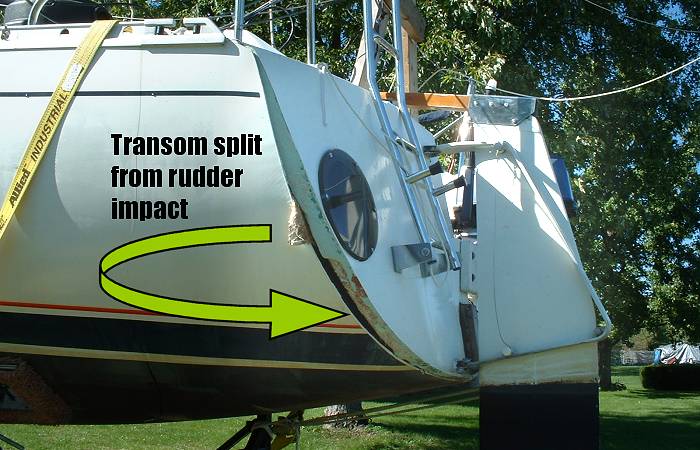
Bene- transom popped out

Just when I thought I may have seen it all...With that method of construction, combined with rudder deeper than keel - even if it was not the same would still apply - it does seem a tad obvious, I'd hope ( in a way ) that the designer intended a lot of glassing in and stiffening, but this was a 'Friday Afternoon Boat' ???!

Edited as Mark-1's post was simultaneous, I'd have thought it fair enough to have strong rudder fittings and backing, without pulling the whole transom clean out like something from a cartoon !
 
Last edited:
Makes me glad my boat is an old one, hand laid up in one go with no joints like that.....


Yes sir'ee that's no way to make a boat, underwater joints, pah!

Hang on a tick, my boat was cobbled together out of two halves. Bloody Hell.

Revise that earlier thought; it's a sensible and workmanlike idea, how may joints does a wooden boat have?
 
windseeker_transom.jpg


Blimey. That joint looks pathetic - I'd have expect loads of GRP layup bridging the gap inside but it looks as if there nothing more than glue round the flange on the transom.
 
Agree with the article that it is essentially bad design to have a boat whose deepest point is the rudder, unless that rudder has provision to kick up.
Even my Wayfarer has a kick-up facility... you can buy a special cam-cleat that releases under impact should you ground... and I get quite nervous running into shallow water with the board up and usually hold the rudder downhaul in my hand, ready to let fly.
Although I doubt a Wayfarer would actually lose it's transom if the rudder grounded! What with it being a properly built boat, etc etc.

Is this method of construction (separately moulded transom) quite normal these days? The shape of a modern boat would suggest so.
 
I'm quite glad to have a boat with no transom whatsoever!

Well this owner nearly got to emulate you !

I don't know the particular design, but wouldn't mind betting it has an aft cabin; it's no excuse for the lack of glassing in etc, but I can't help wondering if more structure aft in general may have prevented the hull from flexing and 'popping' out the transom ?

And yes, if the keel must be shallower than the rudder, a frangible lower section of the rudder seems a good idea !
 
OK so most larger boats don't have transom hung rudders, but I don't really see that as an excuse !

Does this mean one should not rest one's feet on the end in aft cabins ??! May be worth bearing in mind as an emergency escape route I suppose...

TK, 'frangible' always was a popular word in my old workplace, as practice bombs and real torpedos had the pointy bits protected by frangible wotsits.
 
dunno if this is old news

and if it is the item will sink like a stone

http://www.beneteau235.com/f235_rudder.htm

I guess it shows the rudder is pretty strong

D

Well I think it is safe to say that the second hand market for Beneteau 235's has just been wiped out!!! Hope some surveyors are taking note..!!! On a serious note from a construction/design perspective this is appauling and I hope this does not reflect on the current models!
 
This seems a fair response to the "Why do we take the P out of Ben-Jen-Bav's?"

And, "Joints on wooden boats" always run fore & aft do they not? Has anyone ever seen a Clinker boat with vertical joints between the planking so that a grounding will rip them open? :confused:

I didn't think so. :cool:
 
Errrm, surely transoms on wooden boats are attached as a panel in a similar way? Unless it's canoe stern or smack I guess. But they wouldn't have a rudder deeper than the keel, usually being very low aspect ratio.
 
Top