Bending thin stainless

eddystone

Well-Known Member
Joined
18 Aug 2013
Messages
1,936
Location
North West Devon
Visit site
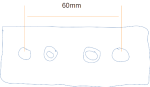
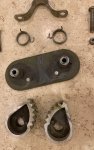
Whilst my mainsheet blocks (Main brand) are serviceable, the cam cleat on the lower block needs replacing. The hole centres are 60mm but all the possible replacements from Selden, Holt Allen, Harken etc are much too small. The nearest I can find is a Barton K cam cleat maxi with hole centres at 50mm. The s/s adjustable bracket which attaches to the bottom block has cheeks about 1.5mm thick, maybe less which are splayed outwards. How easy would it be to bend them in to gain 5mm on each side? I thought the easiest way would be to use a clamp to hold it while I attached new fitting but the elasticity of the metal would put a big strain on the fitting. I'm not sue how easily they would bend in situ. Rather not remove it as the mainsheet terminates in a splice round the becket on the top block and re-splicing is not my forte.
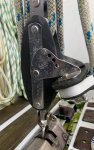
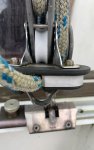
DB74A2D9-5328-4110-B0FE-2489F6D56F9F.jpeg5FF49943-1A0B-4AC0-8E3F-A97DB258037F.jpeg
 
I would say you a good chance of bending the steel cheeks in by the 5mm per side, I would take both blocks and the sheet off the boat. Put on clamp/vice across the back edge of the cheek and secure. Get another clamp/vice and squeeze the front edges below the cam cleat plates, squeeze it until the hole centres are less than 50mm and release. You may need to squeeze it a number of times until the get the right amnountb of overbend.

David MH
 
I would say you a good chance of bending the steel cheeks in by the 5mm per side, I would take both blocks and the sheet off the boat. Put on clamp/vice across the back edge of the cheek and secure. Get another clamp/vice and squeeze the front edges below the cam cleat plates, squeeze it until the hole centres are less than 50mm and release. You may need to squeeze it a number of times until the get the right amnountb of overbend.

David MH
That sound like a good plan. Looks as if I"m going to have to overcome "The Sailors fear of a Splice" (paraphrasing Wim Wenders film - the Goalkeepers fear of a Penalty.)
 
I think bending without dismantling the thing may cause problems. If so, I would make a transfer plate out of something like2mm stainless. By the miracle of Computer Aided Design here is a fully dimensioned engineering drawing:

1644662205508.png

You bolt to the existing and countersunk screws attach the new. As 60 and 50 are close, you would probably want to look at the smaller new cleats.


PS
Alternatively, you could pull the holes in by 10mm, with a round file and bury the evidence with oversize washers

.
 
I would try a mix of squeezing and a round file to elongate the existing holes. A big problem with squeezing is trying to avoid putting pressure on the plastic cheeks that will jam the sheave.
 
1.5mm stainless is tough stuff to bend. Your plan might work, but I wouldn't guarantee it. What's wrong with the cam-cleat? If it's that the teeth are worn, could you investigate restoring them with, say, a triangular file to give them a new lease of life instead of brutalising the mounting plate. The individual cams should be removable.
 
1.5mm stainless is tough stuff to bend. Your plan might work, but I wouldn't guarantee it. What's wrong with the cam-cleat? If it's that the teeth are worn, could you investigate restoring them with, say, a triangular file to give them a new lease of life instead of brutalising the mounting plate. The individual cams should be removable.
It's not that the teeth are worn - they maybe a bit but the problem is in the spring loading or lack of it - some of the time it grips the rope but at others there isn't enough spring tension and the rope slips. So the consensus is that it's best to elongate the holes into a slot and use s/s washers. The best tool I've got to do that it's a Dremel but I'll have to bring the whole mainsheet system home as it's mains powered.
 
Regarding the splice, it looks tidy but it's not necessary, my mainsheet was always tied on to the identical block system with a bowline.

Easier to swap ends to even out wear too.

I now use a 6 to 1 system with Barton's ball bearing blocks. Quite pricy but so much easier to use.
 
Why is the splice a problem? Surely you just pull the pin out & release it then put it back.
Personally I would take the whole lot home, put the SS cheeks in a vice & using an adjustable spanner grip the plate & bend it to suit. It is a relatively easy job in a decent vice.. If you do not have a vice look for a boat trailer in the yard with heavy RSJ sections, lay the plates over them, so they act as an anvil & hammer them to shape. Grip them in a pair of mole grips .
As for the splice, you could use the opportunity to dump that old sheet & get a new one. The chandler will put a splice on it for you. Putting splices in old ropes can be very difficult if you are not very good at it. One would be better off whipping the eye, which if done properly, with the whipping pulled in tight, would be perfectly OK.

Of course you could think laterally You could fix a tackle to the fixed end of the mainsheet for trimming up wind. That would give you a massive purchase, make the use of the old cleat less important when sailing up wind- it is probably OK off wind- It would make sail trimming so much easier as well.
 
Whilst my mainsheet blocks (Main brand) are serviceable, the cam cleat on the lower block needs replacing. The hole centres are 60mm but all the possible replacements from Selden, Holt Allen, Harken etc are much too small. The nearest I can find is a Barton K cam cleat maxi with hole centres at 50mm. The s/s adjustable bracket which attaches to the bottom block has cheeks about 1.5mm thick, maybe less which are splayed outwards. How easy would it be to bend them in to gain 5mm on each side? I thought the easiest way would be to use a clamp to hold it while I attached new fitting but the elasticity of the metal would put a big strain on the fitting. I'm not sue how easily they would bend in situ. Rather not remove it as the mainsheet terminates in a splice round the becket on the top block and re-splicing is not my forte.
I did the same modification and fitted the Barton cam cleat. In your photo the two ss brackets are splayed out slightly so i bent mine in the vice to splay in slightly. However, I did this after drilling out the two main rivets so the brackets were completely detached to work on. I also, while dismantled, replaced the sheaves with Allen ball bearing ones then reassembled with bolts instead of rivets. Been working well for about 10 years now.
20220214_135039_resize_2.jpg

www.solocoastalsailing.co.uk
 
In response to a few of the points:
- the sheave to which the spliced loop is attached is riveted in
- I don’t understand the Easymatic jammer - there’s a post where the rope should lie between the toothed cams; also only available from EU based online chandler; as far as I know they reacted to HMRC proposal that they had to collect UK VAT on their behalf with a “thanks but no thanks “
I’ve removed the cam cleat and the teeth are still “toothy” and the springs still spring - perhaps inserting washers would enable the cams to operate more freely. Also give it a good clean before reassembly.5019B0CB-F33F-431A-82B8-4239D7719969.jpeg
 
In response to a few of the points:
- the sheave to which the spliced loop is attached is riveted in
- I don’t understand the Easymatic jammer - there’s a post where the rope should lie between the toothed cams; also only available from EU based online chandler; as far as I know they reacted to HMRC proposal that they had to collect UK VAT on their behalf with a “thanks but no thanks “
I’ve removed the cam cleat and the teeth are still “toothy” and the springs still spring - perhaps inserting washers would enable the cams to operate more freely. Also give it a good clean before reassembly.View attachment 130434
I had some cam cleats, lewmar I think like that and the jaws struggled to close smoothly for a couple of reasons. The first was the hole on the cam jaw had reduced in size. It was a nylon bush in the aluminium cam. Some fine sandpaper removed some material and sorted that out.
The second was the cams touching the stainless rope hoop bit. Again a fine file sorted it out.
It worked again for a while but was never perfect so got replaced. Maybe if I had spent a bit more time on the filing it might have worked better but I think that the cam corrosion kept reducing the bush size so it kept binding.
 
It seems to me that the cams have enough spring in them when separated from the block but when screwed down hard to the bracket there is not enough tension to reliably jam the rope. Aslo noticed not much real estate on the faces of the bracket to which they attach and therefore scope for turning hole into a slot. May need combination of bending the arms of the bracket say 2-3mm each side and then gaining the rest through filing the holes.

I've noticed replacing the sheaves is a non-starter because they are riveted in from both cheeks.
 
Top