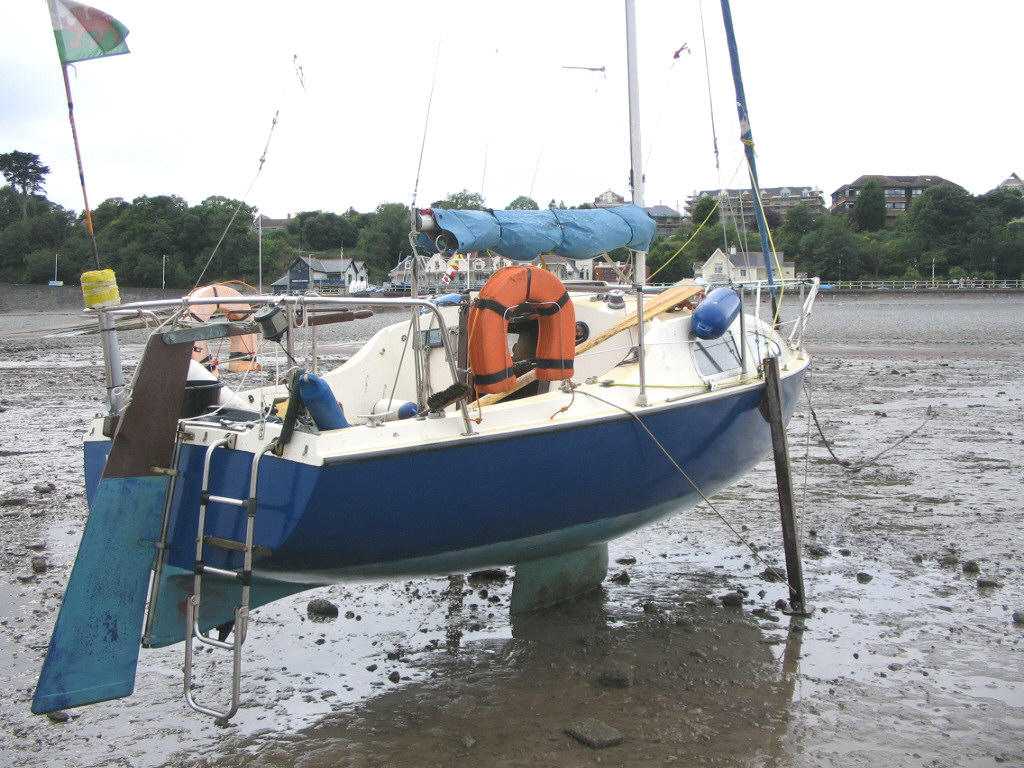
Beaching Legs Fittings - permanent or temporary

Roach1948

Well-Known Member
Joined
27 Apr 2006
Messages
1,268
www.dallimoredesigns.nl
Coming to the end of a restoration and have decided that I would make some beaching legs for my wooden yacht. She evidently used to have them as I have two holes on either side of the hull in the mid-way point with stainless backing pads.

My question is how other yachtsmen with beaching legs fit the legs when required? Does one have a set of permanent stainless pins sticking out of the side of the hull (at the widest point and therefore a great scratch threat to other yachts/Pontoons) to slot the legs into? Or does one mess around leaning over the side of the hull trying to fiddle around with a large nut and bolt and line that up (I would imagine rather tricky procedure if your singlehandling)? The later option leaves a hole in the hull on the side of the yacht when well heeled - how do others' deal with water spurts down their backrests?

Many thanks for your suggestions.
 
I had a boat with beaching legs. The bolts were permanently in the legs, rather like studs, although in fact they were just steel bolts "frozen" in oak. The procedure was to line up the end of the bolt with the relevant hole in the hull, pop it through, fit a washer and nut inboard and tighten the nut.

The threaded portions of the bolts were well over length, so that the bolts could be started with the legs floating, and thus near horizontal. Since the upper part of the legs (padded with canvas) was shaped to accomodate the topsides, the bolt needed to be a bit longer than when the leg was vertical.

There was a fairly solid "butt strap" in way of the hole in the topsides. Ideally, I would fit a short stringer here, extending over 3-4 frames, and pack the space between it and the planking, but all we had was a butt block.

The holes in the topsides were just corked with old wine bottle corks. Sounds alarming but never gave any trouble.

On my present, larger, boat I have been thinking of Plan B where the legs are secured to the chainplates and there are no holes in the topsides.
 
We only had a single bolt. Your two bolt set up seems better, but I suggest having one bolt overlength so you can start it with the leg floating.

Our legs were angled slightly outwards - which looks very much better, and gives the leg a chance to be vertical should the bottom prove not to be quite flat - as indeed it tends not to be.

The legs were an inch or maybe two shorter than the draft. This seems to be normal and is a wise precaution against the boat's entire weight coming on the legs, should the keel find itself in a hollow!

Chocking the boat off for the winter, when not on concrete, we tried to get a sleeper (she was small enough for a normal 8ft 6ins sleeper to just do the trick!) across between both legs, under the keel, which also rested on it, and put softwood wedges between the feet of the legs and the sleeper, to get everything
level. On concrete, this is unnecessary of course.

We had guy ropes fore and aft, led through the fairleads and belayed on deck. I believe that this is usual.

I never beached her on legs without looking at the area first during the previous low water.

I am thinking of making a set for the present boat because the supply of scrubbing posts seems to be dwindling.

Good luck.
 
I'll see how I get and thanks for the sensible observations regarding the length and angle of the legs. I might even add a couple of steps up the sides (I have seen a few with these on). This project is not a priority, but seeing as I am painting/antifouling the thing soon, I might as well paint the legs too.
 
legd.jpg
 
Mine's got oak legs much as Mirelle describes, though they bolt through the bulwark stanchions so no need for the corks ! As per Rich's photo, they're shaped to fit round the rubbing strake etc. I wonder if having a little weight on the bottom of each leg would be good- I find them a bit fiddly on my own but they're fine as long as I'm not in a hurry.
 
They also need a foot piece made out of inch thick ply or similar to spread the load when drying on sand.Ideally fitted so it can swivel a bit to allow for an uneven bottom.

I think about 12 inches square is normal.

My friend omitted these and we had a struggle to stop his Springtide falling over when one leg dug into the sand. We ended up with a rope around the bilge keel of my dried out hurley attatched to his mast head! /forums/images/graemlins/cool.gif
 
Mine are just the same as Richard's Hermees, (well, exactly really - hello Rich), Ratafia has lived on them for I don't know how many years, without problem.

As for putting them on, if the fore and aft lines are pre-measured so that they can be secured before putting the leg in the water, then the leg bolt just pops into its hole without any difficulty at all and stays there waiting for me to put the nut on from inside. (When I first tried and the fore and aft lines were loose, it was a little more entertaining.) I am usually singlehanding and this is not a problem at all.

The nuts on the inside of the hull has a rod welded on to them, and the hole in the hull gets plugged with a softwood tapered bung when out and about.
 
Regarding Bunging up the holes with wine corks when the legs are off..........

The neatest solution I have seen was inherited by my mate, it was a couple of wine corks, but with plastic tops atop tapered corks, with little handles on them, in red and green! (not that it matters of course). They even have a bit of an O ring to help seal them - although whether this makes any difference is arguable.

I guess a trip to a wine shop may be called for to investigate further..........
 
Well was up at the boat at the weekend making templates of the hull curve in carboard. Once measured up I realised I dont have enough oak left over from the restoration to make the legs. I was have some nice 15cm x 15 cm pine from the boat tent (which I was planning on bastardising as I dont need it anymore) - do you think I will get away with pine legs if I epoxy coat them? Thanks for the weighting/and plywood feet advice - I just wonder how to make the feet swivel?
 
Be careful with the "lining" on the legs where they are in direct contact wih the hull. My Invicta 26 (1964) has noticeable slight blistering on the topsides where the sponge like lining on the wooden legs remained permanently damp. She is now fitted with adjustable alloy legs which have hardly any padded contact with the hull and the problem has not developed any further. With adjustable legs allowance can be made for uneven ground.
 
Pine will be ideal provided its strightgrained and not too many knots. I fixed the feet on mine by bolting two angle iron brackets to the feet with a pivot bolt through the leg with an oversize hole to allow some movement. Crude but it works.

Img_0117.jpg

Hard to see on the pic but the single bolt allows the foot to pivot sideways and the oversize hole allows some fore and aft pivotting.
 

Other threads that may be of interest

Top