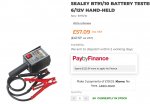
Battery Testers

Ian_Rob

Well-Known Member
Joined
31 Jan 2008
Messages
1,207
Visit site
There are various testers on the market that do non-load test on batteries including one from CTEK.

Are these non-load testers any good for testing battery condition? In as much as CTEK do one, I assume they have some value?

The CTEK one is quite expensive but the BA101 available from Ancel appears to do the same job. Worth getting as a cheaper alternative?


PS. Ancel also make the BST200 Battery Load Tester. Is this worth considering?
PPS Or the BA 201?
 
Last edited:
I've had the ancel ba101 for a few years now. Great device.
Measuring the internal resistance is really handy.
Lots of mechanics on youtube singing it's praises
 
I've had the ancel ba101 for a few years now. Great device.
Measuring the internal resistance is really handy.
Lots of mechanics on youtube singing it's praises

Yes, there a quite a lot of very positive reviews on YT. The BA 101 seems to have a lot more functions than the CTEK though I don’t know whether that is good or indeed necessary?

Ed China (ex Wheeler Dealers) uses the CTEK version in the latest episode of his new Grease Monkey series on YouTube and he got me thinking about them.

Thankyou ....and Poey50 for the interesting link.
 
I've had the ancel ba101 for a few years now. Great device.
Measuring the internal resistance is really handy.
Lots of mechanics on youtube singing it's praises
Any links to comparisons to actually temperature controlled 20h capacity tests would be interesting, but can't see a 40 quid meter being anywhere near accurate to actual 20h capacity. CCA yes but thats pretty easy to do. Doubt if anyone has done a comparison either, no mean feat getting accurate 20h constant current temp controlled capacity test data on a lead acid... Would be happy to be proved wrong be very doubtful....
 
All I really want to establish is the current state of my batteries as a base line for their future state.

What criteria of battery performance should I be looking at to determine the current condition of my batteries and what test equipment that doesn’t cost an arm and a leg, could I look at?

Mindful that pro equipment can cost several £K perhaps there isn’t a cheap solution?
 
All I really want to establish is the current state of my batteries as a base line for their future state.

What criteria of battery performance should I be looking at to determine the current condition of my batteries and what test equipment that doesn’t cost an arm and a leg, could I look at?

Mindful that pro equipment can cost several £K perhaps there isn’t a cheap solution?

I don't think there's really anything to suit your needs. And the high cost of some equipment might be better spent on new batteries!
 
All I really want to establish is the current state of my batteries as a base line for their future state.

What criteria of battery performance should I be looking at to determine the current condition of my batteries and what test equipment that doesn’t cost an arm and a leg, could I look at?

Mindful that pro equipment can cost several £K perhaps there isn’t a cheap solution?
If they hold a charge, and recover from a successful drop test, there is unlikely to be much wrong with them. This only applies to normal lead acid batteries though.
 
If they hold a charge, and recover from a successful drop test, there is unlikely to be much wrong with them. This only applies to normal lead acid batteries though.
Nope. Drop testing tells you little about actual 20h rate capacity, there could be plenty surface charge on the plates to give a healthy drop test reading but next to no aH capacity left.
 
Nope. Drop testing tells you little about actual 20h rate capacity, there could be plenty surface charge on the plates to give a healthy drop test reading but next to no aH capacity left.
That's a bit odd, because for me and lots of others, drop testers have been successful at identifying good or bad batteries for decades, and there is one in every scrapyard and garage in the world.
 
That's a bit odd, because for me and lots of others, drop testers have been successful at identifying good or bad batteries for decades, and there is one in every scrapyard and garage in the world.

That's because garages are interested in how well a battery will start an engine. I think the OP may (it's not yet clear) want to know how long his domestic batteries will power his loads. For the second he needs to capacity test. Usually done with a known load, a clock and a notepad. Or he could use the device I linked to.
 
If you want to do a drop test. Tells you nothing about battery capacity the way it gets used on a boat.

Shows up duff cells pretty quick though.

I have an antique Heavy Discharge meter. Two asbestos plates sandwiching a heavy coil and passing through a voltmeter. Spring loaded pivoting prongs for the terminals fitted with wooden handles.

Dont 'alf get 'ot!

I have had it since the mid seventies.

A heavy discharge tester is predominantly used for testing starter batteries.

Not much use for anything else.
 
Any links to comparisons to actually temperature controlled 20h capacity tests would be interesting,
There are shootouts on youtube comparing many electronic testers who also include a drop load tester for comparison.
The beauty of electronic testers over old type testers is they don't need the battery to be fully charged before testing, the battery can be totally flat ! Can test starting and charging systems and the ability to detect the many types of battery in use as they are no longer just flooded lead acids.
They give you a percentage of health left and internal resistance, giving you an idea of how far along in life they are.
Electronic battery testers are available from £5 so a £40 in today's electronics is not cheap but with all the information it can give and ease of use its light years ahead of a load type tester.
 
That's because garages are interested in how well a battery will start an engine. I think the OP may (it's not yet clear) want to know how long his domestic batteries will power his loads. For the second he needs to capacity test. Usually done with a known load, a clock and a notepad. Or he could use the device I linked to.

I am mainly interested in the condition of my batteries from the POV of their future life expectancy and my question was aimed at that. From the responses so far it seems there isn’t really anything that is cheap that will help with this.

Regarding my domestic loads , I have it mind to buy a Victron BV 712 but that is down the line.......
 
They give you a percentage of health left and internal resistance, giving you an idea of how far along in life they are.
Electronic battery testers are available from £5 so a £40 in today's electronics is not cheap but with all the information it can give and ease of use its light years ahead of a load type tester.
Where are the links? Without evidence of proper temp controlled aH tests showing cheapo meter coming up with accurate results i remain very doubtful. Bring on the data! :)
 
I am mainly interested in the condition of my batteries from the POV of their future life expectancy and my question was aimed at that. From the responses so far it seems there isn’t really anything that is cheap that will help with this.

though from Rappey’s response perhaps there is...??

or from GHA‘s response perhaps there isn’t......??,?
 
or from GHA‘s response perhaps there isn’t..
GHA is entitled to his beliefs. I'm not expert enough to explain why they are superb or a waste of time.
What i can say is I've read enough Web sites and watched enough videos on various testers and battery related science, how they work and gone more far more technical than I can understand to conclude it's only a small minority that think they are a waste of time .
I've tested hundreds of batteries and mine has been spot on .
These testers will tell you the current state of life by ohms.
 
Top