Battery Switch Wiring Questions

thesaintlyone

Well-Known Member
Joined
12 Sep 2015
Messages
902
Visit site
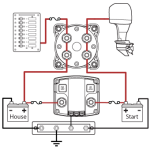
Have decided to start from scratch go with the following wiring diagram from Blue sea but if possible will use my existing battery switch with the same configuration. I feel I understand this whole diagram alot better than whats already on the boat
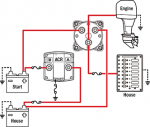
2015-2batt_1eng.png


So in order to put this system together I need some help regarding components and what to purchase???

1) What Automatic Charge Relay Should I buy did find this one on ebay???

http://www.ebay.co.uk/itm/140Amp-12v-SPLIT-CHARGE-RELAY-FULLY-AUTOMATIC-/141720881013?epid=1188797466&hash=item20ff390775:g:ndYAAOSwu4BVqMa1

2) What is the Ideal Positive Wire Cable Size from both the batteries to the switch (Run is about 4-5ft) and do I need a different size from the battery switch to the 12 Blade fuse panel and again size from each battery to the ACR???

3) What Battery Terminal Post connections should I use???

4) As I understand correctly there are fuses between the Batteries and the ACR what is the best Option???

5) Diagram shows a fuse between the battery switch and the switch panel but I have a Blue sea 12 blade fuse panel which will then connect to the switch panel do I still need that fuse???

6) Again Diagram shows Negatives going to something what do you suggest???

Many Thanks
 
The negatives from motor and switch go back to the battery normally via the battery monitor shunt, as said the drawing is not very good
 
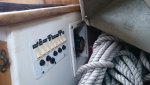
What do you mean?? I will have help putting this together but when it comes to getting it all together. If you mean the battery switch I have the original large black One fitted as standard with three poles with positions On Off 1&2 or I would look at purchasing another
 
Best view I have at the mo as not at the boat

ATTACH=CONFIG]66578[/ATTACH]
 

Attachments

  • 37192485010_d7e16c2d38_z.jpg
    37192485010_d7e16c2d38_z.jpg
    60.9 KB · Views: 6
What do you mean?? I will have help putting this together but when it comes to getting it all together. If you mean the battery switch I have the original large black One fitted as standard with three poles with positions On Off 1&2 or I would look at purchasing another

Many older boats end up with a mish-mash of good/bad, old/new, well done and bodge jobs. A change of owner often means the mess gets sorted. Unfortunately, you seem to be designing a "from scratch" system with all of the bad points i just mentioned. So, on the assumption that you want a decent system ;

Dump the old isolator switch. Don't buy the cheapest, nastiest Ebay junk you can find, your fuse panel is good quality, stick with that theme or you may as well not bother.

Fit an isolator switch for the domestics and another for the engine, ideally with a 3rd one for emergency use. A decent VSR from Victron will do you nicely. We'll need to know how many batteries you have and lengths of cable run to give a better idea of cables sizes.

Do you have the tools to make up good crimped battery and charging cables ? If not a hydraulic crimper from Ebay would be a good investment.
 
What do you mean by Isolator switches??? would I not need the battery switch???
One thing I like about the above diagram concept (Sourced From Blue Sea) is its simplicity even I can understand how it goes together connects up and works. which is something I like the idea of if ever caught out at sea.


Another option I considered is the is using the Blue Sea Dual Circuit Switch. But using the Victron VSR as suggested
instead of the part that comes in the add a battery kit which would also save £50 on that kit Price

37450559261_2ea2524f74_o.png

From Battery to existing battery switch position is 4ft I have 1 Leisure Battery and 1 start battery

Again image sourced from Blue Sea
 
Last edited:
What do you mean by Isolator switches??? would I not need the battery switch???
One thing I like about the above diagram concept (Sourced From Blue Sea) is its simplicity even I can understand how it goes together connects up and works. which is something I like the idea of if ever caught out at sea.


Another option I considered is the is using the Blue Sea Dual Circuit Switch. But using the Victron VSR as suggested
instead of the part that comes in the add a battery kit which would also save £50 on that kit Price

Having two separate isolator switches, one for the start battery, one for the house battery, avoids the potential confusion of a 1-2-Both switch. There's no chance of setting the switch wrongly and finding yourself with a flat starting battery. A VSR takes care of distributing the charge current automatically. However, the Blue Sea Dual Circuit switch is a suitable alternative, as it's essentially two on/off switches in one unit.
 
What do you mean by Isolator switches??? would I not need the battery switch???
One thing I like about the above diagram concept (Sourced From Blue Sea) is its simplicity even I can understand how it goes together connects up and works. which is something I like the idea of if ever caught out at sea.


Another option I considered is the is using the Blue Sea Dual Circuit Switch. But using the Victron VSR as suggested
instead of the part that comes in the add a battery kit which would also save £50 on that kit Price

View attachment 66582

From Battery to existing battery switch position is 4ft I have 1 Leisure Battery and 1 start battery

Again image sourced from Blue Sea

Battery switch = isolator switch.

The benefits of three switches include, one switch turns on the domestics, one turns on the engine battery, the 3rd is your emergency switch, you turn it on if the engine battery is flat and you can start the engine using the domestic battery, for instance. If the engine battery failed due to internal shorting you can turn it off and turn the emergency switch on, using the domestic battery for everything.

The Blue Sea switch is very similar in use, except that you cannot isolate the faulty battery, you'd need to disconnect it. It is, however, a million times better than the 1-2-both switch that you have now.

Cables sizes : Positive cables from engine battery to isolator and from isolator to starter, domestic battery to isolator all 35mm. Negative cable from battery to battery and batteries to engine all 35mm. If using three switches, interconnecting cables 35mm.

Negative from domestic battery to busbar and from isolator to busbar/fuse panel, VSR to batteries or isolators* at least 10mm.

* Technically, the VSR can be connected to the positive terminals of each battery or to the battery terminals of the isolators, whichever is easiest/requires the shortest cables.

If fitting the Blue Sea switch, the wiring diagram you posted is almost correct. I would connect the VSR to the battery terminals of the switch (very short cables) and put the fuses in the battery cables, next to the batteries. That said, there are cases where there is no point in fusing the battery cables. If they are located in an area where they cannot short there is little point fusing them. (Awaiting flaming).
 
What size wiring you need will depend on how much current you need it to take.
If your engine is as pictured, an outboard, the charging current probably is not huge. So little benefit in big cable.
If it's an inboard with a big alternator, life is very different.
If you want to charge the house batteries as effectively as possible, consider moving the alternator feed to the house battery and using the VSR to charge the engine battery.
The resistance of the extra wiring and two fuses can reduce the charge rate more than you might think.
If you can easily swap the leads to start the engine from the house battery, there is no need for an 'emergency' link switch. However if swapping is not easy, then you are losing an option which the much-derided 1both2 switch provides.
1both2 switches are fine for people with the discipline to use them correctly. Many of the old ones seem to be well made and more reliable than todays isolator switches, which is why there are still so many about. It's worth making sure you carry the spanner and the cable is long enough to bypass the isolator by putting both wires on one terminal.

A voltmeter is a good addition for very little money, a push button to connect it to either battery is one option.

A lot depends on how you intend to use your boat, but IMHO, most people would be best considering bigger batteries and some solar panels ahead of wizzy charging gadgets.
The other main thing IMHO, is to really understand whatever system you have and its pros and cons.
 
Oki Cool now I get it was leaning towards the blue sea Dual circuit after seeing a 6 part youtube video on boat electrics but thought if I can use the original it would save money but if you say its better then happy to go that way. is the Victron VSR essentially the same thing that comes in the blue sea Add a battery kit. which is £163 where as the Dual Circuit is £70 and the victron £40

Engine is a Volvo MD11C Inboard which does have a manual cranking handle, I do already have a 100watt solar panel fitted to the House battery via a charge controller
 
Do you want the solar panel to charge the engine battery, e.g. if you don't use the boat for a while?
You could have the VSR control that.
 
Did you manage to find a marine electrician to sort out the smoking wiring after your last attempt at re-wiring? Could he not help you with this?
 
Not yet but tbh if I go with the Second diagram could probably sort it out myself with help from my brother who knows his stuff but busy. One of the reasons I like the simplicity of it.
 
Top