Battery question

When you see a battery advertised as being 90ah, 100ah, 250ah etc, it's almost always at the 20ah rate. This is so people can make an at a glance comparison of a batteries capacity. If different manufacturers quoted different discharge rates it would be more difficult to do that. This does not mean it's a set in stone capacity, various factors will affect the useful ah's. A major factor is the rate at which it's discharged, the faster you discharge a battery, the lower the number of ah you get. If a battery has a stated ah capacity of125 at a 20hr discharge rate, that doesn't mean it's the most ah you can get from it. If you discharge it slower (subject it to less load), you get more ah.

Sorry, i don't know how to explain it any simpler than that, if you still don't get it, Goggle a few battery spec sheets etc.
 
I'm afraid you're showing your ignorance here. Battery capacity varies according to how quickly it's discharged. This is due to the Peukert effect - Google it if you'd like to understand it.

I am fully aware of Peukert. I am also aware that you do not get more out than you can get in.

I also mentioned the chemical action affecting the amount you get out ...
 
When you see a battery advertised as being 90ah, 100ah, 250ah etc, it's almost always at the 20ah rate. This is so people can make an at a glance comparison of a batteries capacity. If different manufacturers quoted different discharge rates it would be more difficult to do that. This does not mean it's a set in stone capacity, various factors will affect the useful ah's. A major factor is the rate at which it's discharged, the faster you discharge a battery, the lower the number of ah you get. If a battery has a stated ah capacity of125 at a 20hr discharge rate, that doesn't mean it's the most ah you can get from it. If you discharge it slower (subject it to less load), you get more ah.

Sorry, i don't know how to explain it any simpler than that, if you still don't get it, Goggle a few battery spec sheets etc.


I agree with this - I am fully aware of the effects of rates of discharge. Its based on various factors such as Internal Resistance, which varies as the battery temperature changes and Peukerts effect.
Peukerts of course is based on a calculated factor K for each battery and is used to determine that reduction in apparent capacity during discharge. Unfortunately Peukerts ignores a significant factor - Temperature rise of the battery as it discharges at high rates. (It also only states what output you can get at that rate .. it does not include declining amp rate discharge - but that's another matter not for debate here).

The interesting fact is that even though a high rate of discharge gives an apparent reduced output - letting the battery settle and then applying a lower rate of discharge will gain further output. This is most evident when you try starting that reluctant engine and battery drains .... You switch off and 5 mins later turn key again to find battery turns it over again.

Whether its Lead Acid or Lithium batterys as I use virtually every day - Capacity is a fixed amount for a cell - you cannot get out more than you put in. As PRB says - Lead Acids are quoted at 20A rate ... which for majority of Lead Acids other than SLA - is a figure that does not unduly stress a Lead Acid. It gives a very good representation of its near max capacity. The amount of extra A/Hr that would be found if discharge rate is ie 5A - would not normally be great enough to worry about.... but of course is advantage.

When I go to buy a battery - I want to know 3 things : 1. Total design nominated capacity (A/Hr) 2. Its max recc'd discharge rate (C) 3. Its max recc'd charge rate (C). If its a starter battery - then 4. CCA rate.

Despite what some think - I am not arguing against the factor of Peukerts and the 90 A/hr at high discharge rate ... I originally stated that the battery in question is by the industry standards a 125 A/Hr battery. I assumed that the OP would not be aware of the difference for the 90 and 125 on left of label. My wording was poor - I agree.

Just to finish off : Here's the datasheet for the 12 FS 125 - which clearly states confirming my point - design capacity 125 A/Hr.

http://www.ffsolar.com/products/pdf/Rolls_12FS125.pdf
 
I agree with this - I am fully aware of the effects of rates of discharge. Its based on various factors such as Internal Resistance, which varies as the battery temperature changes and Peukerts effect.
Peukerts of course is based on a calculated factor K for each battery and is used to determine that reduction in apparent capacity during discharge. Unfortunately Peukerts ignores a significant factor - Temperature rise of the battery as it discharges at high rates. (It also only states what output you can get at that rate .. it does not include declining amp rate discharge - but that's another matter not for debate here).

The interesting fact is that even though a high rate of discharge gives an apparent reduced output - letting the battery settle and then applying a lower rate of discharge will gain further output. This is most evident when you try starting that reluctant engine and battery drains .... You switch off and 5 mins later turn key again to find battery turns it over again.

Whether its Lead Acid or Lithium batterys as I use virtually every day - Capacity is a fixed amount for a cell - you cannot get out more than you put in. As PRB says - Lead Acids are quoted at 20A rate ... which for majority of Lead Acids other than SLA - is a figure that does not unduly stress a Lead Acid. It gives a very good representation of its near max capacity. The amount of extra A/Hr that would be found if discharge rate is ie 5A - would not normally be great enough to worry about.... but of course is advantage.

When I go to buy a battery - I want to know 3 things : 1. Total design nominated capacity (A/Hr) 2. Its max recc'd discharge rate (C) 3. Its max recc'd charge rate (C). If its a starter battery - then 4. CCA rate.

Lots of busy Googling i see.

Despite what some think - I am not arguing against the factor of Peukerts and the 90 A/hr at high discharge rate ... I originally stated that the battery in question is by the industry standards a 125 A/Hr battery. I assumed that the OP would not be aware of the difference for the 90 and 125 on left of label. My wording was poor - I agree.

No, what you said was "
The label at first appears confusing ... but the Version number to right clears up most of it.

The ref to 90 and 125 A/Hr is a generic label .. the battery is in fact a 125 A/hr ... "

You went on to say "the Battery Model Number clearly shows it to be a 125 A/Hr max unit. "

and

"the fact the battery is at MAX CAPACITY a 125 A/Hr ..... clearly stated in its model ID : 12 FS 125 "

etc etc.

Just to finish off : Here's the datasheet for the 12 FS 125 - which clearly states confirming my point - design capacity 125 A/Hr.

http://www.ffsolar.com/products/pdf/Rolls_12FS125.pdf

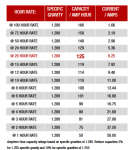
The data sheet was linked to way back in post #2, along with the correct answer to the OPs question. But anyone can see from the data sheet that it absolutely does not confirm anything you said. Rather, it confirms that the capacity varies according to the rate of discharge and can be as high as 166ah or as low as 50ah. There is no mention of a "design capacity" because it is simply impossible to have such a fixed figure.
 
Lets stop this right now .... you know full well that the reason for a lower figure at the higher rate is down to chemistry. The higher the rate - the less you will get out due to constraints on the chemical processes. It does not change the fact the battery is at MAX CAPACITY a 125 A/Hr ..... clearly stated in its model ID : 12 FS 125

With your statement ... the implication is that at 40 hrs it would be ~200 A/Hr ....

Good bye.

If you read the link in post#2, Rolls state the 50hr capacity at 149AH, 100 hr rate 166 AH. But what do they know they only make them.

1579602766865.png
 
Hi,

As a chartered electrical engineer of over forty years experience, I find reading this thread painful. There is confusion between Amps and Amp hours, confusion about how to present a simple division, and another appearance of that obscure unit "Amp per hour" (an Amp is 1 Coulomb per second).

If any non technical readers wish to get any useful guidance out of it, they would best, imho, pay attention to the lostings of Paul Rainbow - I've never met him, but what he has written here makes good sense.

Peter.
 
As a chartered electrical engineer of over forty years experience, I find reading this thread painful. There is confusion between Amps and Amp hours, confusion about how to present a simple division, and another appearance of that obscure unit "Amp per hour" (an Amp is 1 Coulomb per second).

I'm afraid that the confusion over A and Ah is a regular feature of any electrical threads here. Fortunately, it's usually possible to understand what people actually mean.
 
Top