Battery compartment ventilation

CT846

New Member
Joined
10 Jan 2025
Messages
11
Visit site
I'm in the process of updating the wiring in my '80s Scotland based yacht (lots of corroded copper cable being replaced with correctly gauged tinned copper). I'm also upgrading the charging circuits using Victron equipment (Orion XS, Blue Smart, SmartSolar MPPT, Smart shunt etc). The plan is to use my existing Lead Acid batteries (2 x 140Ah) but with the future option of changing to LifePo4 (say 300Ah). There is no intention for running 'high power' inverters, so I will be dealing with modest 12v usage & charging currents (say max 60A combined alternator / solar charging).

I am also taking advantage of moving the location of the house batteries from their current position under a seat / bunk in the saloon to in a unit next to the Nav station.

My question is about ventilation. The current battery location is unventilated. I'm understand the need to vent potential hydrogen build-up from charging lead acid batteries & also the advice to provide 'suitable ventilation' for gases that could be produced by LifePo4 batteries if they overheat. From the new battery location there is the potential to run some ventilation ducting up and out to the cockpit, although space is reasonably tight.

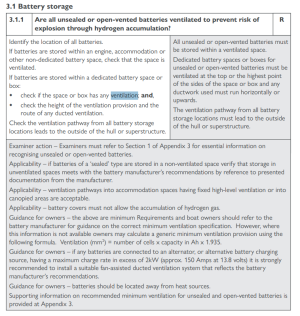
What is considered 'suitable ventilation'? I'm unable to find any guidance to ventilation pipe diameter or cross-sectional area. I understand that two ventilation ducts are better (one high & one low) and also that there's the potential to use (computer) fans to help force ventilation if required. Does anyone have any experience of adding ventilation ducting?
 
I'm in the process of updating the wiring in my '80s Scotland based yacht (lots of corroded copper cable being replaced with correctly gauged tinned copper). I'm also upgrading the charging circuits using Victron equipment (Orion XS, Blue Smart, SmartSolar MPPT, Smart shunt etc). The plan is to use my existing Lead Acid batteries (2 x 140Ah) but with the future option of changing to LifePo4 (say 300Ah). There is no intention for running 'high power' inverters, so I will be dealing with modest 12v usage & charging currents (say max 60A combined alternator / solar charging).

I am also taking advantage of moving the location of the house batteries from their current position under a seat / bunk in the saloon to in a unit next to the Nav station.

My question is about ventilation. The current battery location is unventilated. I'm understand the need to vent potential hydrogen build-up from charging lead acid batteries & also the advice to provide 'suitable ventilation' for gases that could be produced by LifePo4 batteries if they overheat. From the new battery location there is the potential to run some ventilation ducting up and out to the cockpit, although space is reasonably tight.

What is considered 'suitable ventilation'? I'm unable to find any guidance to ventilation pipe diameter or cross-sectional area. I understand that two ventilation ducts are better (one high & one low) and also that there's the potential to use (computer) fans to help force ventilation if required. Does anyone have any experience of adding ventilation ducting?
Little note of caution. If using a computer fan it should be on the input side of the vent. system, you don't want to be dragging hydrogen over something that could cause a spark :eek: As for for vent pipe anything 50 mm or above and yes an inlet and outlet would be ideal.
 
I'm in the process of updating the wiring in my '80s Scotland based yacht (lots of corroded copper cable being replaced with correctly gauged tinned copper). I'm also upgrading the charging circuits using Victron equipment (Orion XS, Blue Smart, SmartSolar MPPT, Smart shunt etc). The plan is to use my existing Lead Acid batteries (2 x 140Ah) but with the future option of changing to LifePo4 (say 300Ah). There is no intention for running 'high power' inverters, so I will be dealing with modest 12v usage & charging currents (say max 60A combined alternator / solar charging).

I am also taking advantage of moving the location of the house batteries from their current position under a seat / bunk in the saloon to in a unit next to the Nav station.

My question is about ventilation. The current battery location is unventilated. I'm understand the need to vent potential hydrogen build-up from charging lead acid batteries
If your LA batteries are venting more than a tiny amount when on bulk charge you have a problem. Hydrogen is lighter than air anyway, so will quickly disperse. It is possible that a faulty battery or charger can cause excessive venting, but even so, it's unusual for battery compartments on boats to have vent pipes. No reason why you can't fit something simple, such as a pipe from the top of the battery compartment to the outside. Only needs to be a small pipe and certainly no need for fans.
& also the advice to provide 'suitable ventilation' for gases that could be produced by LifePo4 batteries if they overheat.
If your LFP battery is overheating and venting gas you have a very serious issue, the BMS should not allow the battery to overheat in use. LFP cells are sealed, so no need/point in providing ventilation for venting. If the batteries are in a location where the ambient temperature can adversely affect the battery then venting might be needed and a fan would likely be needed too. Such venting would need to be automatically controlled, you would not want fans running continuously. But, better to install in a more suitable location.
 
Great, thank you for the advice. I totally agree that, with a correctly designed system, there shouldn't be any serious amount of gases produced, however I'm very conscious of the potential issues around insurance & some of the recent advice / guidelines / standards about lithium installs. It makes sense to address that now while everything's in bits!
 
Great, thank you for the advice. I totally agree that, with a correctly designed system, there shouldn't be any serious amount of gases produced, however I'm very conscious of the potential issues around insurance & some of the recent advice / guidelines / standards about lithium installs. It makes sense to address that now while everything's in bits!
Link to LFP standards that require ventilation for gassing please ?

If your system is so designed that it allows the LFP battery to overheat and vent gas, you are doomed.
 

That's for commercial vessels, not relevant to leisure boats.


That is not a standard, that is just ridiculous nonsense from an insurer who does not have a clue about LFP. If you wish to follow this advice you will not be able to comply with a LFP installation.

https://www.havenkj.com/guides-and-tips/lithium-ion-battery-guidance/
ISO 23625:2025 (para 7), although I haven't been able to find a full online excerpt of this paragraph.

Still not a standard.

Any talk of gassing LFP in a correctly spec'd system is nonsense, as i said earlier, the cells are sealed, they do not vent.
 
That's for commercial vessels, not relevant to leisure boats.


That is not a standard, that is just ridiculous nonsense from an insurer who does not have a clue about LFP. If you wish to follow this advice you will not be able to comply with a LFP installation.

https://www.havenkj.com/guides-and-tips/lithium-ion-battery-guidance/


Still not a standard.

Any talk of gassing LFP in a correctly spec'd system is nonsense, as i said earlier, the cells are sealed, they do not vent.
Yes, I appreciate that, however if it's the case of making minor adjustments at the design stage in order to avoid problems of insurance it's certainly worth considering, regardless of whether we think their reasons are nonsense. Two 50mm vent pipes should be achievable in my scenario.
 
Yes, I appreciate that, however if it's the case of making minor adjustments at the design stage in order to avoid problems of insurance it's certainly worth considering, regardless of whether we think their reasons are nonsense. Two 50mm vent pipes should be achievable in my scenario.
Which insurance company are you with that accepts DIY LFP installs ?
 
I'm not at the moment, hence the "for but not with" approach & hope that things become more sensible in due course.
OK, i was interested because at the moment insurance companies seem to fall into two camps, not interested in LFP or if they are, no DIY installs.

As for fitting a vent, i said in post #3 "No reason why you can't fit something simple, such as a pipe from the top of the battery compartment to the outside. Only needs to be a small pipe and certainly no need for fans."

2x 50mm vents for gassing is excessive, even for LA. LA batteries have vent holes in them, about 3mm. LFP are totally sealed, if they are creating gas you have a very badly designed system and something is seriously wrong. Such a system will certainly not comply with the requirements of an insurance company that's interested in an LFP installation.

However, feel free to fit whatever vents you want, it's your boat.
 
Top