Batteries

petem

Well-Known Member
Joined
16 May 2001
Messages
19,161
Location
Cotswolds / Altea
www.fairlineownersclub.com
At work we have an expression "technical suicide" for those questions that you REALLY REALLY should know the answer to but don't. Colleagues generally roll their eyes, take the piss, etc when one of these questions is asked but it has to be done.

Anyhow here's a question that I should know the answer to but don't (so be kind)....

When I'm off shore power, how do I tell that my batteries are getting low in charge? Will I see the voltage drop on the 12v panel? Is there a point at which I should switch off the 12v supply in order to save my batteries?
 
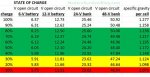
for a resting battery - ie one with no charge being added, or no charge being taken:-

12.8v - 12.9v = fully charged

12.0 = totally dead

switch off batteries at around 12.4v ? maybe

If you're running systems off the batteries when you take the voltage measurement ,these numbers will be lower. They could be substantially lower if running a 'hungry' device.
 
Last edited:
You can get capacity battery monitor gauges / instruments which will give a far greater accuracy but if your batteries are good a simple voltage check should give you a good indicator 12.6 and above is fully charged, 11.5V is considered flat and AFAIC 12.0V is when I start considering recharging so as not to damage the battery longevity. EDIT (These being Deep Cycle House Batteries btw)
 
Last edited:
Check resting voltage, ie no load or charge for at least 1hr so that any surface charge after charging has dropped or the battery has recovered after any previous load has been switched off. Try to never let them get below 50% state of charge.
Image1.jpg
 
Victron BMV or NASA.

+1

As far as I understand it, voltage in itself isn't the best way to measure how much charge you have left in your battery bank.
A (relatively low cost) battery monitor measures current flow and voltage over time and computes the amount of power left in the battery bank.
I fitted a Victron BM series monitor about 9 years ago.
Once set up, it will display the amount of power left in the battery as a percentage.
There are other pages on the display like TTG (time to go) etc.

To install, you fit a shunt onto the battery - essentially a big resistor that enables the monitor to calculate the current drawn from or to the battery bank.
The actual Victron BM monitor then plugs into the shunt.

I've just done a quick Google and found this link
https://www.victronenergy.com/battery-monitors/bmv-700
or this one with a built in Bluetooth interface that lets you monitor on a smart phone.
https://www.victronenergy.com/battery-monitors/bmv-712-smart

Ours is an old one but I couldn't manage without it.

About 125 quid on Ebay including the shunt - a must have device.

EDIT
The Victron monitor includes two voltage inputs so that you can monitor the voltage of a second bank - mine is connected to my engine start batteries.
 
Last edited:
At work we have an expression "technical suicide" for those questions that you REALLY REALLY should know the answer to but don't. Colleagues generally roll their eyes, take the piss, etc when one of these questions is asked but it has to be done.

Anyhow here's a question that I should know the answer to but don't (so be kind)....

When I'm off shore power, how do I tell that my batteries are getting low in charge? Will I see the voltage drop on the 12v panel? Is there a point at which I should switch off the 12v supply in order to save my batteries?


The fridge will tell you by switching off ;)
 
+1

As far as I understand it, voltage in itself isn't the best way to measure how much charge you have left in your battery bank.
A (relatively low cost) battery monitor measures current flow and voltage over time and computes the amount of power left in the battery bank.
I fitted a Victron BM series monitor about 9 years ago.
Once set up, it will display the amount of power left in the battery as a percentage.
There are other pages on the display like TTG (time to go) etc.

To install, you fit a shunt onto the battery - essentially a big resistor that enables the monitor to calculate the current drawn from or to the battery bank.
The actual Victron BM monitor then plugs into the shunt.

I've just done a quick Google and found this link
https://www.victronenergy.com/battery-monitors/bmv-700
or this one with a built in Bluetooth interface that lets you monitor on a smart phone.
https://www.victronenergy.com/battery-monitors/bmv-712-smart

Ours is an old one but I couldn't manage without it.

About 125 quid on Ebay including the shunt - a must have device.

EDIT
The Victron monitor includes two voltage inputs so that you can monitor the voltage of a second bank - mine is connected to my engine start batteries.

+1

you're right mike,
the battery voltage can't be used to have a indictaion of its SOF.

a battery voltage should never be below 12.3V, or its damaged !
there are many points in the system (including the battery's internal resistance) where there can be a few 0.1Voltage drop,
so the voltage readings on a usual boat electric panel, are never "accurate" enough for any meaningfull conclusion .
 
@12.3V you have used 30% of full capacity. Do you mean to tell me that I cannot go lower on a deep cycle battery? I'm not quite sure I can agree with this. Starter battery yes, Deep cycle house batteries no.

The OP asked for an indicator. He obviously doesn't have a monitor. How can he tell, his only indicator is his 12V panel. It doesn't really matter in this instance if his batteries now have half their original capacity through age or what ever, the same rule of thumbs re voltage will still apply. Fair enough if he takes a measurement while running an inverter and several domestic appliances he will get a skewed result, but if he should throw the isolator switch and take a measurement he will still get a reasonable idea of his state of charge with respect to his battery capacity whatever condition that may currently be in. Things dont always have to be bigged up to the nth degree here.
 
@12.3V you have used 30% of full capacity. Do you mean to tell me that I cannot go lower on a deep cycle battery? I'm not quite sure I can agree with this. Starter battery yes, Deep cycle house batteries no.

The OP asked for an indicator. He obviously doesn't have a monitor. How can he tell, his only indicator is his 12V panel. It doesn't really matter in this instance if his batteries now have half their original capacity through age or what ever, the same rule of thumbs re voltage will still apply. Fair enough if he takes a measurement while running an inverter and several domestic appliances he will get a skewed result, but if he should throw the isolator switch and take a measurement he will still get a reasonable idea of his state of charge with respect to his battery capacity whatever condition that may currently be in. Things dont always have to be bigged up to the nth degree here.

In principle, I have to disagree with you but I do understand your point.

OK, I do agree that if you don't have anything else, then look at the voltage.

However, the cost of these battery monitors are far less than the cost of replacing the battery bank so, IMHO, it is worth the money to monitor them properly.
I'm no battery expert but, as for deep cycle, I think this is just the construction - they will take a smaller current for longer times
Rather than the usual starter batteries that take massive currents for very short periods.
You should never take a lead acid battery to less than 50% of its amp hour rate.
If you do, it is ?ucked.
Believe me, I've done it lots of times.
This isn't "biggering up" the issue - it is real.
 
We may be talking from the same view but with different emphasis. See my first post to the question. You place greater emphasis than I have. And where as I whole heartedly agree that you can kill your batteries if you abuse them, please bear in mind I am river berthed (no leccy) and without genny so am wholly reliant on battery and must nurse them. My batteries see a shore - charger maybe twice in a season. So I can come from this also with quite some experience and where as your monitor is a nifty little affair it is just that. It does not preserve the batteries. You do. As such it is just an aid to insight on the state of your batteries. And I find that on mine at least just looking at the voltmeter is equally good enough. Fair enough I have a boat in the same size range as the OP. We have 3 or 4 batteries. Whether they last 4 years or 5 years is hardly going to make much difference, and having kids on board I do not restrict their pleasure until the batteries hit 12 V. Then I need to fire up the engines.
 
By then, the battery bank will be ?uggered.
IMHO of course.
And I have form in these matters.

In jest of course.. but on a smaller boat without a genny.. what do you want to do..spend 200 quid to monitor 80 quid batteries merely to tell you go for a long drive or switch everything off?
And agreed..it's the damn fridge!
 
In jest of course.. but on a smaller boat without a genny.. what do you want to do..spend 200 quid to monitor 80 quid batteries merely to tell you go for a long drive or switch everything off?
And agreed..it's the damn fridge!

I quite agree. But when you have 14 of the beggers if you knacker them its get expensive
 
As has been posted a fully charged and rested battery will be ~ 12.8 - 12.9 v and almost dead it will be at 12v, so not too much difference - these levels will drop as load (current flow out) increases. A decent panel voltmeter reading to two decimal points will give a better indication across this small range, but due to the small difference it is essential that the chosen meter is accurately calibrated. Many cheap meters can be adjusted to match a calibrated meter, and this is something that should be done for accurate battery comparison use.

I am afraid my own opinion of the use of intelligent Battery meters is similar to the effectiveness of ashtrays on a motorbike. This is not just because in my own experience the don't work too reliably, but much also depends upon how they and their associated shunts etc have been installed.
 
Top