Daydream believer
Well-Known Member
Dynemapolyester or nylon, or is the core something else?

Dynemapolyester or nylon, or is the core something else?




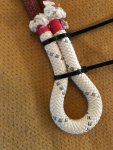
Sorry but the rope joint is in SHEER and the action of the sewn thread is to keep the two in friction - while adding own thread strength .... total of the rope friction + thread then completing the desired result.
If anyone doesn't appreciate the rope friction part ..... watch a professional in a bosuns chair .... when he gets to height ... with one hand - he grips the running and standing ropes together while securing himself in position with the other.
Of course I've resorted to a hard surface to 'push' needle through when too lazy to get my palm .... but in any case - the palm gives better control of the needle .... too often when pushing on a block - the needle goes of vertical ....
Horses for Courses .... I prefer Palm .. you prefer Block.
Dynema
The point I was making that stiching that predominantly holds the cover rather than the core MIGHT possibly lead to failure. There being no bond betwixt cover & core .
A few loops of whipping that might catch the core will not take the full load & could easily snap. The simple loop in the pictures have nowhere near the friction I had in the cleat with several figure of 8 turns under load. If the outer cover stretches the inner core can slide through.
Unbeknown to us the cover had broken under the water as well. I only found that when recovering the airbag & release mechanism. The rope was sold to me by the chandler in good faith (special order of 70M) as 12 or 14mm Marlow cruising Dynema. ( I forget which). I now use 14mm full dynema with no cover.
 ) or your clutch when you already have it secured on your yacht.
Slippage of dyneema inside a cover, especially at a clutch is common place - so much so you should never leave a dyneema halyard under tension in a clutch. Halyards are commonly tensioned similarly when used and the clutch wears the outer cover - and the core can slip which transfers some of the tension to the cover. The cover is not intended to take tension - and it fails. Been there done that.
When the cover fails the halyard pulls up through the slot in the mast but the cover simply bunches up at the slot, as the core slips through. You cannot pull the halyard down, because the cover bunches up inside (as well as outside). You end up with an unrestrained sail and the only method of retrieval is to cut the dyneema (a Herculean task in itself). You don't have a mouse line - no time and replacing the halyard is not as easy as it could be. Retreiving the sail is not easy either, particularly short handed.
To obviate the problem the common remedy is to keep the halyard under tension on the winch drum and not rely on the clutch - except when you release tension (to drop the head sail).
There maybe dyneema cordage with a better and tighter cover where the core does not slip and there may be clutches that better hold the core - but you only really find out the characteristics of your halyard cordage (when you use it - and its too late to take it back
It is well worth checking such halyard for wear, cut the end off and move the wear point progressively (so if you replace a halyard make sure the new one is a bit too long)..
The two halyards that we find wear are for the mainsail and to a much greater extent the unstayed headsail, screecher, Code Zero etc.
Jonathan
See above in RED. All of this assumes I understood you correctly.It seems evident that, watching the testing of multiple sewn splices in the video here that when the standing part stretches under load, it pulls asymetrically past the shorter length to which it is stitched.... thus overloading the stitching at the distant end of the stitching, which gives way sequentially, then the splice fails entirely. Yes, exactly how nylon fails. The stretch of polyester is low enough that it is not a problem if the stitching is close-packed. You have to pack the stitching closely. The stretch of the thread and compression of the rope does compensate for some of the stretch.
It occurs that one could support the distant 'free' end of the eye splice by A: cutting off ~6-8 inches of core from the rope end before offering up then 'bar-tack' stitching together the two full rope-parts, then B: after the 'bar-tacking' stitching had been done, bury the spare 6-8 inches of now-hollow cover fully into the standing part of the rope, using a wire splicing needle, then C: square-stitch through the standing part + hollow cover, securing them together. Clever. It won't help when stitching old rope that are too stiff to splice, but will work in marginal cases. Try it! It would also make the end of the splice very smooth. It might be difficult or impossible to bury the cover in some very tight climbing rope-type covers. (Yacht ropes have loose covers to facilitate splicing.)
It seems to me that doing such would share the increasing load almost equally into both sides of the stitched splice - instead of into only the one side - and consequently increasing the overall load that the splice could support before failure.
It would cost me but a few minutes' extra effort to do that, with the likelihood of an improved max. load at failure.
It seems evident that, watching the testing of multiple sewn splices in the video here that when the standing part stretches under load, it pulls asymetrically past the shorter length to which it is stitched.... thus overloading the stitching at the distant end of the stitching, which gives way sequentially, then the splice fails entirely.
It occurs that one could support the distant 'free' end of the eye splice by A: cutting off ~6-8 inches of core from the rope end before offering up then 'bar-tack' stitching together the two full rope-parts, then B: after the 'bar-tacking' stitching had been done, bury the spare 6-8 inches of now-hollow cover fully into the standing part of the rope, using a wire splicing needle, then C: square-stitch through the standing part + hollow cover, securing them together.
It seems to me that doing such would share the increasing load almost equally into both sides of the stitched splice - instead of into only the one side - and consequently increasing the overall load that the splice could support before failure.
It would cost me but a few minutes' extra effort to do that, with the likelihood of an improved max. load at failure.
To avoid the issue of a broken outer covering bunching & causing a blockage, I am told that the sailors on the larger craft have a simple solution. They remove the cover from the core on the part that enters the clutch & sits on the winch. The cover then only acts as a protector over the pullies etc. Obviously it has to be checked regularly for wear but any blue water sailor would do that as a matter of course.
On my own boat I have a dynema sheath spliced into the jib halyard where it exits the mast & goes through the mast aligner. The rest of the dynema has a very tight cover being a somewhat eye wateringly expensive liros halyard. Same for the mainsail.
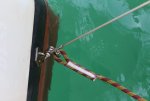
I note your tubular steel 'sheathing' on your shackle-pin, addressing the 'D:d' concern.
