Bar tacking

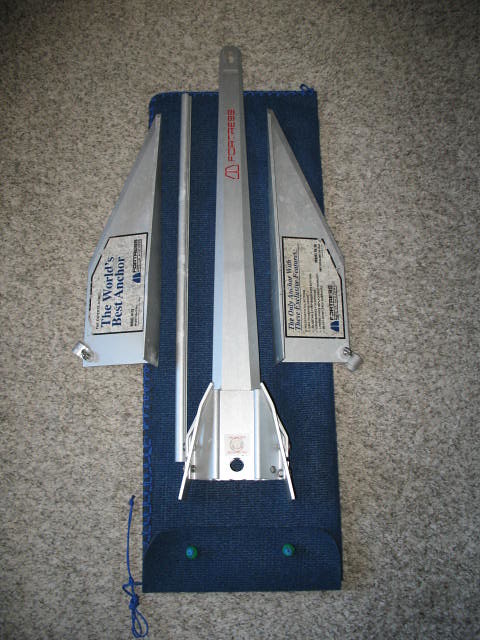
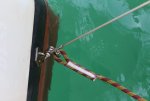
For the avoidance of confusion/speculation, I intend to use the two 90m. lengths of this 'braid-and-parallel-core' 16mm rope as anchor warps, with shortish chain onto two Fortress anchors I have..... which I can carry 'demounted' in bags until wanted. e.g....

52598249838_5c20dbe39c_z.jpg


and

52597241932_7d166b13ee_z.jpg


These store in deep cockpit lockers until wanted. Re-assembly takes under 3 minutes, ready to deploy. I also have an 'adequate' Spade, together with 'adequate' chain, which is kept in my deep bilge until wanted. That benefits my Metacentric Height and thus AVS, something I remain aware of on a small 27' boat.

I have now sealed deck access to the forepeak - the 'navel pipe' - for I do not want seawater ingress there. Nor do I want the weight of 200' of chain in the bows. Chain, rope-rode and anchor will be brought up when wanted. And no, this is not a new idea. It is traditional seamanship....

The concept of 'applied friction' between two parts of a laden rope is intriguing. One needs to recognise the firm grip of a horny bosun's hand applying 'external' friction, and the firm grip of a good braid-on-braid splice applying 'internal' friction. One is, I offer, more reliable in service than the other.....

As for 'them wot can splice and them wot can't be bovvered', I do splice when it's appropriate.... in the past year, 32mm Dockline, 22mm Polysteel, 10mm singlebraid Dyneema, 4mm singlebraid Dyneema. I no longer even consider wire splicing as worth the effort, despite still having the tools.

Happy Hogmanay to a'....!

:)
 
Sorry but the rope joint is in SHEER and the action of the sewn thread is to keep the two in friction - while adding own thread strength .... total of the rope friction + thread then completing the desired result.

If anyone doesn't appreciate the rope friction part ..... watch a professional in a bosuns chair .... when he gets to height ... with one hand - he grips the running and standing ropes together while securing himself in position with the other.

Of course I've resorted to a hard surface to 'push' needle through when too lazy to get my palm .... but in any case - the palm gives better control of the needle .... too often when pushing on a block - the needle goes of vertical ....

Horses for Courses .... I prefer Palm .. you prefer Block.

I think this is a matter of terminology. In post 31 you said "Waxed sailmakers is exceedingly strong for its size and is in sheer when used in this way" which is not technically accurate. In post 37 you correct yourself by saying "the rope joint [as a whole] is in SHEER," which is true, adding that rope-to-rope friction plays a predominant role, which is also true. An unusual case to be sure, with the thread serving mostly to pull the ropes together, and the resulting friction holding most of the load.

As for block vs. palm, either works. I like palms. This is also the only stitching I use a block for.
 

That was the problem. Not enough friction. A simple core burry would have been faster and stronger.

Basically the entire strength come from the core when under tension. Think of the core as a non-stretch steel cable (Dyneema) with a stretchy bungy cord (polyester) reinforcing it. When the tension comes on there is no load on the bungee, even as the cable approaches the breaking point, because it has not stretched and the bungee has not stretched. How strong the polyester cover is hardly matters in the strength calculation. It is there for UV and chafe, but cannot contribute to strength.

Seizings also don't work on nylon. At high load the shrinks as much as 30% in cross section and the seizing gets loose and slips. This kind of speaks to Refueler's comment about friction; for friction alone to work you need an unreasonable thread pre-tention.
 
The point I was making that stiching that predominantly holds the cover rather than the core MIGHT possibly lead to failure. There being no bond betwixt cover & core .
A few loops of whipping that might catch the core will not take the full load & could easily snap. The simple loop in the pictures have nowhere near the friction I had in the cleat with several figure of 8 turns under load. If the outer cover stretches the inner core can slide through.
Unbeknown to us the cover had broken under the water as well. I only found that when recovering the airbag & release mechanism. The rope was sold to me by the chandler in good faith (special order of 70M) as 12 or 14mm Marlow cruising Dynema. ( I forget which). I now use 14mm full dynema with no cover.
 
The point I was making that stiching that predominantly holds the cover rather than the core MIGHT possibly lead to failure. There being no bond betwixt cover & core .
A few loops of whipping that might catch the core will not take the full load & could easily snap. The simple loop in the pictures have nowhere near the friction I had in the cleat with several figure of 8 turns under load. If the outer cover stretches the inner core can slide through.
Unbeknown to us the cover had broken under the water as well. I only found that when recovering the airbag & release mechanism. The rope was sold to me by the chandler in good faith (special order of 70M) as 12 or 14mm Marlow cruising Dynema. ( I forget which). I now use 14mm full dynema with no cover.

You made a good point. Seizings were common and effective back in the days of hemp rope, but with modern ropes they are very, very difficult to make strong, and nearly (or entirely for some materials) impossible to make as strong as the rope. With nylon it is difficult to reach 30% BS.
 
Slippage of dyneema inside a cover, especially at a clutch is common place - so much so you should never leave a dyneema halyard under tension in a clutch. Halyards are commonly tensioned similarly when used and the clutch wears the outer cover - and the core can slip which transfers some of the tension to the cover. The cover is not intended to take tension - and it fails. Been there done that.

When the cover fails the halyard pulls up through the slot in the mast but the cover simply bunches up at the slot, as the core slips through. You cannot pull the halyard down, because the cover bunches up inside (as well as outside). You end up with an unrestrained sail and the only method of retrieval is to cut the dyneema (a Herculean task in itself). You don't have a mouse line - no time and replacing the halyard is not as easy as it could be. Retreiving the sail is not easy either, particularly short handed.

To obviate the problem the common remedy is to keep the halyard under tension on the winch drum and not rely on the clutch - except when you release tension (to drop the head sail).

There maybe dyneema cordage with a better and tighter cover where the core does not slip and there may be clutches that better hold the core - but you only really find out the characteristics of your halyard cordage (when you use it - and its too late to take it back :( ) or your clutch when you already have it secured on your yacht.

It is well worth checking such halyard for wear, cut the end off and move the wear point progressively (so if you replace a halyard make sure the new one is a bit too long)..

The two halyards that we find wear are for the mainsail and to a much greater extent the unstayed headsail, screecher, Code Zero etc.

Jonathan
 
Slippage of dyneema inside a cover, especially at a clutch is common place - so much so you should never leave a dyneema halyard under tension in a clutch. Halyards are commonly tensioned similarly when used and the clutch wears the outer cover - and the core can slip which transfers some of the tension to the cover. The cover is not intended to take tension - and it fails. Been there done that.

When the cover fails the halyard pulls up through the slot in the mast but the cover simply bunches up at the slot, as the core slips through. You cannot pull the halyard down, because the cover bunches up inside (as well as outside). You end up with an unrestrained sail and the only method of retrieval is to cut the dyneema (a Herculean task in itself). You don't have a mouse line - no time and replacing the halyard is not as easy as it could be. Retreiving the sail is not easy either, particularly short handed.

To obviate the problem the common remedy is to keep the halyard under tension on the winch drum and not rely on the clutch - except when you release tension (to drop the head sail).

There maybe dyneema cordage with a better and tighter cover where the core does not slip and there may be clutches that better hold the core - but you only really find out the characteristics of your halyard cordage (when you use it - and its too late to take it back :( ) or your clutch when you already have it secured on your yacht.

It is well worth checking such halyard for wear, cut the end off and move the wear point progressively (so if you replace a halyard make sure the new one is a bit too long)..

The two halyards that we find wear are for the mainsail and to a much greater extent the unstayed headsail, screecher, Code Zero etc.

Jonathan

There was an impregnating treatment for the clutch area of the rope intended to reduce slippage (Spinlock RP25). It also reduces chafe, and I have tested it for that, but I did not test slippage under realistic conditions. Unfortunately, Spinlock discontinued the product due to low sales volume.

I'm working on an alternative formulation, but it's too cold here now for field testing.

On a winch there can be enough turns to generate suffcient internal friction. More problematic for a jammer. I've never focused on the problem, but interesting.
 
It seems evident that, watching the testing of multiple sewn splices in the video here that when the standing part stretches under load, it pulls asymetrically past the shorter length to which it is stitched.... thus overloading the stitching at the distant end of the stitching, which gives way sequentially, then the splice fails entirely.

It occurs that one could support the distant 'free' end of the eye splice by A: cutting off ~6-8 inches of core from the rope end before offering up then 'bar-tack' stitching together the two full rope-parts, then B: after the 'bar-tacking' stitching had been done, bury the spare 6-8 inches of now-hollow cover fully into the standing part of the rope, using a wire splicing needle, then C: square-stitch through the standing part + hollow cover, securing them together.

It seems to me that doing such would share the increasing load almost equally into both sides of the stitched splice - instead of into only the one side - and consequently increasing the overall load that the splice could support before failure.

It would cost me but a few minutes' extra effort to do that, with the likelihood of an improved max. load at failure.
 
It seems evident that, watching the testing of multiple sewn splices in the video here that when the standing part stretches under load, it pulls asymetrically past the shorter length to which it is stitched.... thus overloading the stitching at the distant end of the stitching, which gives way sequentially, then the splice fails entirely. Yes, exactly how nylon fails. The stretch of polyester is low enough that it is not a problem if the stitching is close-packed. You have to pack the stitching closely. The stretch of the thread and compression of the rope does compensate for some of the stretch.

It occurs that one could support the distant 'free' end of the eye splice by A: cutting off ~6-8 inches of core from the rope end before offering up then 'bar-tack' stitching together the two full rope-parts, then B: after the 'bar-tacking' stitching had been done, bury the spare 6-8 inches of now-hollow cover fully into the standing part of the rope, using a wire splicing needle, then C: square-stitch through the standing part + hollow cover, securing them together. Clever. It won't help when stitching old rope that are too stiff to splice, but will work in marginal cases. Try it! It would also make the end of the splice very smooth. It might be difficult or impossible to bury the cover in some very tight climbing rope-type covers. (Yacht ropes have loose covers to facilitate splicing.)

It seems to me that doing such would share the increasing load almost equally into both sides of the stitched splice - instead of into only the one side - and consequently increasing the overall load that the splice could support before failure.

It would cost me but a few minutes' extra effort to do that, with the likelihood of an improved max. load at failure.
See above in RED. All of this assumes I understood you correctly.
 
It seems evident that, watching the testing of multiple sewn splices in the video here that when the standing part stretches under load, it pulls asymetrically past the shorter length to which it is stitched.... thus overloading the stitching at the distant end of the stitching, which gives way sequentially, then the splice fails entirely.

It occurs that one could support the distant 'free' end of the eye splice by A: cutting off ~6-8 inches of core from the rope end before offering up then 'bar-tack' stitching together the two full rope-parts, then B: after the 'bar-tacking' stitching had been done, bury the spare 6-8 inches of now-hollow cover fully into the standing part of the rope, using a wire splicing needle, then C: square-stitch through the standing part + hollow cover, securing them together.

It seems to me that doing such would share the increasing load almost equally into both sides of the stitched splice - instead of into only the one side - and consequently increasing the overall load that the splice could support before failure.

It would cost me but a few minutes' extra effort to do that, with the likelihood of an improved max. load at failure.

It is New Year so I may be slightly befuddled and not quite understanding what you are saying.

I think that Thinwater has alluded to the issue of the rope stretching (for some stitch patterning and thread?) disproportionately compared to the rope itself. Possibly you need to stop the complete eye stretching and use stronger thread. I try to sew both sides of the spice together, through both 'sections' and then sew at 90 degrees through one and then 90 degrees through the other - with dyneema. The finished splice looks a bit like whipping where every 1/4 of the circumference the whip passes through one or both sections.

The cover of some rope (Kernmantle) does not factorially add to the strength, its there as a protective cover rather offering additional strength. Consequently stitching back the cover is not going to add, much. Additionally some covers are tight round the core (Kernmantle, torque ropes) and stitching, burying, any more cover is going to be difficult.

The difference between what you are attempting and what I do is the application. I'm making a bridle or snubber where the fall back is the chain. If my bridle fails it is a bit inconvenient - but I have a spare. Your cordage is the rode, there is no fall back.

The difference between the testing and my application is that the snatch loads (the tension) is mitigated by elasticity. There is no mitigation in the testing - the tension is ramped up and up until it fails. Your application, or your cordage offers some elasticity (not much because you need the ultimate strength) but tensions will be reduced, compared to an inelastic rode, with the elasticity.

Jonathan

Thinwater and my post crossed but we have the same issues with your solution - except I did not think to encourage you to try it (I thought it impossible!)
 
If you were splicing an eye in double braid or dyneema I would suggest a bury, or variation of. You could neaten it up with whipping or sewing.

Your rope you describe as Kernmantle, parallel core, braided outer cover, but looking at your picture it seems a very loose construction, tactile, soft....?? very unlike climbing rope

It may be possible to bury the core, it may be possible to taper, it may be possible to bury the cover (If the cover actually offers much additional strength). I thought what you were suggesting (based on a tight construction and the strength of the cover of the Kernmantle I am used to) an impossibility - but maybe...... :)

Jonathan
 
Re. Stiching nylon rope. I looked back through the testing I did ~ 8 years ago.

  • Using the cover to spread the load farther down the line did not help. Stitched or buried. It seemed like a good idea, I tested it ... and it didn't help, other than neatness.
  • Sandwiching a piece of nylon webbing between the ropes, to control stretch, did help. The idea was tested by the US Army in WW II for chutes. All tests were 93-95% BS, which is as good as any splice.
  • Packing the stitching as tightly as practical helps, hence bar tacking. Really, only the stitching in the first inch makes much difference. The rest is for durability, which is not a mistake.
Polyester rope was always 90-95% if enough stitches were used. Not much stretch, so it didn't much matter.

I did very little testing with Dyneema. Single braid does not hold stitches well and it is super easy to splice anyway, so I could never think of a reason.
 
If I interpret correctly.

Make your sewn splice to produce the eye, take dyneema hollow tape, braid and over sew the dyneema to cover the splice and offer resistance to stretch (and as its for an anchoring application) also offer abrasion resistant to the bar tacking of the eye splice.

The splice will not stretch, it is cemented by the dyneema sleeve. The splice will be abrasion resistant, its covered by the dyneema.

The extra cost is nominal, 1 metre, maybe 2 metre at the outside of braided dyneema tape.

Another option. Cover the section to be spliced with a dyneema sleeve, sew as intended. The whole eye then has a dyneema cover, no stretch, abrasion resistant. The sewing is exposed - shrink cover

J
 
To avoid the issue of a broken outer covering bunching & causing a blockage, I am told that the sailors on the larger craft have a simple solution. They remove the cover from the core on the part that enters the clutch & sits on the winch. The cover then only acts as a protector over the pullies etc. Obviously it has to be checked regularly for wear but any blue water sailor would do that as a matter of course.
On my own boat I have a dynema sheath spliced into the jib halyard where it exits the mast & goes through the mast aligner. The rest of the dynema has a very tight cover being a somewhat eye wateringly expensive liros halyard. Same for the mainsail.
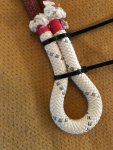
 
To avoid the issue of a broken outer covering bunching & causing a blockage, I am told that the sailors on the larger craft have a simple solution. They remove the cover from the core on the part that enters the clutch & sits on the winch. The cover then only acts as a protector over the pullies etc. Obviously it has to be checked regularly for wear but any blue water sailor would do that as a matter of course.
On my own boat I have a dynema sheath spliced into the jib halyard where it exits the mast & goes through the mast aligner. The rest of the dynema has a very tight cover being a somewhat eye wateringly expensive liros halyard. Same for the mainsail.

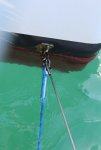
I think I must misunderstand - if you remove the cover 'raw' dyneema becomes uncomfortable and difficult to handle by hand, its too slippery. It will not be held by the clutch because the clutch will not grip the dyneema, its too small (unless you have bought oversized rope) is slippery and under tension flattens out in the clutch and cannot be gripped by the 2 plates. You could buy smaller clutches (but then they might not be strong enough?). Its easier to leave the cover on and replace as the cover wears. Contrarily - removing the cover allows the rope to run more freely, its thinner and more slippery but is still as strong.

The 53' cat I was doing a delivery on as crew - I did not note the halyard until it failed - it was one of those learning experiences you don't forget.

For the big boats they will save weight. Rothmans took all the covers of their dyneema back in the late '80s - they bought from Bridon, whom I also bought from for all the running rigging on our our X-99.

Our screecher we are on our third Dyneema halyard and the mainsail I replaced a week ago, after 23 years.

I cut the offending worn part off the halyard and this gives me about 4m of wastage, I make shackles or double eyed strops (Barber hauling), I've just finished making one from the offcuts to the main halyard, and the long length makes a spare for the other halyards - or a spare anchor warp (with a snubber) or shore line.

As you say - Dyneema is really expensive and our main and screecher halyards are both 2:1 - its not something you would waste.

Jonathan
 
Based on the thread this would be my option:

Buy some dyneema braid, just a dyneema cover (or hollow tape or webbing) to the same size as the cordage. I'd buy enough to completely cover the splice, say 300mm each arm. Being the same size the braid will need to be bunched up to fit and then milked evenly. Once it is 'in place' stretch, milk, it out till its tight (and as with a buried splice it will not move, easily).

I've done this with this 12mm dynamic kernmantle and 12mm Nautilus Braids, NZ, dyneema braid, see picture. This is simply an example of when I was developing the ideas for my bridle/snubbers and initially I had abrasion issues.

I've whipped the ends of the dyneema - but there must be a better way to manage the fraying of the ends of the dyneema braid. I know I could sew the ends into the cover - but I did not have the patience - for this example.

I'd double the dyneema over to form the eye and bar tack, as I have done with the ziplocks/cable ties.

IMG_2974 2.jpeg

I now have the splice made - but if there were still doubts I might buy larger braided dyneema and cover the splice I've just made, so I'd have a double thickness of dyneema where the sewing would be and a single cover for the eye itself. I'd have the extra, outer, cover also bar tacked. I might then add a heat shrink cover to heated the ends and reduce fraying.

The locking of the initial cover with the bar tacking will cement the eye and it will not stretch, the second cover is simple 'belt and braces'. The heat shrink cover will protect the whole assembly and neatens up the ends if the cover is longer than the splice. I would shrink the cover in boiling water, accepted by both Marlow and the makers of Dyneema to not impact the strength of the dyneema. There may be some impact on the splice, due to heat, depends on the cordage but there are 2 lengths of cordage being used.

I have been using bar tacking on my bridle for months - without any issues - the elasticity of the bridle reduces the impact of any snatch loads - adding dyneema to remove the elasticity of the splice is probably overkill - not unnecessary for a crucial feature of an anchor rode.

IMG_4869.jpegIMG_0002.jpeg

The blue rope (bridle) is 10mm kernmantle and the yellow/red rope is also kernmantle but 12mm. We found the 12mm to inelastic and down sized. The bar tacking was completed by the rope maker, as was the heat shrink cover.

Jonathan
 
Top