Bar tacking

What are you using this spliced rope for that requires such a whipping?
A standard whipping across the standing part & the tail should be more than enough for most tasks, in spite of all the tales of whoe posted so far.
Do 2 sets of whipping if you are worried, but probably not really necessary.
If you do want to go down the stitcher route, go & buy a needle, a palm & some waxed whipping twine.
Give you something to do whilst the wife is watching Eastenders
I cannot help thinking that a simple task is being over stated, as if it is something life threatening.
It is only a loop in a bit of string after all.
 
Last edited:
My dear Dd-b....

I've lived long and prospered ( that's true in part ) by having learned as a young and precocious rock-climber back in the days of hemp ropes and tricouni-nailed boots to diffentiate between matters where it don't matter how gash and cavalier I am about the outcome - and other matters where it does matter. That long, tortuous and so far successful process certainly helped me survive more than a decade of occasionally very butt-clenching military flying - including being shot at here and there by folk paid to be good at it - and more than a handful of decades of offshore/inshore racing/sailing which was on memorable occasions a darn sight more dangerous than the preceding.

These days I 'use my superior judgement to avoid situations which may call for a display of my superior skills' to determine where 'Third Best' just won't do. One of these is the attachment of my 16mm hi-spec anchor rode to my hi-spec anchor chain.....and hi-spec anchor.

And yes, it could easily become life-threatening. The reports of events in the Isles of Scilly during Storm Evert are testimony. And I sail there.

You'll have heard of 'The Weakest Link'. That would be a knot of the 'double figure eight' or 'bowline' flavour.

You are, of course, completely at liberty to be as gash and cavalier as you wish to be.... and I wish you luck with that.

:)
 
Reel of sailmakers twine (waxed) .... Sailmakers needles and Palm ....... low temp heat shrink tubing .....

Total cost less than one made by 'shop' ...... AND I would be more confident in MY work than a shops !!

Honestly not trying to be smart or rude .... but such work is quite easy and IMHO good to know how as you never know when you may need to do yourself.

In fact, for stitching rope it works better to place a block of wood on the table, place the needle on that, and press the rope down onto it. Faster and easier. I've done hundreds for testing and use. For 16 mm rope I'd used 0.8-1.0 mm twine, which is 70-90 pound test. You will need 100 passes. Staggering placement helps.

For smaller ropes stitching through both ropes at the same time reduces the number of passes about 30% and reduces exposure to chafe, but this can be difficult at 16 mm.

In this image the stitching goes through both ropes a the same time and then around the outside (the rows of stiching on each side are separate) so fewer stitches are visible (twice as many passes as the machine pattern). I also like to stitch the cover down to make it smoother. This genoa sheet was in service for 8 years until I sold the boat, with a working load of about 1500 pounds. The stitching safety factor at the breaking point of the line is about 50%. doubled 1mm twine, which is about 10-20 times the strength of machine thread,

genoa%2Beye.jpg
 
Last edited:
These days I 'use my superior judgement to avoid situations which may call for a display of my superior skills' to determine where 'Third Best' just won't do. One of these is the attachment of my 16mm hi-spec anchor rode to my hi-spec anchor chain.....and hi-spec anchor.
:)
Interesting comment when you have already informed us that you do not even know what the bit of rope that you originally wanted to splice is.
If I wanted to anchor somewhere dodgy - & I don't- I would use a chain. But to each his own & I do understand your interest in having a decent fixture. Somehow I seem to recall you mentioning mooring warps. Perhaps I was mistaken with another thread.

I cannot say that the whipping shown in the post following looks particularly professional. But once again if it has done the job then it is not an issue ,other than one of tidiness

I note from the original pictures the whipping looks really neat but very close to the edge of each section of rope. I would make the comment that I would be concerned that the core may not be fully constrained. I had a situation when using a 14mm double braid line of several tonnes excess SWL, I was laying a 2.5 tonne sinker. The line was on a cleat with a fair number of turns. The core slid out of the outer cover & the result was that a lump of timber flew up like a javelin. It could have killed someone. Missing 2 people's heads by less than 12 inches
So if you do try your own whipping you may consider checking that the whipping twine does penetrate the core fully. Just a point.
DSC_0003 (2) (600 x 329).jpg
 
Last edited:
In fact, for stitching rope it works better to place a block of wood on the table, place the needle on that, and press the rope down onto it. Faster and easier. I've done hundreds for testing and use. For 16 mm rope I'd used 0.8-1.0 mm twine, which is 70-90 pound test. You will need 100 passes. Staggering placement helps.

For smaller ropes stitching through both ropes at the same time reduces the number of passes about 30% and reduces exposure to chafe, but this can be difficult at 16 mm.

In this image the stitching goes through both ropes a the same time and then around the outside (the rows of stiching on each side are separate) so fewer stitches are visible (twice as many passes as the machine pattern). I also like to stitch the cover down to make it smoother. This genoa sheet was in service for 8 years until I sold the boat, with a working load of about 1500 pounds. The stitching safety factor at the breaking point of the line is about 50%. doubled 1mm twine, which is about 10-20 times the strength of machine thread,


Been using a Palm for over 50yrs ....... and a pair of pliers to extract needle when exits other side.

Waxed sailmakers is exceedingly strong for its size and is in sheer when used in this way ...
 
Reel of sailmakers twine (waxed) .... Sailmakers needles and Palm ....... low temp heat shrink tubing .....

Total cost less than one made by 'shop' ...... AND I would be more confident in MY work than a shops !!

Honestly not trying to be smart or rude .... but such work is quite easy and IMHO good to know how as you never know when you may need to do yourself.

that's what i've been doing ever since I discovered that I was crap at braid on braid splicing; I do sew the two sides together first to prevent slippage and give additional peace of mind.
 
... and a pair of pliers to extract needle when exits other side.

Not been necessary for the diameter of ropes I've ever done (max 14mm) but when it comes to sewing through several layers of sailcloth and perhaps a reinforcement board too, i found that a dremel with a very fine drill bit to pre-drill the holes is helpful.
 
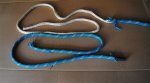
I'm hunting for a business in Southern England that can do THIS for me in 16mm rope.

52593916388_e7bb8240ff_w.jpg


Any pointers?

I might point out that the cordage in the image provided by the OP is kernmantle climbing rope, not braid on braid. 13mm kernmantle is a common size but is not the largest available - though I have only once seen a large diameter kermantle rope. 13mm kernmantle is a devil to knot, the rope construction is not tactile, and even more of a devil to splice - I've never seen a splice being used. Thicker kernmantle has the tactility of a game fishing rod, I had some 14mm made, and you can buy smaller, 8mm and 10mm are again common sizes.

Many of the comments are very valid - for braid on braid but not for a kernmantle construction.

This is 10mm kernmantle but the sewing overlap is, possibly, a bit short. The plastic thimbles have since been dispensed with.

IMG_4760.jpeg
If you need an eye then sewing is the neatest (though this may depend on the individual, the eye of the beholder) and machine sewing the quickest method of making an eye. If you are worried about strength - then have the sewing and overlap longer.

This is a longer overlap - the sewing is a bit crude - but it does the job. Its probably better to simply sew the eye and use a shackle to attach the hook

IMG_4834.jpeg

IMG_4833.jpeg
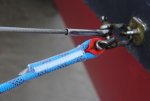
The kernmantle construction is specific, it offers elasticity and the cover offers abrasion resistance and protection of the core (that provides the strength). The 'in built' elasticity ensures that the eye does not take a snatch load - it is minimised by the elasticity. The eye may be constructed holding a chain hook, which might be sewn into the eye or the hook may be attached using a shackle, or using a cow hitched short strop.

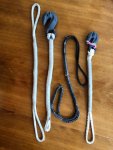
Here are series of spliced dyneema short strops. The right hand strop has a shrunk cover with allow the strop to be stiffened, its a bit like a flexible stick, it makes it easier to clip onto the chain, for those with shorter arms.
IMG_2731.jpeg

The rope construction is such that the cover does not slip, if there is slippage - there is something wrong with the construction.

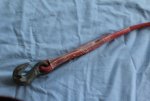
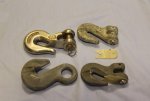
Hooks come in all shapes and sizes, some are well designed, some poorly. Most hooks are either eye hooks, to accept a splice, or clevis hooks to accept a chain link or shackle. Hooks can fall off - it is easy to make a retaining gate, see the stainless hook, but only if its a clevis hook. The 2 right hand hooks were tapped prior to galvanising allowing a little rotating gate to be attached using short Alan keyed bolts.

IMG_4857.jpeg

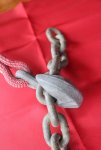
This hook, below, is not perfect but is fairly securely retained on the chain link. The snubber in this case is 3 ply, not as good as Kernamntle in my view, but easier to knot. If you compare the long hook, below, with the cast hooks above - you will note that the base of the jaw of the cast hooks is curved but the long hook has a sharp corner - point loading the link. If your chain fails - it is likely to be poor manufacture or.... point loading
chain lock 10mm.jpeg20220618_105038.jpeg

You could make the eye from a figure of eight knot, which is a common method of attachment - but though easy to make (and safe) it is large and clumsy. A sewn eye is much neater, is safe (as long as it is long enough) and neat.

In answer to the OP - any sailmaker, and maybe a boot repairer in a shopping mall (one that will repair luggage) or an upholsterer would be able to sew an eye - though you might want to specify the thread. You need a sailmaker able to construct large sails, so not dinghy sails. If they can sew the clew or headboard of a sail for 40' yacht - they can sew you an eye. I might specify a 20cm 'seam' and if you want the hook sewn into the eye - take it with you. If you want to use a shrink cover, see my earlier post on shrink covers, take it with you and apply before sewing (its saves having to thread the whole length through the cover). You can then shrink on later. I prefer boiling water to a heat gun or blow torch, just lay the eye in a frying pan of boiling water.

I use braided dyneema fishing line for sewing eyes.

Jonathan
 
... Waxed sailmakers is exceedingly strong for its size and is in sheer when used in this way ...

There is virtually no way in which a thread can be put in sheer, short of scissors. If you examine any of the stitch patterns closely under high load the thread is in tension because of the way the rope distorts. Think about how hard it is to keep scissors sharp, and then imagine a rope accomplishing that. In fact, the turns are quite gradual as a ratio to thread diameter.

As for the block of wood ... try it, you might like it. Yes, I have several palms and know very well how to use them. The block of wood on the bench is faster and easier.
 
Interesting comment when you have already informed us that you do not even know what the bit of rope that you originally wanted to splice is.
If I wanted to anchor somewhere dodgy - & I don't- I would use a chain. But to each his own & I do understand your interest in having a decent fixture. Somehow I seem to recall you mentioning mooring warps. Perhaps I was mistaken with another thread.

I cannot say that the whipping shown in the post following looks particularly professional. But once again if it has done the job then it is not an issue ,other than one of tidiness

I note from the original pictures the whipping looks really neat but very close to the edge of each section of rope. I would make the comment that I would be concerned that the core may not be fully constrained. I had a situation when using a 14mm double braid line of several tonnes excess SWL, I was laying a 2.5 tonne sinker. The line was on a cleat with a fair number of turns. The core slid out of the outer cover & the result was that a lump of timber flew up like a javelin. It could have killed someone. Missing 2 people's heads by less than 12 inches
So if you do try your own whipping you may consider checking that the whipping twine does penetrate the core fully. Just a point.
View attachment 148334
polyester or nylon, or is the core something else?
 
If you read the link to the Med storm, which I find more educational than the Scilly storm report, one of the failures (apart from the chain hook (which bent and fell off) was the inability to be able to add a storm snubber to the everyday snubber being used.

Safety at Sea: Surviving a Powerful Storm in the Med

These are 2 'hooks' both of which I tested and like the one in the Med article, easily bent. AFAIK the Mantus hook was withdrawn (I like to think because of the testing - but maybe they had some failures in actual use) but the claw from Oscalutti is still available.


IMG_5322.jpeg

IMG_5327.jpeg
IMG_5336.jpeg

You can achieve a storm snubber by adding to the one you already have, there are difficulties in doing this - or extend the one you have.

To add a storm snubber - it will be difficult to retrieve the one you have, it means motoring into the wind and simultaneously taking in the snubber and rode, take everyday snubber off, add a bigger one, release rode until snubber takes strain - this is in a wind gusting to 50 knots, say, and rising chop.

Alternatively you could extend your existing snubber having more elasticity to accept the
snatch loads

chain lock 10mm.jpeg

This hook has been designed to allow you to extend the snubber - using the LFR as a 'sheave' rather than an eye for a knot or splice.

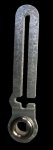
This hook, for a single snubber, is a derivative of these bridle plates (for beefy monohulls or multihulls:

The hook is made from HT steel, and galvanised, the first bridle plate made from high tensile aluminium and the black bridle plate made from Duplex stainless - the plates will not bend :)
IMG_9723.jpeg
IMG_0027.jpeg

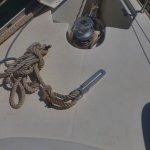
By routing the snubber/bridle from the transom and having 'spare' cordage - you can very simply extend the bridle/snubber with out the need to retrieve the original.

Jonathan
 
Last edited:
There is virtually no way in which a thread can be put in sheer, short of scissors. If you examine any of the stitch patterns closely under high load the thread is in tension because of the way the rope distorts. Think about how hard it is to keep scissors sharp, and then imagine a rope accomplishing that. In fact, the turns are quite gradual as a ratio to thread diameter.

As for the block of wood ... try it, you might like it. Yes, I have several palms and know very well how to use them. The block of wood on the bench is faster and easier.

I use a small steel 10mm plate (its part of my splice kit), I find the needle can penetrate the wood too easily :( - and then needs pliers to retrieve (must find harder wood). - bamboo....??
Jonathan
 
Some one is bound to say

"this is the 21st Century Neeves, this is a perfect application for a soft shackle"

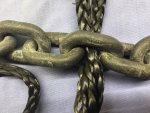
This is 6mm high tensile chain and 6mm dyneema - in practice on a dark wet night it is impossible to thread 6mm cordage through the links to attach the shackle - its difficult enough to thread a soft shackle through the space sitting in the comfort of home. You could of course simply secure round the whole chain - and rely on it not slipping or loosening and falling off.

Each to their own.

IMG_9645.jpeg

Jonathan
 
I might point out that the cordage in the image provided by the OP is kernmantle climbing rope, not braid on braid. 13mm kernmantle is a common size but is not the largest available - though I have only once seen a large diameter kermantle rope. 13mm kernmantle is a devil to knot, the rope construction is not tactile, and even more of a devil to splice - I've never seen a splice being used. Thicker kernmantle has the tactility of a game fishing rod, I had some 14mm made, and you can buy smaller, 8mm and 10mm are again common sizes.

Many of the comments are very valid - for braid on braid but not for a kernmantle construction.

This is 10mm kernmantle but the sewing overlap is, possibly, a bit short. The plastic thimbles have since been dispensed with.

View attachment 148341
If you need an eye then sewing is the neatest (though this may depend on the individual, the eye of the beholder) and machine sewing the quickest method of making an eye. If you are worried about strength - then have the sewing and overlap longer.
I use 10mm dynamic climbing rope for tethers. Ya can't splice it any other way. Try a arborist supplier or climbing shop like Climbing Ropes or Climbing Rope | Climbing accessories and climbing hardware
 
There is virtually no way in which a thread can be put in sheer, short of scissors. If you examine any of the stitch patterns closely under high load the thread is in tension because of the way the rope distorts. Think about how hard it is to keep scissors sharp, and then imagine a rope accomplishing that. In fact, the turns are quite gradual as a ratio to thread diameter.

As for the block of wood ... try it, you might like it. Yes, I have several palms and know very well how to use them. The block of wood on the bench is faster and easier.

Sorry but the rope joint is in SHEER and the action of the sewn thread is to keep the two in friction - while adding own thread strength .... total of the rope friction + thread then completing the desired result.

If anyone doesn't appreciate the rope friction part ..... watch a professional in a bosuns chair .... when he gets to height ... with one hand - he grips the running and standing ropes together while securing himself in position with the other.

Of course I've resorted to a hard surface to 'push' needle through when too lazy to get my palm .... but in any case - the palm gives better control of the needle .... too often when pushing on a block - the needle goes of vertical ....

Horses for Courses .... I prefer Palm .. you prefer Block.
 
As per usual .... from making an eye in a rope - to anchor snubbers .....

Time to unsubscribe from this thread ???

What else is kermantle used for .... on a yacht. If it was any other cordage you can and would splice. The clue is in post 1.

Take care, stay safe - have a great night and hopefully 2023 can be better for all of us.

Jonathan
 
What else is kermantle used for .... on a yacht. If it was any other cordage you can and would splice. The clue is in post 1.

Take care, stay safe - have a great night and hopefully 2023 can be better for all of us.

Jonathan

Post #1 asked about making an eye and possible places to get it done. I cannot find any reference in post #1 about what use its put to ...

As to splice - some people can .. some people can't ....

I wish everyone a great 2023 and many happy days of sailing ...
 
Top