
backup mooring strop: how to attach it?

chal

Well-Known Member
Joined
13 Jul 2010
Messages
581
Location
Valentia Island, Kerry
Visit site
I know this general topic has been covered a lot and everyone has different opinions, but I'd still be interested in any comments:

My MAB lives on a swinging mooring and this year is there over winter. The advice from the local moorings officer is that under these circumstances, a chain backup strop should be used.

My main strop is nylon and passes over the bow roller and loops over the bitts (not in photo). I have occasionally arrived to find that, after stormy weather, the strop has jumped off the roller and passes over the toerail, but it is inside a plastic tube and doesn't seem to cause any damage.

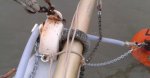
I didn't really want the chain to do this as it's likely to be more destructive, so I have passed it under the roller so it is impossible for it to get free. It can pass through (it snags a bit but doesn't seem to catch too badly) but cannot escape. I had intended to loop it, too, over the bitts but, if I put some protective tube around it, it's a little too short to do this and leave very much slack. Since the nylon must stretch, I wanted the chain to be pretty slack: it's only really intended to take up the strain if the nylon snaps.

You can see the arrangement pretty clearly in the photo. Because the chain wouldn't quite reach the bitts, I've shackled it to a ring on the stem. This seems very strong: the stem is about 12cm wide and 20 deep (oak afaik). The bow roller fitting is bolted through side to side. The eye the chain is shackled to is bolted through the other way, also passing through the iron band on the front of the stem that goes down to the waterline.

My question is: does this seem strong enough, or should I lengthen the chain and use the bitts? The 2 sorts of damage I could imagine (assuming that the nylon has snapped and the chain is taking the strain) are either that the pull ends up being from off the port side and this rips off the roller, or that the eye gives way. Given that the eye is so close to the roller, I don't think it would ever get to the point of there being enough leverage for the former to arise, and the eye gives the impression that you could hit it with a sledge hammer without bothering it very much. The boat was built in 1939 in traditional brick outhouse style.

A more general thought: I really wonder if it's worth having the nylon strop at all? I assume the point is that the stretch in the nylon acts as a bit of a shock absorber, but how much stretch can there really be in a 2 metre strop? The riser chain is about 11 metres (and then there's another 5 metres of really serious chain between the between the riser and the sinker); the max water depth at high springs is about 6 metres so there must be a reasonable amount of give. Most people around seem to use rope of some sort for the strop, but a few use chain, which seems to me to be both stronger and cheaper. I use only chain with the anchor and have never had a problem though I've never been anchored in a really bad storm.
 

Attachments

  • stem.jpg
    stem.jpg
    31.5 KB · Views: 23
I know this general topic has been covered a lot and everyone has different opinions, but I'd still be interested in any comments:

My MAB lives on a swinging mooring and this year is there over winter. The advice from the local moorings officer is that under these circumstances, a chain backup strop should be used.

My main strop is nylon and passes over the bow roller and loops over the bitts (not in photo). I have occasionally arrived to find that, after stormy weather, the strop has jumped off the roller and passes over the toerail, but it is inside a plastic tube and doesn't seem to cause any damage.

I didn't really want the chain to do this as it's likely to be more destructive, so I have passed it under the roller so it is impossible for it to get free. It can pass through (it snags a bit but doesn't seem to catch too badly) but cannot escape. I had intended to loop it, too, over the bitts but, if I put some protective tube around it, it's a little too short to do this and leave very much slack. Since the nylon must stretch, I wanted the chain to be pretty slack: it's only really intended to take up the strain if the nylon snaps.

You can see the arrangement pretty clearly in the photo. Because the chain wouldn't quite reach the bitts, I've shackled it to a ring on the stem. This seems very strong: the stem is about 12cm wide and 20 deep (oak afaik). The bow roller fitting is bolted through side to side. The eye the chain is shackled to is bolted through the other way, also passing through the iron band on the front of the stem that goes down to the waterline.

My question is: does this seem strong enough, or should I lengthen the chain and use the bitts? The 2 sorts of damage I could imagine (assuming that the nylon has snapped and the chain is taking the strain) are either that the pull ends up being from off the port side and this rips off the roller, or that the eye gives way. Given that the eye is so close to the roller, I don't think it would ever get to the point of there being enough leverage for the former to arise, and the eye gives the impression that you could hit it with a sledge hammer without bothering it very much. The boat was built in 1939 in traditional brick outhouse style.

A more general thought: I really wonder if it's worth having the nylon strop at all? I assume the point is that the stretch in the nylon acts as a bit of a shock absorber, but how much stretch can there really be in a 2 metre strop? The riser chain is about 11 metres (and then there's another 5 metres of really serious chain between the between the riser and the sinker); the max water depth at high springs is about 6 metres so there must be a reasonable amount of give. Most people around seem to use rope of some sort for the strop, but a few use chain, which seems to me to be both stronger and cheaper. I use only chain with the anchor and have never had a problem though I've never been anchored in a really bad storm.

FWIW my boat has always been moored using chain only. The chain has a loop in the end which drops over what I suppose you'd call a "bitts" not an ordinary cleat anyway.

I always lash the chain to the bow roller having seen the damage than can occur if the chains jumps off the roller. Sometimes I also put a lashing round the loop so that it cannot lift off the bitts

I think if anything were to fail it would be the chain well down below where any emergency nylon strops could be attached.

The mooring is classed as suitable for a 9m vessel, my boat is only 6m so the chain is of a a very adequate size , in fact anything larger would not fit on the roller.


If I were you I would extend the chain, putting loop in the end to drop over the bits, and lash it to the roller.

Your chain looks very light in the picture
 
Last edited:
I would have turned the eye around so that it poked forward from the stem. Then the pull on it would be straight rather than introducing a sort of turning motion. The answer of course is to buy a longer (and stronger) chain. How much is 3 metres of chain going to cost?

Also, the main corrosion will occur at the water/air interface. I had some similar chain which looked fine above water but the 2 or 3 feet around the water surface corroded quite badly. My chain may not have been very well galvanised.

Can you see what is happening inside that pipe on the strop? Look at this pic of a strop that the cracked pipe has cut through where it passes over the roller.

Mitsybrokenmooring3.jpg
 
Last edited:
FWIW my boat has always been moored using chain only. The chain has a loop in the end which drops over what I suppose you'd call a "bitts" not an ordinary cleat anyway.

I always lash the chain to the bow roller having seen the damage than can occur if the chains jumps off the roller. Sometimes I also put a lashing round the loop so that it cannot lift off the bitts

I think if anything were to fail it would be the chain well down below where any emergency nylon strops could be attached.

The mooring is classed as suitable for a 9m vessel, my boat is only 6m so the chain is of a a very adequate size , in fact anything larger would not fit on the roller.


If I were you I would extend the chain, putting loop in the end to drop over the bits, and lash it to the roller.

Your chain looks very light in the picture

Precisely as I used to do, in the Dyfi estuary, until one day the chain broke the cleat and pulled it and its backing washers through the top of the chain locker. Fortunately the pick-up rope, attached to the pulpit (to keep it out of the water) held and, despite a badly distorted pulpit, the boat didn't follow one (E-boat) to the bottom and 3 others onto the sand.

The reasons for the mayhem was a spring tide, a storm-surge and a Bf 9.

I would suggest that it's probably wiser to use a nylon strop (because of its elasticity) and a chain backup the other way around.
Incidentally none of the boats were big, heavy, long-keelers, all were lightweight go-faster vessels.
Make of that whet you may!!!
 
The chain in your pic secured to the top of the mooring seems to me to be inadequate. I, and others, can see the weak links in your photo. Similarly, you seem to use the ring on top of the mooring buoy, which would transfer all shock loads through the rod to whatever is used to secure the ring-fixing on the underside. Often as not, this is simply a split-pin..... Once that corrodes - which can be blurry fast - then there little to prevent the lower ring-fixing from unscrewing..... As they do.

Ideally, the mooring buoy is secured to the riser chain independent of your strop - chain or rope - and your boat is secured to the top of that hefty riser chain DIRECTLY using a 'bombproof' shackle and boat's mooring chain that you inspect frequently. It's not suggested this is used every time - just when leaving the boat to her own devices.

IMG_1837-2.jpg


Of the major 'enemies' of your mooring security in a big blow, un-noticed corrosion and hard snubbing are the main culprits. You can combat the first by conscientious regular inspection ( and log/record/photograph when you do this and what you find - for the loss adjuster ) and by use of a small car tyre as a 'rubber snubber'. How? Wind your mooring chain 5 or 6 times around the tyre, positioning it so it is closer to the mooring than the bow, and secure to your mooring bits as VicS suggests, and also to the riser chain with a double-cable-tied/moused and BIG shackle.

By all means use your nylon strop as well, if you like, but the above arrangement with 10mm chain should be 'bomb proof' and far more reliable than the majority of your neighbours' lashups. That'll help you sleep at night when the wind gets up and you're several hours fast drive away.

Of course, there will be posters on 'ere who will tell you "I did xyz for years and never had a problem." I found in my research for the recent PBO article on moorings security that a wide range of 'lashups' get by. However, the weather finds out many who 'wing it' each year, as Scillypete's post above shows all too graphically. The insurance companies and brokers' spokespeople tell me they are fed up with owners who don't bother to take quite simple precautions for their boats' security, and are rejecting more and more claims. You don't hear those owners coming on here to tell us how they didn't bother and ended up faced with a bill for thousands due to their neglect.

The OP asks for sound advice. That's good, and there's sufficient expertise around - 'wheat from chaff' - to help. Maybe my above comments will contribute to that.
 
Where I moor, in the Dart, the harbour authority specify and insist, that mooring chains are attached directly to the ring on top of the buoy, with a secondary strop/bridle additionally.
 
The chain in your pic secured to the top of the mooring seems to me to be inadequate.

... use of a small car tyre as a 'rubber snubber'. How? Wind your mooring chain 5 or 6 times around the tyre, positioning it so it is closer to the mooring than the bow, and secure to your mooring bits as VicS suggests, and also to the riser chain with a double-cable-tied/moused and BIG shackle.

By all means use your nylon strop as well, if you like, but the above arrangement with 10mm chain should be 'bomb proof'

The chain I used was 10mm, that was the largest my local chandlery had; I could get some heavier, though you say 10mm bomproof installed as you suggest. Also, I *have* to attach to the top of the buoy - the main riser passes through these hippo buoys, and the swivel at the top is very substantial. Local rules forbid attaching anything below this swivel. The whole mooring is inspected annually (most recently about 10 weeks ago) and is sound, any issues will be with my strop. Because this is entirely above the water at least it's easy to keep an eye on.

I agree that the nylon strop can't be inspected within the tubing and that is a concern, but I had the strop made up exactly as recommended by the mooring officer, and I think chafe would be a big problem without the tube. Overall, I agree that chain seems a safer bet: stronger, easier to keep an eye on, and a fair bit cheaper too, so no problem simply replacing it every 2-3 years.

I don't quite get what you mean about the tyre. I can see that wrapping it the tyre would introduce some give into the system, though as I visualise it the chain would just fall off the tyre, so I've obviously got something wrong.

The boat is a little over 30 feet and probably about 8 tons btw.
 
I don't quite get what you mean about the tyre. I can see that wrapping it the tyre would introduce some give into the system, though as I visualise it the chain would just fall off the tyre, so I've obviously got something wrong.

The boat is a little over 30 feet and probably about 8 tons btw.


Let's try again. It looked to me that the chain size, in your pic, was less than 10mm, so it's reassuring that you have the big stuff. However, the real point is that the shackle you've used to secure the end of your chain to the mooring buoy 'looks to be' of smaller stuff than the chain, and also 'looks to be' one of those insubstantial Chinese farming links that every chandlers sells, but which are NBG for this job.... the legendary Weak Link.

As for wrapping some chain around a tyre, be assured it works very well. I used this arrangement on a Rival 34, overwintering twice, which kept the twinned nylon warps from chafing. Let me try again to describe how to arrange it.....

Visualise the tyre standing upright and you standing astride it. Have a pile of chain to hand, and pass one end through the 16" or 17" empty space - say from left to right. Pass this end back over the top of the tyre from right to left, then down and once more through the centre space from left to right. Repeat this 3 or 4 times, then shackle the end of your chain to the mooring buoy using a BIG tested/lifting shackle. Secure the other end to your mooring bitts on board.

Now, when waves cause the boat to pitch hard, instead of the boat being brought up hard by the rod-straight chain and straining the bitts.... maybe breaking something, the tyre will afford some needed stretch and your mooring bitts and fastenings will be much relieved.
 
Where I moor, in the Dart, the harbour authority specify and insist, that mooring chains are attached directly to the ring on top of the buoy, with a secondary strop/bridle additionally.

Mooring to the top ring is not acceptable with some mooring buoys. eg Anchor Marine rod mooring buoys

mooringlinedrawing.jpg


Presumably the buoys provided by DHNA are suitable
 
To add to what oldbilbo has written above I have seen lots of moorings buoys fail in a blow with the loss of the boat (October 1987). The wields break, the loops shear as do the rods. A simple way to overcome this is to extend the mooring chain from the bottom loop on the mooring buoy and attach it to the loop on the top, then moor the boat to the chain and the loop, the bouy is no longer a structural part of the mooring. A problem with this arrangement is that the boat can suffer gelcoat damage if it can ride up onto the buoy and hit the chain. Better is to pass the chain through the buoy and moor to that - but few buoy designs allow this. Angels and tyres will all help to reduce shock loads but heavy chain is a must to allow for wear and corrosion, in my experience (now over 25 years old) a 3/4 chain with 2X1" warps spliced and shackled on is not too big for a 30ft boat.

EDIT: Vics has beaten my post with a nice diagram but I would attach my mooring lines to the chain NOT the ring on the buoy.
 
Last edited:
To reiterate. The entire mooring system will fail if there is one failure (weak link in the chain).
I do not agree that chain onto the boat is essential but I do think that additional alternative strops are desirable.
The alternative strop should go to a different attachment on the hull. Cleats can let go.
If you use the rod through the buoy as I do then yes it is part of the load path and must be up to the job. Mine has a swivel built into the rod to ring attachment at the bottom.
The local mooring authority supplied the buoy and the first 10000 or so had a 10mm rod. These started to fail so they went to a 12mm rod and then removed the ring on top so you could not use the rod as part of the mooring path.
I had moved to connect at the bottom of the buoy when my rod broke so the buoy itself ended up on the beach but boat OK. They gave me a new heavier rod. I go the old ring drilled out to take the larger rod and now use the rod as a load path. (perhaps a mistake but I feel happy with the heavier rod).
I use 2 rope strops one to the deck cleat (back up) and one to a saddle attached half way down the bow. This is through bolted in a very substantial part of the hull and via a big snap shackle there is no place for chafe even from any other wayward boats.
Because the mooring authority require the use of their buoy which has stainless steel components there was a real corrosion problem when iron shackles were attached. I have gone now for stainless steel chain right down to the mooring mass. There are some other masses (tires filled with concrete) also attached but by rope. The SS seems to be resistant to wear compared to iron. Yes I watch it closely.

I disagree with previous poster who said galvanising may not have been good. Even the best galvanising lasts only weeks before the wear on a chain or shackle takes it off. Galvanising on mooring chain is of no value at all.
Also I disagree about cheap Chinese shackles. The strength of the shackle is not an issue simply becuase they must be so oversized to give a longer wear time. So it is thickness of metal that matters. bigger is better. Far better a 13mm cheap shackle than a 1mm tested good quality. Simply more meat. good luck olewill
 
I disagree with previous poster who said galvanising may not have been good. Even the best galvanising lasts only weeks before the wear on a chain or shackle takes it off. Galvanising on mooring chain is of no value at all.
Also I disagree about cheap Chinese shackles. The strength of the shackle is not an issue simply becuase they must be so oversized to give a longer wear time. So it is thickness of metal that matters. bigger is better. Far better a 13mm cheap shackle than a 1mm tested good quality. Simply more meat. good luck olewill

With regard to Galvanizing, I agree the load bearing surfaces will loose thier coating but the the rest of the galvanizing should act like an anode for those surfaces. So IMHO Galvansing does have some value on mooring systems.

As you say more meat is good heavier chain heavier shackles in the same manner as heavier gear when anchoring, moor wear before the system is significantly weakend... Although I do agree with caution with excessively cheap gear, you only need one weak link and some cheap stuff is seriously :eek:.

I always kept a heavy duty plastic hose over the chain between the riser boat connection to stop the chain damaging the boats hull...

I also avoided putting a loop of chain over a samson post/ cleat/ bits:
It can be difficult to remove underload.
It encourages the wear on the chain to happen on the same links on the fairlead.
 
The entire mooring system will fail if there is one failure (weak link in the chain) ....Cleats can let go.
If you use the rod through the buoy as I do then yes it is part of the load path and must be up to the job. Mine has a swivel built into the rod to ring attachment at the bottom.... The local mooring authority supplied the buoy and the first 10000 or so had a 10mm rod. These started to fail......
.....when my rod broke .....I got the old ring drilled out to take the larger rod and now use the rod as a load path. (perhaps a mistake but I feel happy with the heavier rod)......Because the mooring authority require the use of their buoy which has stainless steel components there was a real corrosion problem when iron shackles were attached..... I have gone now for stainless steel chain right down to the mooring mass.

Also I disagree about cheap Chinese shackles. The strength of the shackle is not an issue simply becuase they must be so oversized to give a longer wear time. So it is thickness of metal that matters. bigger is better.

Sounds like a catalogue of failures. The several mooring authorities consulted for the recent PBO article are agreed that significant corrosion is the primary culprit, and that shows up in a variety of predictable places. One of them is the threads of a shackle pin. It seems that over-enthusiastic and unnecessary tightening of a pin fractures the galvanising coating just where it enters the female thread. Corrosion starts there immediately on immersion in sea water and swiftly proceeds.


IMG_1845.jpg


There is plenty of evidence that the use of poor-quality shackles is a causal factor in moorings failures. Each of the many mooring authorities consulted about this stressed the need to avoid 'cheap 'n nasty' products which have a high rate of failure in moorings applications. Our resident consultant metallurgist has plenty of examples of brittle fracture, severe pitting, and simply wrong composition of metal giving 'not fit for purpose'. So have the marine insurers....

The issue is one of saving a couple of pounds, in the shackle, and risking the loss of thousands, in the boat. That's gambling, with rather poor odds.
 
Last edited:
Mooring to the top ring is not acceptable with some mooring buoys. eg Anchor Marine rod mooring buoys

mooringlinedrawing.jpg


Presumably the buoys provided by DHNA are suitable

My mooring lines are attached to the riser chain. It was like that when i got the mooring so i've not changed it. I'm on a lake however.
 
With regard to Galvanizing, I agree the load bearing surfaces will loose thier coating but the the rest of the galvanizing should act like an anode for those surfaces. So IMHO Galvansing does have some value on mooring systems.

As you say more meat is good heavier chain heavier shackles in the same manner as heavier gear when anchoring, moor wear before the system is significantly weakend... Although I do agree with caution with excessively cheap gear, you only need one weak link and some cheap stuff is seriously :eek:.

I always kept a heavy duty plastic hose over the chain between the riser boat connection to stop the chain damaging the boats hull...

I also avoided putting a loop of chain over a samson post/ cleat/ bits:
It can be difficult to remove underload.
It encourages the wear on the chain to happen on the same links on the fairlead.

We had a lot of experience of mooring to buoys before the hurricane in 1987 that wiped out many of the fleet in the Thames estuary (so what did we know???). Chain in hose to the boat was abandoned years prior because the chain inside the hose had a tenancy to corrode rapidly. Galvanised chain vs white chain was found to have no advantage, indeed we reckoned the galvanised chain corroded faster, anodic corrosion theory would tend to support this observation. BIG and long hawsers with spliced eyes and loops were found to be the best answer and two of them, one a couple of feet shorter than the other to provide some redundancy, these should be pinned and/or lashed to the bow roller or fairlead.

WillH The buoys that failed in 1987 had 30ft yachts on them and 20mm rods and eyes, big beefy kit, or so it seemed, the power of the wind is incredible.
 
Last edited:
Top