

chal
Well-Known Member
I know this general topic has been covered a lot and everyone has different opinions, but I'd still be interested in any comments:
My MAB lives on a swinging mooring and this year is there over winter. The advice from the local moorings officer is that under these circumstances, a chain backup strop should be used.
My main strop is nylon and passes over the bow roller and loops over the bitts (not in photo). I have occasionally arrived to find that, after stormy weather, the strop has jumped off the roller and passes over the toerail, but it is inside a plastic tube and doesn't seem to cause any damage.
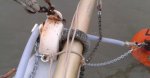
I didn't really want the chain to do this as it's likely to be more destructive, so I have passed it under the roller so it is impossible for it to get free. It can pass through (it snags a bit but doesn't seem to catch too badly) but cannot escape. I had intended to loop it, too, over the bitts but, if I put some protective tube around it, it's a little too short to do this and leave very much slack. Since the nylon must stretch, I wanted the chain to be pretty slack: it's only really intended to take up the strain if the nylon snaps.
You can see the arrangement pretty clearly in the photo. Because the chain wouldn't quite reach the bitts, I've shackled it to a ring on the stem. This seems very strong: the stem is about 12cm wide and 20 deep (oak afaik). The bow roller fitting is bolted through side to side. The eye the chain is shackled to is bolted through the other way, also passing through the iron band on the front of the stem that goes down to the waterline.
My question is: does this seem strong enough, or should I lengthen the chain and use the bitts? The 2 sorts of damage I could imagine (assuming that the nylon has snapped and the chain is taking the strain) are either that the pull ends up being from off the port side and this rips off the roller, or that the eye gives way. Given that the eye is so close to the roller, I don't think it would ever get to the point of there being enough leverage for the former to arise, and the eye gives the impression that you could hit it with a sledge hammer without bothering it very much. The boat was built in 1939 in traditional brick outhouse style.
A more general thought: I really wonder if it's worth having the nylon strop at all? I assume the point is that the stretch in the nylon acts as a bit of a shock absorber, but how much stretch can there really be in a 2 metre strop? The riser chain is about 11 metres (and then there's another 5 metres of really serious chain between the between the riser and the sinker); the max water depth at high springs is about 6 metres so there must be a reasonable amount of give. Most people around seem to use rope of some sort for the strop, but a few use chain, which seems to me to be both stronger and cheaper. I use only chain with the anchor and have never had a problem though I've never been anchored in a really bad storm.
My MAB lives on a swinging mooring and this year is there over winter. The advice from the local moorings officer is that under these circumstances, a chain backup strop should be used.
My main strop is nylon and passes over the bow roller and loops over the bitts (not in photo). I have occasionally arrived to find that, after stormy weather, the strop has jumped off the roller and passes over the toerail, but it is inside a plastic tube and doesn't seem to cause any damage.
I didn't really want the chain to do this as it's likely to be more destructive, so I have passed it under the roller so it is impossible for it to get free. It can pass through (it snags a bit but doesn't seem to catch too badly) but cannot escape. I had intended to loop it, too, over the bitts but, if I put some protective tube around it, it's a little too short to do this and leave very much slack. Since the nylon must stretch, I wanted the chain to be pretty slack: it's only really intended to take up the strain if the nylon snaps.
You can see the arrangement pretty clearly in the photo. Because the chain wouldn't quite reach the bitts, I've shackled it to a ring on the stem. This seems very strong: the stem is about 12cm wide and 20 deep (oak afaik). The bow roller fitting is bolted through side to side. The eye the chain is shackled to is bolted through the other way, also passing through the iron band on the front of the stem that goes down to the waterline.
My question is: does this seem strong enough, or should I lengthen the chain and use the bitts? The 2 sorts of damage I could imagine (assuming that the nylon has snapped and the chain is taking the strain) are either that the pull ends up being from off the port side and this rips off the roller, or that the eye gives way. Given that the eye is so close to the roller, I don't think it would ever get to the point of there being enough leverage for the former to arise, and the eye gives the impression that you could hit it with a sledge hammer without bothering it very much. The boat was built in 1939 in traditional brick outhouse style.
A more general thought: I really wonder if it's worth having the nylon strop at all? I assume the point is that the stretch in the nylon acts as a bit of a shock absorber, but how much stretch can there really be in a 2 metre strop? The riser chain is about 11 metres (and then there's another 5 metres of really serious chain between the between the riser and the sinker); the max water depth at high springs is about 6 metres so there must be a reasonable amount of give. Most people around seem to use rope of some sort for the strop, but a few use chain, which seems to me to be both stronger and cheaper. I use only chain with the anchor and have never had a problem though I've never been anchored in a really bad storm.


 .
.

