Automatic bilge pump routing

PaulGS

Well-Known Member
Joined
15 Dec 2022
Messages
95
Location
The Clyde
Visit site
Fairly straightforward one this! I currently have a manual Whale Gusher (I think it's called) bilge pump and want to supplement it with an automatic one. On an old thread one participant opined that an auto BP could simply be installed in-line with the manual one. I'm sceptical of this idea but I'm sure the forum can reassure me before I go trying to tee into the outlet pipe between the manual pump and the skin fitting. (Thinking about it a bit more, perhaps the in-line fitting would work but might be dependent on the diaphragm of the manual pump being left at a particular point of its 'stroke'?)
[Edit: I've introduced a bit of obfuscation by using the term "in-line". I wished really to establish the viability of using the single current skin fitting.]
 
Last edited:
There must be at least a non return valve between the automatic pump and the skin fitting. Otherwise discharge of the manual bilge pump will be directed (partially) via the automatic pump into your bilges again.
 
There must be at least a non return valve between the automatic pump and the skin fitting. Otherwise discharge of the manual bilge pump will be directed (partially) via the automatic pump into your bilges again.
True, some water could trickle back down absent an NRV. But I judge that the amount would be so minimal as to be able to be discounted.
 
Last edited:
From an experience with a serious leak when a few days out to sea, I was very grateful indeed that the auto bilge pump was in a separate line to the manual pump. Dry bilges for many years meant that all sorts of debris was picked up and clogged the auto filter again and again. Having a larger bore pipe in a different position (about 5 cm above the auto one) meant that we could keep pumping out clean water until we eventually managed to avoid the problem and stop the ingress.
 
I have 2 different bilge pump setups

1) centrifugal pump in line with diaphragm manual pump in line with the outlet going up to under the deck head then down to the skin fitting /seacock.

2) where their is a Y fitting to connect a centrifugal pump in parallel with a diaphragm manual pump both pumps has a separate U bend and the Y fitting is just above the seacock / skin fitting.

Both work fine with no back flow into the bilge
 
From an experience with a serious leak when a few days out to sea, I was very grateful indeed that the auto bilge pump was in a separate line to the manual pump. Dry bilges for many years meant that all sorts of debris was picked up and clogged the auto filter again and again. Having a larger bore pipe in a different position (about 5 cm above the auto one) meant that we could keep pumping out clean water until we eventually managed to avoid the problem and stop the ingress.
Thank you for that. Avoiding having one clogged pump disabling both is certainly a serious consideration!
 
I have 2 different bilge pump setups

1) centrifugal pump in line with diaphragm manual pump in line with the outlet going up to under the deck head then down to the skin fitting /seacock.

2) where their is a Y fitting to connect a centrifugal pump in parallel with a diaphragm manual pump both pumps has a separate U bend and the Y fitting is just above the seacock / skin fitting.

Both work fine with no back flow into the bilge
So you have found that (as per set up 1) an ABP will discharge through a manual pump?
 
So you have found that (as per set up 1) an ABP will discharge through a manual pump?

Yes my diaphragm pumps are henderson MkV which are similar to your whale gusher.

The flow may be slightly lower due to the extra resistance of the whale valves but not significant
 
Thank you for that. Avoiding having one clogged pump disabling both is certainly a serious consideration!
And it was also interesting that the water pumped by the auto was very much less than the manual. Smaller bore pipe and a longer distance with more bends and the resistance of a filter. The manual could easily keep up with the leak, but the auto could not even when unclogged. Manual was Henderson diaphragm and auto Jabsco ParMax 4.

It had been on my list to create a much shorter wider pipe to a new fitting but once I’d fixed the design flaw that led to the leak I just I bought another manual portable pump to drain into the sink.
 
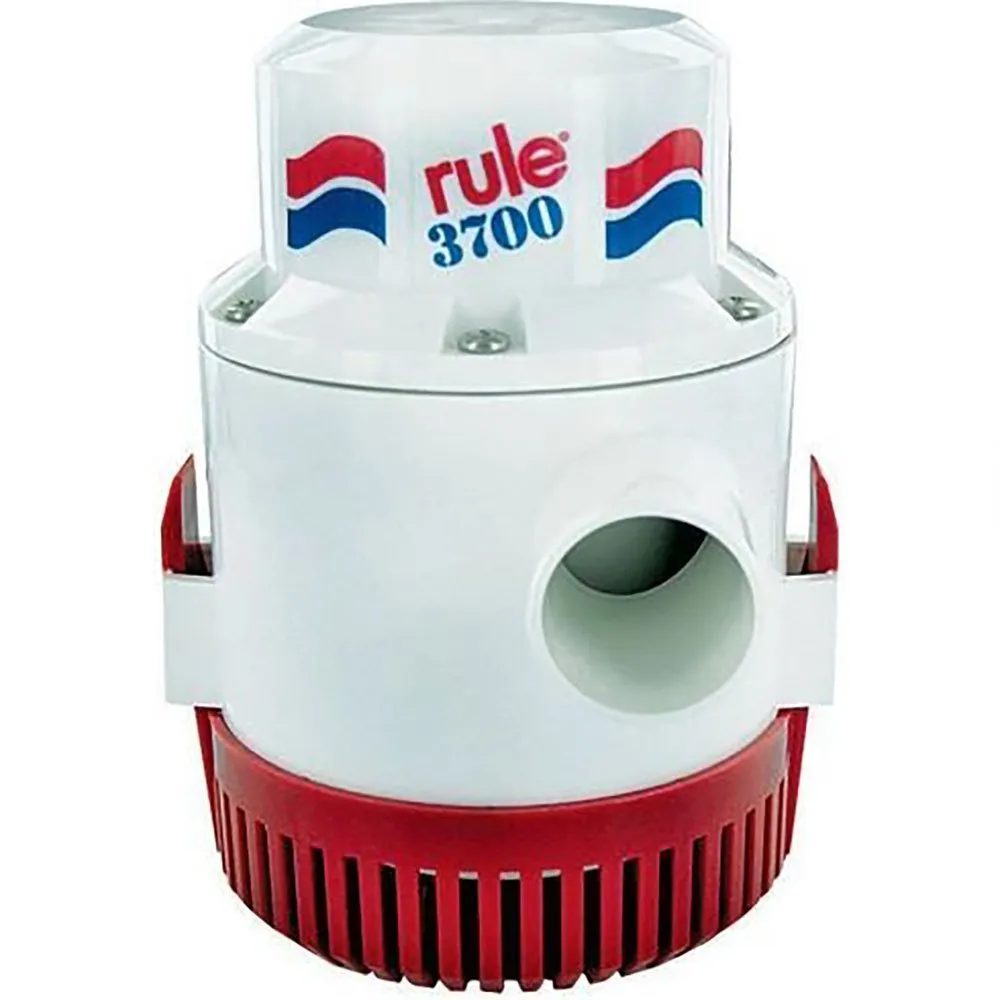
This is the bilge pumps I have

The Jabsco ParMax 4. is not realy a bilge pump moe a fresh water pressure pump

rule-pumps-3700-gph-12v-bilge-pump.jpg
 
That doesn't seem necessary.
Post #4 would suggest otherwise.

Pumping the auto pump through the manual diaphragm means that if there is a blockage in the manual pumps joker valves you don't have a bilge pump. It also means that you cannot effectively use both at the same time.

Fitting T or Y connectors with NR valves also seriously reduces the flow. You could fit a Y connector close to the through hull, without any NR valves, which does work, but again, you are restricting flow, everything from both pumps would have to pass through a single through hull. If you've run two pipes all the way to the through hull it would make more sense to fit a second through hull.
 
My auto bilge pump connects via Y to the sink overboard - which has a valve at hull face to close off when sailing. The bilge pump pipe is looped up under the worktop so sink does not drain to bilge.
I need the valve as when sailing - that overboard is often below water when boat heels.

I tried a NRV - but the flow was so slow - I reverted back to plain - which has worked fine for many years.
 
Not in the event of separate routing to a tee after the manual pump surely?
You need to read the rest of #13

Plus, from #14 "I tried a NRV - but the flow was so slow - I reverted back to plain - which has worked fine for many years."

At the end of the day, it's up to you.
 
My auto bilge pump connects via Y to the sink overboard - which has a valve at hull face to close off when sailing. The bilge pump pipe is looped up under the worktop so sink does not drain to bilge.
I need the valve as when sailing - that overboard is often below water when boat heels.

I tried a NRV - but the flow was so slow - I reverted back to plain - which has worked fine for many years.

There are many types of NRV some introduce higher resistance than others.

The best types are those like the ones like a flap valve of like a 3 lobe (heart valve).

The type with a spring do introduce higher resistance

If you put a U up under the deck head then down to the seacock the water is pumped up to the U the gravity will then aid the flow downwards No moving part to go wrong.

The only issue is if you careen your boat but closing the seacock will prevent any flooding a Y connection below the U will prevent any back flow from either manual pump

With the electric bilge in series with a manual bulge pump there are 2 NRV i the pump anyway in my Henderson therea flap valve at the input and a heart type NRV in the output
 
Last edited:
You need to read the rest of #13

Plus, from #14 "I tried a NRV - but the flow was so slow - I reverted back to plain - which has worked fine for many years."

At the end of the day, it's up to you.
I don't know if my current skin fitting has an NRV (is such a thing standard?) but it's way above the waterline even when heeling. I've not introduced NRV's into the discussion because I'm not aware one is necessary - therefore the issue of restricted flow from that cause isn't present.
As for the issue of flow restriction due to simultaneous use of both pumps: I only envisage an ABP as mitigating small-ish leaks (say at the stuffing box) occuring in my absense. My reading of various sources persuades me that little can be done if holed or similar. Therefore, again, I don't see a huge problem teeing (or Y-ing) onto the one skin-fitting, nor a need for a second.
 
It common on larger vessels to fit a large diameter through hull with a matching diameter pipe running vertically to a position a high as possible under the deck. This acts as a discharge manifold where discharge connections can be made, such that the outflows from each connection, fall under gravity. This is how my bilge pumps are set up. I might need to draw it to make it clear
 
Top