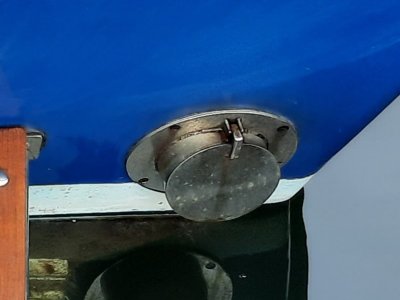
Automatic bilge pump routing

It common on larger vessels to fit a large diameter through hull with a matching diameter pipe running vertically to a position a high as possible under the deck. This acts as a discharge manifold where discharge connections can be made, such that the outflows from each connection, fall under gravity. This is how my bilge pumps are set up. I might need to draw it to make it clear
Perfectly clear description.

That's fine on large freeboard vessels where gunwhale rarely dips below water such as a Mobo ... but many sail yachts when sailing often dip the gunwhale and that through hull is below water... with the pipe loop under the side deck- often also below W/L when heeled. If the loop is made too high - then it becomes harder for pumps to overcome the rise of head.

My 25 - I MUST close the valve at hull side for that very reason. My 38 - I have not noted same - but I am sure that once I get seriously pushing her .. I will need to close of the through hull.
 
It could be possible to locate the loop up under the cabin side roof to increase the loop hight

This is a skin fitting with a NRV that could be fitted to the outlet of a bilge pump on a boat with low freeboard

Force-4-Nylon-Skin-Fitting-with-Check-Valve.jpg
 
It could be possible to locate the loop up under the cabin side roof to increase the loop hight

This is a skin fitting with a NRV that could be fitted to the outlet of a bilge pump on a boat with low freeboard

Force-4-Nylon-Skin-Fitting-with-Check-Valve.jpg

Dunno how much you know about ships sanitary overboards ..... but thats similar design ... commonly called a Flapper valve ...

Many a ship I've sailed on that the sinks etc have 'gurgled' from them not closing properly ....
 
Dunno how much you know about ships sanitary overboards ..... but thats similar design ... commonly called a Flapper valve ...

Many a ship I've sailed on that the sinks etc have 'gurgled' from them not closing properly ....
Bit of weed or something in it and you're shipping water. I'd want the manual shutoff valve, such as yours.
 
Dunno how much you know about ships sanitary overboards ..... but thats similar design ... commonly called a Flapper valve ...

Many a ship I've sailed on that the sinks etc have 'gurgled' from them not closing properly ....

Don't Know much about ship sanitary systems but I did remember that some Mobos engine exhausts have a flapper valve to try to prevent flow back of a following sea from flowing up the exhaust when the mobo stops
 
I a
Perfectly clear description.

That's fine on large freeboard vessels where gunwhale rarely dips below water such as a Mobo ... but many sail yachts when sailing often dip the gunwhale and that through hull is below water... with the pipe loop under the side deck- often also below W/L when heeled. If the loop is made too high - then it becomes harder for pumps to overcome the rise of head.

My 25 - I MUST close the valve at hull side for that very reason. My 38 - I have not noted same - but I am sure that once I get seriously pushing her .. I will need to close of the through hull.
I am fortunate that I have a walk in engine room where it is easy to extend the loop higher than most. It still only goes to deck level though. It's been set up like this since the boat was built in 1980. It works very well. The loop and skin fitting are not at the widest part of the beam of the boat. They are further back such that this part of the hull doesnt dip the toerail. We have a bilge alarm that sounds every time the pump runs. It doesn't run when hard pressed to weather
 
I a
I am fortunate that I have a walk in engine room where it is easy to extend the loop higher than most. It still only goes to deck level though. It's been set up like this since the boat was built in 1980. It works very well. The loop and skin fitting are not at the widest part of the beam of the boat. They are further back such that this part of the hull doesnt dip the toerail. We have a bilge alarm that sounds every time the pump runs. It doesn't run when hard pressed to weather

When I bought the Sunrider ... I never thought about it ... till happily sailing along .. heeling to stbd and wondered why my sink was full !!

ALVTBXTl.jpg


The sink level is only about 15 - 20cms higher than the level waterline of the boat .. the bilge pump loop sits up under the same worktop wedged against the sink sides. Its not possible to loop higher due to the lockers etc.
 
When I bought the Sunrider ... I never thought about it ... till happily sailing along .. heeling to stbd and wondered why my sink was full !!

ALVTBXTl.jpg


The sink level is only about 15 - 20cms higher than the level waterline of the boat .. the bilge pump loop sits up under the same worktop wedged against the sink sides. Its not possible to loop higher due to the lockers etc.
Our boat sits deep in the water. The sinks are only 2 foot above the static water level. We routinely close the seacock in the galley and aft heads on passage. The front heads sink has a push button plug. We just push the plug. This is the heads we use on passage. Our bilge pump loops extend way higher than worktop level. Another 3 feet. The heads both have Blakes Lavac toilets with loops up close to ceiling level
 
I have separate pipes for both of my automatic bilge pumps. We did 1500 miles like this with a seriously leaking stern tube (not the gland) letting in over 7 litres per hour in moderate revs or waves ( a mere 2 to 3 litres on moorings), and the only change we made was to replace the non-automatic electric pump for an auto by phoning ahead to Scottish marina to order the Whale auto in

Its really really easy to fit a new outlet pipe as the outlets at stern are well above waterline, just make sure the final loop of pipe is between 15 and 30cm above the cheap plastic hull fitting. Non-return valve dont always work and can be readily clogged.

I dont think it would work joining electric bilge outlet to main manual pipe and, as I said never trust a low pressure non return valve. Never ever skimp when your pride and joy and your own life may pay the price of you saving a few pounds or dollars.
 
Some small racing boats which heel a lot just have bilge pump outlet on deck.
Keeps the pipes short, and won't be underwater.
Sometimes they have the pump operated by a string and pulley system, so you can pump from sat on the rail steering etc. Easier than plumbing to a pump by the helm perhaps?


I've put in an auto bilge pump which goes to the old outlet in the cockpit, which is self draining and well above the waterline.
I've moved the manual bilge pump's output to a skin fitting well up the transom.

I had a NRV, not good, it could stop the centrifugal electric pump from priming, and reduced flow.

Actual bilge water is removed with a sponge or cloth.

Simple is good.
 
This siting of through hulls is something that is on my list for the heater I will be fitting .....
The exhaust will need to be sited so no amount of healing interferes with it regardless of loop up etc.

This means dead centreline at high up transom ....
Not too high!
Mine is too high and makes it hard to fit a proper swan neck effect.
With the double wall exhaust fitting, it's a big hole to move IYSWIM.
 
Fairly straightforward one this! I currently have a manual Whale Gusher (I think it's called) bilge pump and want to supplement it with an automatic one. On an old thread one participant opined that an auto BP could simply be installed in-line with the manual one. I'm sceptical of this idea but I'm sure the forum can reassure me before I go trying to tee into the outlet pipe between the manual pump and the skin fitting. (Thinking about it a bit more, perhaps the in-line fitting would work but might be dependent on the diaphragm of the manual pump being left at a particular point of its 'stroke'?)
[Edit: I've introduced a bit of obfuscation by using the term "in-line". I wished really to establish the viability of using the single current skin fitting.]

My manual bilge pump (diaphragm type) and engine driven bilge pump (impeller type) both tie into a common outlet via a Y junction. The outlet hoses join at the Y about a foot below the deck head, then the common outlet hose loops up to the underside of the deck head and back down a skin fitting a few inches above the water line, maybe 2 1/2' drop from the deck head.

The manual bilge pump of course has non return flaps and the engine type just relies on the impeller vanes to stop any back flow. However, I a dont believe there is any significant risk of back flow anyway, even when well healed and gunwales awash. The deck head loop and outlet are well aft of the beam.

Both pumps work well without interfering with each other i.e. I don't back flow out of the manual pump when using the engine pump and vice versa.
 
My manual bilge pump (diaphragm type) and engine driven bilge pump (impeller type) both tie into a common outlet via a Y junction. The outlet hoses join at the Y about a foot below the deck head, then the common outlet hose loops up to the underside of the deck head and back down a skin fitting a few inches above the water line, maybe 2 1/2' drop from the deck head.

The manual bilge pump of course has non return flaps and the engine type just relies on the impeller vanes to stop any back flow. However, I a dont believe there is any significant risk of back flow anyway, even when well healed and gunwales awash. The deck head loop and outlet are well aft of the beam.

Both pumps work well without interfering with each other i.e. I don't back flow out of the manual pump when using the engine pump and vice versa.
I guess this is what I was hoping to hear! I'd have a slight preference for having the 'Y' connection after the hose loop - but it obviously isn't essential.
 
... a slight preference for having the 'Y' connection after the hose loop ...

Yes, I can appreciate why that would be better, below the deck head on the outlet side to further reduce risk of back flow. My arrangement was put in place by a pervious owner. So far it has not been an issue under my 13 years of ownership.

Good luck with your installation, always more than one way to skin a cat.
 
Top