Attaching anchor to its chain?

Most people would use either a bow shackle (rather than a parallel sided 'ordinary' shackle), or some sort of swivel.
Like most things, the quality of either can be good or bad. You'd want the safe working load of the connector to be at least as good as or better than he chain it connects to. Most shackles/swivels bought in chandlers do not specify this. Who wants to rely on a pig in a poke?

You'd be well advised to read this: https://coxengineering.sharepoint.com/Pages/Connectors.aspx

P.S. In response to the post above, I've never had a problem with SS connectors on galvanised chain used for anchoring (and I anchor a lot); yes, there's the possibiity of galvanic action on the chain, but in practice the effect is very, very slow. Keep and eye on it, and be prepared to chop of a couple of links if needs be. But it really isn't an issue. On moorings, underwater 24/7, it's different. (Incidentally there was a recent thread in which this very issue was debated exhaustively.)
 
Last edited:
There was a recent thread about this.
Also see Vyv Cox's website for results of destructive testing on various anchor connectors, swivels and shackles.

On the basis on these discussions I have actually just bought a Wichard flush-pin 8mm s/s bow shackle, to replace my no-name swivel which looked very much like the ones that Vyv tested and found wanting. Seems like a tenner well spent for peace of mind.
 
I'm still wondering why people use swivels at all.
One day someone will have a sensible reason?
Without a swivel I have occasionally had the problem of the chain twisting so much that when retrieved it bunches up or becomes hockled and will not pass through the gypsy.

This has only happened occasionally and I do not feel it justifies the complication of a swivel in my case. However, those that anchor in areas where the wind swirls more, or in shallower anchorages it will be more of a problem. It is also more of an issue with high holding power anchors that do not easily break out.

Here is an underwater image of a twisted chain from last year. It does not show up in the photo very well but if you zoom in you can see the twisted bunched chain. Some of the links are lying horizontally parallel to the seabed. At this stage there was a lot of force on the chain. It is an annoying problem that takes a long time to fix, but is rare.

When you can eventually break out the anchor it spins at very alarming rate :).


image.jpg1_zps9xcc16to.jpg
 
Last edited:
I'm still wondering why people use swivels at all.

One day someone will have a sensible reason?

Galvanised, rated, bow shackle works for us.

Jonathan

I thought I had posted on this previously. In the 2014 season, following the comments of you and others, we did not use a swivel at all. Overall we found that we preferred the swivel because:
1. On numerous occasions the anchor came up facing the wrong way. It beats me how this can happen when it sets off the right way and the bow roller is grooved for the chain, but it does. When this happens Jill cannot turn the anchor the right way up. She does not like helming in close quarters situations so she does the foredeck. Consequently I motor out to clear water, then have to go forward to turn the anchor over.
2. The windlass most definitely displayed signs of displeasure at not having a swivel. Not sure whether it was due to the twists it insists on putting into the chain not being resolved by the swivel, or for some other reason, but it was most definitely more noisy without it.
3. The shackle I used instead of the swivel jammed several times between the bolt head that held the forestay and the cheeks of the bow roller. This is not really the fault of the shackle, resolved later in the season by changing to a clevis pin, but it was a factor at the time.

I started the 2015 season with an Osculati cranked swivel. Right from the start we encountered problems of anchor not setting that we had never experienced before. After a couple of weeks of erratic anchoring I dived on the anchor and found the bizarre situation shown in the photo - the chain seemed to have looped itself around the base of the swivel, which was pointing straight up. We immediately reverted to our standard arrangement of Wichard countersunk shackle, three links of 10 mm chain, Kong swivel and 8 mm anchor chain, the one shown on the website. My advice is 'If you don't need a swivel, don't buy one.' I certainly find mine beneficial and will continue to use it.

So far as corrosion is concerned, the three links of 10 mm chain sandwiched between stainless shackle and swivel are now devoid of zinc after five years or more but the steel is still OK. The last few links of 8 mm chain look to have little zinc left but are not rusty.

P5180073_zpsnh3d4eql.jpg
 
Perhaps someone who uses a swivel will try to explain how it helps an anchor to come up onto the bow roller, facing the correct way. When my anchor comes up to the surface, it may be facing in any direction, but it's only an anchor, and has no decision-making brain cells. I just don't see how including a swivel helps.

I use a bent link between the anchor and the chain, and it ensures that as soon as the link reaches the roller, the bend in the link, makes it rotate, so that the anchor can only come up the right way. The bent link is a short length of round bar, with a bend in it, and having an eye at each end, then galvanised. Other similar designs exist.

I would not introduce a stainless link or shackle between a galvanised anchor and galvanised chain. I have had a serious loss of galvanising from my chain doing this (admittedly after leaving my boat anchored for four weeks).
 
Perhaps someone who uses a swivel will try to explain how it helps an anchor to come up onto the bow roller, facing the correct way. When my anchor comes up to the surface, it may be facing in any direction, but it's only an anchor, and has no decision-making brain cells. I just don't see how including a swivel helps.

I use a bent link between the anchor and the chain, and it ensures that as soon as the link reaches the roller, the bend in the link, makes it rotate, so that the anchor can only come up the right way. The bent link is a short length of round bar, with a bend in it, and having an eye at each end, then galvanised. Other similar designs exist.

I would not introduce a stainless link or shackle between a galvanised anchor and galvanised chain. I have had a serious loss of galvanising from my chain doing this (admittedly after leaving my boat anchored for four weeks).

I'll give one example. Our anchor is under the trampoline and is not easy to reach. It usually comes up the wrong way and sometimes did that without the swivel. Without the swivel it was a bugger to try and get it round but with the swivel it's often sufficient just to lower it back down to the sea and the forward motion of the boat will flip it. If it doesn't then it is just possible to reach a few fingers past the trampoline and flip it. Because of the swivel it does flip round with just a gentle touch.

I have thought about trying one of the Osculati cranked links (I assume not the Osculati cranked swivel which Vyv refers to) and perhaps I should have gone down that route but as I now have the Kong swivel I'm happy to stick with it until such time as I need to replace it.

Richard
 
I'll give one example. Our anchor is under the trampoline and is not easy to reach. It usually comes up the wrong way and sometimes did that without the swivel. Without the swivel it was a bugger to try and get it round but with the swivel it's often sufficient just to lower it back down to the sea and the forward motion of the boat will flip it. If it doesn't then it is just possible to reach a few fingers past the trampoline and flip it. Because of the swivel it does flip round with just a gentle touch.

I have thought about trying one of the Osculati cranked links (I assume not the Osculati cranked swivel which Vyv refers to) and perhaps I should have gone down that route but as I now have the Kong swivel I'm happy to stick with it until such time as I need to replace it.

Richard

OK so the swivel doesn't automatically rotate the anchor, but makes it easier to rotate it manually. I can understand that, but my bent link achieves that without any manual input. With an anchor that's difficult to reach, like yours, it might be well worth a try.
 
Remember to use a tested, marked shackle.

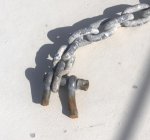
This is the result of using a plain vanilla one off the chandlers shelf:View attachment 56538

Hi, I've seen your photo of that before, and find it most intriguing. How did it manage to break in two places at the same time? Correct me if I'm wrong, but have you not also posted a picture of the shackle, complete with the broken section? If so, it must have broken on deck. Again, if so, how did it break? Just interested.
 
I suspect that thousands of us use a s/s swivel on galvanised chain and anchor and it works fine.

Why would this be any different to a s/s shackle? :confused:

Richard

P.S. In response to the post above, I've never had a problem with SS connectors on galvanised chain used for anchoring (and I anchor a lot); yes, there's the possibiity of galvanic action on the chain, but in practice the effect is very, very slow. Keep and eye on it, and be prepared to chop of a couple of links if needs be. But it really isn't an issue. On moorings, underwater 24/7, it's different. (Incidentally there was a recent thread in which this very issue was debated exhaustively.)

I take your point(s).
The reason I mentioned s/s+galvanised is that having bought two lovely shiny s/s shackles, at considerable expense, the resulting galvanic action on the chains and anchors looks bad enough for my surveyor to "tut tut" it.

Wasted my pennies. :(
 
Hi, I've seen your photo of that before, and find it most intriguing. How did it manage to break in two places at the same time? Correct me if I'm wrong, but have you not also posted a picture of the shackle, complete with the broken section? If so, it must have broken on deck. Again, if so, how did it break? Just interested.
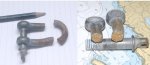
Dug around all the pics that I took this year, here's another. The third piece I found in the scuppers a few days later.

anchor shackle broken.jpg

I was up in Loch Nedd (a bit south of Cape Wrath) winching up the anchor at 5am (there was more than a bit of breeze forecast for the next few days and I wanted to get nearer some 'civilisation' before it came in after lunch). Winching up the anchor on the windlass, came over the bow, all looked normal, then BANG. Anchor fell off into 13m of cold Scottish loch.

Brand new shackle this year. Anchor was a 20kg Rocna and only 3 years old + Kong swivel. Left it on the bottom (how could I retrieve it?). Can't see any obvious sign of failure in the fracture surfaces, such as rusting in a crack forming.
 
Last edited:
I've got the task of attaching the new anchor to new chain and chain to new line this year ...

It's 15m of line, 2m of chain and 1 anchor (duh!) ... the line is 3 strand 4mm, chain is 3mm galvenised and the anchor a 2.5Kg fortress type.

I think I'll just use a normal galvanised shackle and a bowline ... or I might do an eyesplice ...

Don't worry - the Mirror dinghy will be perfectly safe! :D
 
Dug around all the pics that I took this year, here's another. The third piece I found in the scuppers a few days later.

View attachment 56540

I was up in Loch Nedd (a bit south of Cape Wrath) winching up the anchor at 5am (there was more than a bit of breeze forecast for the next few days and I wanted to get nearer some 'civilisation' before it came in after lunch). Winching up the anchor on the windlass, came over the bow, all looked normal, then BANG. Anchor fell off into 13m of cold Scottish loch.

Brand new shackle this year. Anchor was a 20kg Rocna and only 3 years old + Kong swivel. Left it on the bottom (how could I retrieve it?). Can't see any obvious sign of failure in the fracture surfaces, such as rusting in a crack forming.

That's something of a concern. There is no evidence of ductility or, as you say, progressive crack growth. Brittle fracture is always a problem in engineering components as it is unpredictable. Poor quality fittings may suffer from it due either to low manganese or non-metallic inclusions. The cold water could be a factor. I suggest you buy a lifting and hoisting type or a good quality stainless one to replace it .
 
Dug around all the pics that I took this year, here's another. The third piece I found in the scuppers a few days later.

View attachment 56540

I was up in Loch Nedd (a bit south of Cape Wrath) winching up the anchor at 5am (there was more than a bit of breeze forecast for the next few days and I wanted to get nearer some 'civilisation' before it came in after lunch). Winching up the anchor on the windlass, came over the bow, all looked normal, then BANG. Anchor fell off into 13m of cold Scottish loch.

Brand new shackle this year. Anchor was a 20kg Rocna and only 3 years old + Kong swivel. Left it on the bottom (how could I retrieve it?). Can't see any obvious sign of failure in the fracture surfaces, such as rusting in a crack forming.

Yes, I was almost sure that I'd seen the pic with the missing piece. There is, of course a huge load on the shackle just when the anchor reaches the bow roller, and the smaller diameter the roller, the greater the load on the shackle. What did the shackle attach to, and what material was it? I ask because something has obviously been destroying the galvanising on the shackle, but I'm still surprised at the way it has failed in two places.
 
Top
