Are there rogue gusts?

kaj

Active Member
Joined
24 Feb 2002
Messages
52
Location
Finland
Visit site
Most, if not all, of us have heard of rogue waves. Few, if any, have experienced one.

Question is, do 'rogue gusts' exist?

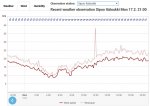
Is the enclosed recording possibly real? Or is it just an error or malfunction? It gives a 37 m/s windburst i.e. 72 knots while the mean is 17 m/s (33 knots).
Ita_Toukki_gusting_170220_ls.jpg
 
Last edited:
I used to specify and build aerodrome meteorological systems, and that looks very much like rogue data rather than a real gust to me.
 
In statistical terms it seems very much an outlier.
The data source is not known, the sampling interval is not immediately visible, google "microburst" to see how such a short term speed difference might be possible in the short term, though the "average" wind should show a bump as well; I deem very unlikely such a phenomenon with average winds in the region 30-40kt and say a few seconds sampling frequency.
 
Last edited:
I have recorded 57 knots of wind while sailing. I am not sufficiently brave or stupid to go out in F11s but on at least one occasion we were sailing in sheltered water around a Swedish Island in winds of about F5, after which I checked the record on my normally reliable Raymarine meter and was surprised to see a max of 57. My guess was that a short gust had 'flipped' the sensor and caused it to overread.

We experienced a rogue calm on one occasion during the Morning Cloud gale. One morning, after several days of gales, the weather report from the Varne was F11, with 6 at Sandettie and gales everywhere else. We had a flat calm in the Blackwater which allowed us to make a two hour trip home. This was nowhere near the centre of the depression, which was somewhere off Scotland.
 
I was once on a visitor's buoy at Itchenor when a sudden gust occurred as a front came through. It was so strong that it heeled us over until the lee rail went under and a boat ashore in a nearby boatyard was blown over. It was all over in a moment and the wind settled from the NW and blew steadily
 
I have recorded 57 knots of wind while sailing. I am not sufficiently brave or stupid to go out in F11s but on at least one occasion we were sailing in sheltered water around a Swedish Island in winds of about F5, after which I checked the record on my normally reliable Raymarine meter and was surprised to see a max of 57. My guess was that a short gust had 'flipped' the sensor and caused it to overread.

We experienced a rogue calm on one occasion during the Morning Cloud gale. One morning, after several days of gales, the weather report from the Varne was F11, with 6 at Sandettie and gales everywhere else. We had a flat calm in the Blackwater which allowed us to make a two hour trip home. This was nowhere near the centre of the depression, which was somewhere off Scotland.
Was that due to wind funnelling which you can experience around islands?
 
Was that due to wind funnelling which you can experience around islands?
I'm sure the island had something to do with it. We were sailing in the lee of Stora Dyron North of Gothenberg at the time, which is a rocky inhabited island with something of a hill in the middle.
 
I had been wafting around the solent all day many years ago. 10-12 knts. Very calm.
Sailing along Southsea sea front heading for Portsmouth Harbour then out of nowhere a freak gust laid the boat over and spreaders virtually touched the water. Luckily the two of us managed to cling on otherwise we would have fallen into the sea.
We came back upright and all was good.
I instantly looked around and no other boats were effected but there were a few surprised faces on other boats looking at us.
I believe there can be freak gusts.
 
You can certainly get very sudden and rapid changes in wind speed and direction when sailing in the Scottish sea lochs, surrounded by substantial hills. They probably arise from vortices, both horizontal and vertical, round features of the terrain. The worst I encountered was at the entrance to Loch Goil.

However, the graph shown looks unrealistic, and I'd suspect one bad data point; perhaps a single point that is off-scale high. The curves have obviously been subject to some sort of smoothing algorithm, but it's interesting that the peak in the gust speed isn't reflected in the steady speed - you'd expect there to be some correspondence. I'm also suspicious about the implied propagation speed of the gust; I haven't tried to calculate it but it looks like it would be unfeasibly high.
 
A couple of times a year or so you can see similar spikes in the Chimet wind speed. It may simply be a data glitch, but highly localised vortices, usually identified as waterspouts, are regularly recorded here in the Solent and mid channel. I've seen maybe half a dozen in the 40 years I have sailed here. These can develop ridiculous windspeeds in a tightly contained area, similar to those recounted above by Rappey, in quite moderate conditions. I met one once out in an HR36 off Ryde when a F3-4 suddenly kicked up and laid her lee rail under for about 15 seconds, then dropped back.

In West Wales an easterly offshore gale is the most feared because the airstream funnels down off the mountains in huge gusts. From high ground ashore you can see these massive squalls racing out across the sea, known as Williwaws to followers of Slocumb, who experienced them in Patagonia. You may have a manageable F6 or 7, which momentarily dies then returns at maybe 50 - 60 knots lasting 2 or 3 minutes befroe dropping back. I am quite sure the Scottish w coast fleet will be familiar with this effect, as confirmed by Antartctic Pilot in the previous post!
 
I was once on a visitor's buoy at Itchenor when a sudden gust occurred as a front came through. It was so strong that it heeled us over until the lee rail went under and a boat ashore in a nearby boatyard was blown over. It was all over in a moment and the wind settled from the NW and blew steadily
Did this occur whilst you were on board your Twister? I imagine the gust would need to be extreme to put the rail of a Twister under water. I've always admired the Twister, a beautiful yacht. The motion under sail must be sublime.
 
We experienced such a wind gust 'spike' just last night at about 20:30 (on board in Plymouth Yacht Haven). Conditions had been quite benign then we had some thunder and lightening (later found it hit a house setting light to the roof) followed by a really heavy downpour and a wind gust of 85knots, recorded by the Fugro Plymouth weather station ( NorthStar: Weather Overview ) Historic data graph tops out at 70 knots, but I watched it on the live data feed. The whole affair was over within half an hour and benign conditions returned.
 
Coming out of Cowes one time .... turned east immediately after the last moorings ...

Its not uncommon for wind to deflect of the East Cowes headland there and cause a freak gust ... and this particular occasion - it laid my boat right over on her side ........ before I had chance to let fly sheets ....

I mentioned to others back at the club later and heard that I was not only one that has been caught out by it ...

The strength of wind gust felt huge ... but was over in a few seconds ... it was as if someone had hurled a ball of wind at us !
 
I'm sure there are, fortunately have only experienced one, that was over 50 years ago in our first boat, a Leisure17' we were about a mile off Lulworth Cove on a lovely clear sunny day wind about top end of Force 3 when suddenly we were laid almost flat, fortunately she quickly righted herself and apart from the mess in the cabin and a rather shaken crew all was OK and once we had sorted ourselves out off we went again.
Wasn't it something like this that hit 'Morning Cloud' whilst sailing in the Channel?
 
Last edited:
Microbursts are a well known danger to aircraft; these are caused by sudden cooling of air by rain, causing the air in a small area to drop downward suddenly. When the downburst reaches the ground, it then spreads out sideways. Apparently that can be of very short duration - seconds to minutes - and be powerful enough to knowck trees down.

BTW, just to reiterate that katabatoic winds aren't a factor in the UK; they result from intense cooling of air at the top of a topographic feature (e.g. over a glacier or ice cap in high mountains). The cooling makes the air more dense so it flows downhill. They are typical of large ice-caps such as Antarctica and Greenland, or smaller ice caps such as those in the southernmost parts of the Andes where there is a drop from glaciers at high elevations to sea-level in a short distance. In Antarctica they can result in persistent winds of over 100 knots for weeks on end!
 
In statistical terms it seems very much an outlier.
The data source is not known, the sampling interval is not immediately visible, google "microburst" to see how such a short term speed difference might be possible in the short term, though the "average" wind should show a bump as well; I deem very unlikely such a phenomenon with average winds in the region 30-40kt and say a few seconds sampling frequency.

I've re-searched and found this by the UK Met Office (How we measure wind), turning out:

UK_MetO_gusts_measurement.JPG

This method of measuring [wind speed every 0.25 second] surely does capture short lived wind bursts. The three second maximum during a ten minute period certainly should catch any lone freak gust, provided the gusting takes place at the spot where the recording is done.

A lone, exceptional, three seconds gust, would be just 12 measurements out of the total 2,400 measurements during a ten minutes period. Thus a 'rogue', 'freak', 'abnormal', 'extreme', gust would not contribute noticeably to the mean (average) wind speed during the corresponding 10 minutes period.

To the OP question, there is in this thread evidence of encounters of 'rogue gusts', some of which might be unexplained by outside factors, like katabatic or other geographical circumstances, or like microbursts.

Are the rogue gusts like there are rogue waves? Explained only by the wind and waves behaviour.
 
Top