
Anyone tried building a frankenbebi anchor light?

Exactly, the negative temp coefficient of Vf means the warmer leds will draw more power and get warmer still.
See post 38
Use good LEDs and apparently not a problem. The original owl also had a linear regulator though possibly different design, but they had a very good reliability record with these new guys, even being completely separate, offering to replace any faulty original lights,.
 
See post 38
Use good LEDs and apparently not a problem. The original owl also had a linear regulator though possibly different design, but they had a very good reliability record with these new guys, even being completely separate, offering to replace any faulty original lights,.
It's an ugly bit of design IMHO.
Imagine it's out there today, the windward, rained on side will be a lot cooler than the leeward side.
It negates the point of the constant current source, possibly introduces as much variation in light output as simply having one resistor per chain and designing for your max charging volts.
But TBH, the main criterion for reliability of LED anchor lights is probably how the waterproofing is done.
I made one as a birds nest smothered in hot melt glue some years ago, that still works!
Also, I don't know that auto on/off is worth it, will the level be right to come on when the weather is dull and murky?
 
It's an ugly bit of design IMHO.
Imagine it's out there today, the windward, rained on side will be a lot cooler than the leeward side.
It negates the point of the constant current source, possibly introduces as much variation in light output as simply having one resistor per chain and designing for your max charging volts.
But TBH, the main criterion for reliability of LED anchor lights is probably how the waterproofing is done.
Well, the original ones are very popular and seemingly reliable amongst bluewater boats which is probably the toughest market there is, tropical sun kills most boat bits much faster than anything we get up here.

Isn't the problem with resisters that you need to design to 16v so when your down near 12 there's not much light coming out?
 
Well, the original ones are very popular and seemingly reliable amongst bluewater boats which is probably the toughest market there is, tropical sun kills most boat bits much faster than anything we get up here.

Isn't the problem with resisters that you need to design to 16v so when your down near 12 there's not much light coming out?

16V is a pretty aggressive charging regime.
If you have 16V charging, maybe the 12V lighting rail should be regulated anyway? or at least a common design approach decided on for the whole boat?

I suspect each of us would weight the importance of design criteria differently.
I like that this is linear and cannot generate RF interference, but it is not that hard to supress a switch mode device adequately.
It's nice to make something as efficient as possible, but having cut consumption from the 1A of a bulb to 120mA, does cutting it a bit more really win you anything?
Would you prefer that it kept working down to a really low voltage instead?
Do you want it to shut off when the battery might be damaged by further discharge, or keep going?
Are you looking for a brighter light rather than just lower power?
Are you looking for a design that will work well even with edge of tolerance components?
One that won't fail completely if one component dies?

Or like me, looking to use what's in the drawer?
 
But TBH, the main criterion for reliability of LED anchor lights is probably how the waterproofing is done.
I made one as a birds nest smothered in hot melt glue some years ago, that still works!

The original Bebi lights were completely potted in resin. Some inside a plumbing end-cap as on this thread, some other types the resin was poured into some kind of mould which was then removed so all you got was the block of resin with LEDs sticking out. The end of the regulator(s) also protruded to let heat escape. Towards they end they started making interior lights as well, which used handmade wooden cases but were still filled with the resin.

Pete
 
If people are concerned about 16v charging on LED and any other lights or gear a regulator can be made that has nil drop at normal uncharged battery volts. You make up a circuit like a VSR using a comparitor so that it operates a relay when the voltagge exceeds say 13volts. Normally made contacts on the relay would open to reveal a couple of silican diodes in series as voltage droppers. If the relay relaxes the diodes are bypassed and so full battery voltage goes to the LEDs etc.
While this is just a one step regulation it would remove much of the anx about high charging volts. Anyone wants to try it PM me olewill
 
Greetings from the "dungeon"

Checking through the stats on the website this morning and picked up the link back to this thread. Lot's of conversations in just a week....

As the project manager for The FrankenBebi Project I am glad to see the interest and debate going on here at YBW. We have joined the forum and subscribed to this thread to try and keep up. While there is no way I can address all the issues and suggestions in 7 pages of posts, I would like to clarify, update, explain a couple of issues I noticed while reading through the posts...

The ugly schematics are entirely my fault. My personal background is in the nuts&bolts side of engineering, not the EE side. Early on in the project I needed to teach myself Eagle Cad to allow efficient design of the printed circuit boards which are (in our opinion) much preferable to other methods of assembly. Since that time, we have added some new members to the electronics design team who draw much prettier Eagle schematic files than I. You can see an example below.

From the begining, one of the goals of the project was to come up with a design that could be assembled with readily available parts, with reliable sourcing and reasonable costs. The finished product must be "bullet-proof" for at least 5 years in adverse conditions with zero maintenance.

Given that everone has their own opinion as to "what's best", not only in the forums, but within the project as well, there is as always in life a little bit of compromise. It is always a battle to decide how good is good enough, and what goals to give up in order to accomplish others.
The posted designs have been our best effort based around a linear regulator and its associated issues with power dissapation at elevated voltages, non-regulation below drop-out voltages etc. It may not be elegant, but it works, and it's tough... Sorta like my boat.

This has not kept us from looking for improvements, and delaying release of final plans, drawings and bill of materials, until we are sure we have the best solution we can. Our reinforced circuit design team has come up with a totally new (and elegant) regulation and photo-switch design that solves a lot of nagging issues with the older design. Don't get me wrong, the ugly 0.11.03 design functions as advertised, on within 15 minutes of dusk, off within 15 minutes of dawn, rain or shine. On deck, in the weather with battery voltages from 11.8-16 Vdc.

Here is a (prettier) schematic of the latest design iteration. Y'all at YBW are the first to see it, as it hasn't even been posted to the website yet. Something more to discuss. :) It actually uses one of the LEDs for current sensing and improves regulation while reducing dissapated heat and overall current demands. (less than 100mA) It will require some fine tuning of resistance values as it undergoes testing, but at this point it looks really good. Some new developements in assembly and finish as well which we will announce as soon as we have tested enough to prove they are a positive step, and not change for the sake of change.
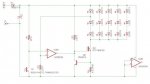
schema-v0.12.03.jpg

Thanks again for the interest in the project.
Cap-Couillon
 
Thanks cap, being a budget driven cruiser always in search of something which can withstand the harsh life onboard I'm certainly a fan :cool:

But quite electronically challenged (but enjoy learning) , how does it work then, anyone :confused:

Does the comparator ic2a oscillate to limit the the current?


Edit:
Got it, it's the FET q3 doing the work, not the comparator. Is it? What does q2 do?
Ta
 
Last edited:
Yes Cap that is a much better circuit using a Field Effect Transistor with low on resistance and volt drop.
Quote " It actually uses one of the LEDs for current sensing" sorry not as I see it. The LED is also used as a voltage reference for the comparator.
The current sensing is through the 8.2 ohm R4 which must still drop about .7 volt. I think if this resistor were reduced in value and the transistor sensing of current be rearranged to have bias on the transsitor so that a small voltage will control the transistor then the lower drop out voltage for the light would be reduced.
Well done olewill
 
Last edited:
help, NigelM, pls. I've tried downloading DS, and ...

"Designspark....is not a valid Win32 application"


Where next, oh guru ?
 
I certainly agree with that.
I played around with Eagle a while ago and gave up on it. I've been playing with DesignSpark recently and it is easier to get into. It's still a steep learning curve though :eek:

All the YAPPs have been done using DesignSpark. There are instructions on how to translate a DS PCB layout to the files that ITead need to make a PCB here...

http://yappelectronics.co.uk/docs/hw/iteadstudio.txt

The SparkFun DS library is worth having as it adds a load more components and footprints that amateur bodgers are likely to use...

http://www.designspark.com/eng/knowledge-item/sparkfun-libary-05-10-11
 
All the YAPPs have been done using DesignSpark. There are instructions on how to translate a DS PCB layout to the files that ITead need to make a PCB here...

http://yappelectronics.co.uk/docs/hw/iteadstudio.txt

The SparkFun DS library is worth having as it adds a load more components and footprints that amateur bodgers are likely to use...

http://www.designspark.com/eng/knowledge-item/sparkfun-libary-05-10-11

Thanks for that.

I've had no problem producing PCB layouts but I'm a little dissappointed with the automatic layouts. I've found them to be little better than my DIY efforts with Veroboard and I would have expected a double layered PCB to produce a more compact layout. I need to spend more time playing with the settings but, so far, I'm getting better results by placing components manually then auto-routing the tracks.

I'll try that library. One more to add to something like 50 which I've already got!:D

Do you find it better to get the boards made up rather than etching them yourself? I had assumed that it was fairly expensive to get small quantities made up and was going to try DIY. It's my skinflint instincts coming out.
 
I don't do auto-placement or layout. I have never seen it done in industry either, especially as commercial outfits have to design for EMC, which requires lots of tricks to reduce emissions rather than just a track between 2 points.

I have never etched PCB's myself. I always get them from ITead Studio. 90p each for 10 for a 5cm x 5cm, £1.25 for 5cm x 10cm - I couldn't match that price with my own kit and chemicals. The downside is that it takes 3 weeks to get them. Apparently according to the people who know they are not the best for very fine surface mount at this price, but they are plenty good enough for my through-hole kludges.
 
I don't do auto-placement or layout. I have never seen it done in industry either, especially as commercial outfits have to design for EMC, which requires lots of tricks to reduce emissions rather than just a track between 2 points.

I have never etched PCB's myself. I always get them from ITead Studio. 90p each for 10 for a 5cm x 5cm, £1.25 for 5cm x 10cm - I couldn't match that price with my own kit and chemicals. The downside is that it takes 3 weeks to get them. Apparently according to the people who know they are not the best for very fine surface mount at this price, but they are plenty good enough for my through-hole kludges.

Hells bells! That is good value. I'll try them. Thanks.

Your comments on auto placement are reassuring. I was beginning to think that I was doing something wrong; the results I was getting were, for want of a better word, inelegant
 
Top