Anyone tried building a frankenbebi anchor light?

About time, too! Your original link was the old version.

You mean my link to the current Davis catalogue listing which starts "This LED low current light (my emphasis) features a light sensor that automatically turns on at dusk and off at dawn" and goes on to mention the 0.110A low-current bulb supplied?
 
You mean my link to the current Davis catalogue listing which starts "This LED low current light (my emphasis) features a light sensor that automatically turns on at dusk and off at dawn" and goes on to mention the 0.110A low-current bulb supplied?

Yes. It seems they've added LED to the title in some parts, but the remaining description refers to the incandescent version. Follow it through to the documentation and you'll see it keeps referring to the two bulbs and low current incandescent circuit. I wouldn't know what I was getting if I ordered that.
 
>As a bit of perspective the original owl was extremely popular among long term cruisers living on the hook

Out of interest where did you get that from, I've never heard a long term cruiser mention it. All the boats we knew, 75+, had 25W incandescent bulbs.
 
>As a bit of perspective the original owl was extremely popular among long term cruisers living on the hook

Out of interest where did you get that from, I've never heard a long term cruiser mention it. All the boats we knew, 75+, had 25W incandescent bulbs.
Might be more pacific/US based. I first saw one about 7 years ago on a boat which had come from the Pacific and bought a bagful in Fiji where they were made. If you search any of the US cruising forums for bebi you'll find a lot of happy customers and possibly no complaints.

75 incandescent bulbs pulling 2A every night? More than my fridge. That have been a while ago, even 7 years ago most cruisers were switching to LED. Is there a cruiser anywhere living at anchor still using a 25w incandescent for an anchor light?
For gadgets which have transformed cruising leds might not be at the pinnacle with gps and Internet but certainly well up there :cool:
 
Back to the OP, I'm having second thoughts about this circuit, I don't know why I didn't spot the fundamental flaw the first time. Although the circuit uses a constant current supply, it then splits that current into the four LED strings. The characteristics of LEDs vary, so one of these strings will take more current than the others, causing the LEDs to heat up more than the others. This can lead to thermal runaway.

The effect can be reduced by using good quality LEDs and matching the Vf during construction, but it is still a concern.
 
Back to the OP, I'm having second thoughts about this circuit, I don't know why I didn't spot the fundamental flaw the first time. Although the circuit uses a constant current supply, it then splits that current into the four LED strings. The characteristics of LEDs vary, so one of these strings will take more current than the others, causing the LEDs to heat up more than the others. This can lead to thermal runaway.

The effect can be reduced by using good quality LEDs and matching the Vf during construction, but it is still a concern.
Frankenbebi seem to be looking at good leds, does binning match Vf closer as well?
The LEDs are manufactured by Cree, a major US based manufacturer since 1986. As there are variations in output even in tightly controlled manufacturing environments, major manufacturers offer "binning" or sorting of a particular LED series by output and color spectrum. There is an "upcharge" for binning but we have opted to purchase binned LEDs in order to be sure all the components used meet the requirements of 33 CFR 84.13 - Color specification of lights and 33 CFR 84.15 - Intensity of lights.

Annoying they don't spec which led they're using.

And for a complete home build if the circular pcb is too expensive, as most of the pcb is for the light sensitive switch, would it be an option to have a lm317 for each string an up the resister as necessary? Not exactly budget breaking chips.

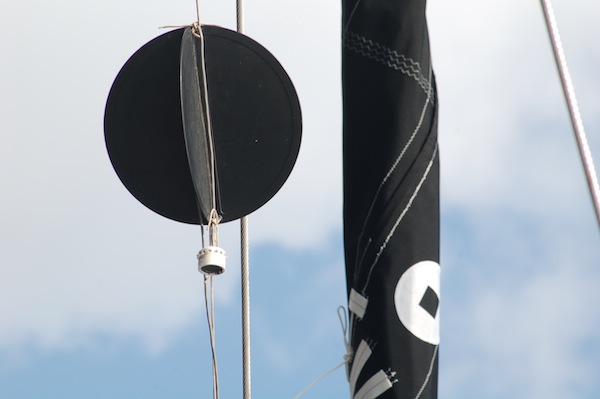
Also while wandering around Google came across this great idea..

DSC_1737-Anchor-ball-and-light.JPG


Mount your anchor light under the ball! Very clever. Then just figure out a way to feed the power through a dorade or something.
 
Mount your anchor light under the ball! Very clever. Then just figure out a way to feed the power through a dorade or something.

Wow - I've been doing that since I had a boat to do it on - never realised it counted as clever :)

What I did think was a little bit clever was my arrangement on the new boat. I made up a permanent downhaul attached to the anchor ball, then I attached the end of the light cable to the core of the rope and pulled it through. So now the downhaul consists of an outer sheath to carry the load with a wire hidden inside that supplies the light. The wire emerges just above the spliced eye that fits over a deck cleat; I pulled a bit of spare sheath over that part just for appearances, and covered the joint with a serving. It ends with a watertight plug that will fit into a socket in the anchor locker.

The only downside is that without a wire visibly snaking back into the cockpit to the searchlight socket, I did once forget to take it down in the morning and was embarrassingly hailed in the entrance to Portsmouth Harbour :)

Pete
 
Back to the OP, I'm having second thoughts about this circuit, I don't know why I didn't spot the fundamental flaw the first time. Although the circuit uses a constant current supply, it then splits that current into the four LED strings. The characteristics of LEDs vary, so one of these strings will take more current than the others, causing the LEDs to heat up more than the others. This can lead to thermal runaway.

The effect can be reduced by using good quality LEDs and matching the Vf during construction, but it is still a concern.

It's a statistical game though - selecting 3 LEDs randomly will reduce the spread of Vf such that the parallel strings will mis-match less than individual LEDs would.

If you are worried, then Vf matching would help.

My designs have individual current sinks matched to 0.2% but that'd seriously push up the cost.
 
Wow - I've been doing that since I had a boat to do it on - never realised it counted as clever :)

What I did think was a little bit clever was my arrangement on the new boat. I made up a permanent downhaul attached to the anchor ball, then I attached the end of the light cable to the core of the rope and pulled it through. So now the downhaul consists of an outer sheath to carry the load with a wire hidden inside that supplies the light.
Double clever squared :cool:

I have a dorade right next to the cutter stay where the anchor ball gets rigged so power should be easy to route down there.
Then that just leaves some little very subtle occasional flashing circuit to sort out so after happy hour extends yet again you can find your own boat among all the other anchor lights :)
 
Then that just leaves some little very subtle occasional flashing circuit to sort out so after happy hour extends yet again you can find your own boat among all the other anchor lights :)

I have plans there too.

While looking for cheap radio controlled relays for an anchor windlass, I discovered that you can get remotes with 500yard+ range for under a tenner delivered. I'm thinking of connecting one of these in parallel with the deck light switch, then as we approach the general area I can press the button and the boat will light up (I've just fitted new LED deck lights and they're very bright). A bit James Bond, but very easy and cheap to do so why not?

Pete
 
It's a statistical game though - selecting 3 LEDs randomly will reduce the spread of Vf such that the parallel strings will mis-match less than individual LEDs would. If you are worried, then Vf matching would help...

I think this would be worthwhile. For anyone considering this design, power up the LEDs individually via a suitable resistor and accurately measure the voltage across them (Vf). Group them so the Vf totals are the same in all four strings.
 
I think this would be worthwhile. For anyone considering this design, power up the LEDs individually via a suitable resistor and accurately measure the voltage across them (Vf). Group them so the Vf totals are the same in all four strings.
Seems like they've looked into this already and it doesn't look like an issue..

http://www.cruisersforum.com/forums/f129/the-frankenbebi-project-114568.html#post1403870

The LEDs being used in the project are being supplied by a US based manufacturer (Cree) with a good reputation for maintaining the tolerances stated in their spec sheet. In addition, the product has been binned to reduce the variation of Vf. A random sample from our first batch order of LEDs (100) showed Vf variation was within specs, and fairly evenly distributed above and below the mean average of the sample.

Edit:using these...
http://www.cree.com/~/media/Files/Cree/LED Components and Modules/HB/Data Sheets/C503D WAN 935.pdf
 
Last edited:
>That have been a while ago, even 7 years ago most cruisers were switching to LED.

From what I saw I wouldn't say most but some, having seen many of them and how little light they give out I wouldn't fit them. It's interesting the Megalight, for example has a great name but no info on it's brightness. The only issue with incandescent lights is power management solved by wind generator, solar panels or a generator, we had the first and last, most long distance boats have similar arrangements. Of course you can also use the engine.
 
>That have been a while ago, even 7 years ago most cruisers were switching to LED.

From what I saw I wouldn't say most but some, having seen many of them and how little light they give out I wouldn't fit them. It's interesting the Megalight, for example has a great name but no info on it's brightness. The only issue with incandescent lights is power management solved by wind generator, solar panels or a generator, we had the first and last, most long distance boats have similar arrangements. Of course you can also use the engine.
Afraid you're behind the times, bright LEDs were available back then if you did enough research and now the brightest lights in the anchorage will all be led. Using a fraction of the power.
 
Top