Any experts on Victron and lithium batteries?

John, it looks like you have davits supporting your dingy could you not add a frame on the top of the davits to support your solar panels.

I did build an arch but changed mt cockpit cover to a rigid cover supported in the same way as my cockpit cover and mooned extra solar panels on top of my cockpit cover

Plenty of sun so power on the east coast of Africa


Showing panels on aft arch and frame for cockpit cover where the extra solar panels are now fitted.
I suppose anything is possible? Our davits already have legs on them with extra winches and lines to support our passerelle.
 
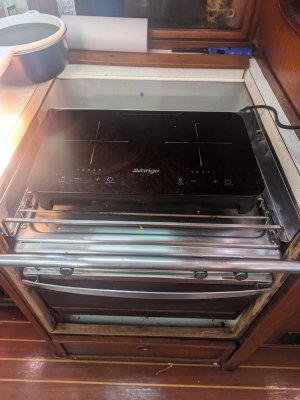
On top of the gimballed cooker, it works well for us. I constructed some wooden supports that fix the feet. If we ever need the gas burners (such as when cruising in a cold climates with limited solar), the induction unit can be lifted off and quickly converted back to gas.

The single-burner units are not large, although ours is an commercial unit, which is bigger than most.

View attachment 189020
I see IKEA are doing portable single induction hobs for £45!
 
I see IKEA are doing portable single induction hobs for £45!
We had a similar, inexpensive induction cooktop. Our was a Tefal brand.

They cook well and are a great way to experiment with induction cooking. The biggest uncertainty is whether you can generate enough electrical energy to make it worthwhile. Even if this turns out not to be the case, the induction unit can still be used in a marina or on a hardstand. Even this will reduce propane/butane usage so the money is not wasted.
 
Sea Change,

I used the words 'portable power station' (as that is what it is) - but its not a bought in Power Station.

I have sourced all the components independently and its all housed in a big box, but the battery capacity is too low and the inverter too small. If we extended the solar from 300w I would want another MPPT controller and a bigger shunt. The battery has its own BMS but no Blue Tooth, so I can only monitor its performance as a single unit not each cell independently - so far its been fine. I included DC-DC capability - but have not used it yet. I would include a battery charger to use mains/shore power in any future upgrade but would not want to include a gen set.

If/when I extend what we currently have I would need a new batteries, as I would not want to use the 2 year old Lithium (I'd have to find a new use for the old one).

The problem with a small inverter is that you need to be careful with what units you use together and in our case cannot use the induction hob to full capacity (but when we started with this project it never occurred to me to plan for induction - we are now converts - and would prioritise induction over a micro wave - and probably not have a micro wave at all).

Its a learning process, as all who have installed Lithium show the same characteristic - they have all, I think without exception, extended beyond their original ideas. This is not only Lithium - Noelex has added to his own, well designed, galley with Induction - with a lash up (as in effect) we have done and most others have done.

We have all lacked foresight - so I'm just nudging John to future proof his ideas.

Jonathan
 
Some haven't ;)
(y).

A portable induction hotplate is the most suitable option for us, but this may not be the best option for everyone.

When we’re cruising in cold areas with limited solar installation, we need to switch back to propane or butane. With a portable unit we can conveniently convert between the two energy sources using the same space in just a few minutes.

Another significant advantage of a portable domestic appliance is its ease of replacement. If it breaks, we can simply throw it out and easily get a new one without the hassle of matching sizes to fit a bench cutout.

Some cruising boats are transitioning to permanently installed all-electric cooking. This approach offers several advantages, including eliminating one fuel source and the associated high cost of installing a propane or butane system. However, it’s important to consider that this path will limit access to certain stunning cruising locations, without installing and putting up with the hassles of a generator. If you’re comfortable with these limitations, all-electric cooking can be a great option, but make sure you’re aware of the compromises involved.
 
Last edited:
(y).

A portable induction hotplate is the most suitable option for us. When we’re cruising in cold areas with limited solar installation, we need to switch back to propane or butane. With a portable unit we can conveniently convert between the two energy sources using the same space in just a few minutes.

Another significant advantage of a portable domestic appliance is its ease of replacement. If it breaks, we can simply throw it out and easily get a new one without the hassle of matching sizes to fit a bench cutout.

Some cruising boats are transitioning to permanently installed all-electric cooking. This approach offers several advantages, including eliminating one fuel source and the associated high cost of installing a propane or butane system. However, it’s important to consider that this path will limit access to certain stunning cruising locations, without installing and putting up with the hassles of a generator. If you’re comfortable with these limitations, all-electric cooking can be a great option, but make sure you’re aware of the compromises involved.
All good points but remember that we’ve already got a generator installed. It’s purring away as I write this.
 
All good points but remember that we’ve already got a generator installed. It’s purring away as I write this.
In that case, I would definitely buy a portable induction hotplate. You won’t regret it.

The combination of reduced heat and water vapor output, along with fewer gas bottle refills, are significant advantages.
 
In that case, I would definitely buy a portable induction hotplate. You won’t regret it.

The combination of reduced heat and water vapor output, along with fewer gas bottle refills, are significant advantages.
We’re serious considering one but gas isn’t a problem and we’ve not got any issues with water vapour so the incentive is low atm.
 
It's not hard to have both gas and induction.
No permanent alterations. £80 hob from Go Outdoors.
We do exactly the same with the same hob, we have not used the gas top since we baught the induction hob. We had fitted two stainless sheets hinged to the rear pan holder frame that cover the burners when not being used.
 
We do exactly the same with the same hob, we have not used the gas top since we baught the induction hob. We had fitted two stainless sheets hinged to the rear pan holder frame that cover the burners when not being used.
Outside, half a world away, of our retail outlets and I'm sure mail order would be extortionate but I believe Vango offer a portable double hob induction device (though I thought Vango was D of E rather than upmarket kitchen appliances - so I may be confused).

SeaChange - I think you said that your inverter drew 2amps on standby - what is your inverter?

Jonathan
 
Outside, half a world away, of our retail outlets and I'm sure mail order would be extortionate but I believe Vango offer a portable double hob induction device (though I thought Vango was D of E rather than upmarket kitchen appliances - so I may be confused).

SeaChange - I think you said that your inverter drew 2amps on standby - what is your inverter?

Jonathan
The hob we use is the Vango Sizzle. It's very compact and cheap. It is a little underpowered but you get used to that very quickly.
If you've bought watery low grade meat to stir fry, the low power can be a pain, but most of the time it's perfectly good.

The inverter is a Victron Phoenix 3kva.
 
We bought the vango because of the lower power, the hob we use at home is rarely used over 800 watts so the vango does what we need and is kinder to the inverter at 800 watts per side. We have had no issues with quality and have used vango stuff for years.
 
As an aside, but continuing the 'induction' theme

We bought an induction metal plate converter to allow us to use non induction pans, half of our stainless pans are non induction, and ceramic pots (which we use to cook rice). It works well. The plate is stainless - but forget which alloy. They are cheap, from Temu.

Sea Change, thank you for the inverter information.

Jonathan
 
The hob we use is the Vango Sizzle. It's very compact and cheap. It is a little underpowered but you get used to that very quickly.
If you've bought watery low grade meat to stir fry, the low power can be a pain, but most of the time it's perfectly good.

The inverter is a Victron Phoenix 3kva.
Should only be about 1.5A, 1.25A if you enable AES mode

The Multiplus 2 is only .75A
 
Last edited:
When purchasing an inverter, especially if you intend to leave it on for extended periods, it’s important to consider its idle power consumption and overall efficiency. There’s a notable variation among different models.

The specifications can sometimes be misleading, especially until you delve into the comprehensive handbook. The specifications sometimes quote power saving modes that do not work well in practice. Ideally, it’s best to measure the actual power consumption to get a more accurate understanding of the inverter’s performance.
 
The specifications sometimes quote power saving modes that do not work well in practice.

I've tried the Eco Mode but the touch control induction hob just cycled on and off continually. I could have made it work if I'd added a simpler load like a light as a way of waking up the inverter. Instead I just fitted a remote switch in the galley.
On the new boat we have a large power surplus so the inverter ends up staying on.
 
Top