Graham_Wright
Well-Known Member
I am currently on shore for scraping, sanding and antifouling.
As in a previous post, the boat was wet and I have had the benefit of inside storage in an attempt to dry her out with infra-red lamps.
Despite 4 kw worth in a test area, the humidity gauge showed no improvement. On the basis that the boat will live longer than me (and probably my heirs) I abandoned the task and epoxied and Coppercoated.
To enter the shed, the mast had to be unstepped. The only crane available at the club had insufficient height.
So I volunteered to make one.
It didn't go well.
After scouring the Hornblower book of problems solved, I dropped the mast using the club hoist and a forestay arrangement. It was less exciting than it could have been but only just.
I now have to restep the mast. W
With half the crane built and proved, the problem remaining concerns the boom. The section I opted for proved to be too light and bent under a test load. It was circular Ø60mm with a 5mm wall. The full length available (7.6m) was used. It was horizontally pivoted to the winch platform which is capable of nearly a full rotation horizontally.
Seeking professional advice, the section choice seems to require the thrust line from the lifting point to rest well within the interior of the section ("middle third"). This recommendation is based on countering the sag in the boom due to its own weight.
The recommended size is 160 X 80 X 6. This seems to me to be a monster.
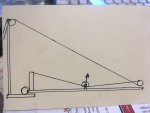
On sailing boats, masts have a similar problem but it is solved by attaching lines to appropriate points. I find it difficult to understand why a similar approach cannot be made for a crane boom. This view is supported by quick glances at fishing boats which have a derrick to allow the unloading of their catch. Universally, it seems, the boom is supported at the lifting wire end and at a point half wasy between that and the base. The routing of the lifting wire confers the winch pull force to the centre of the boom and twice that to the end of the boom by virtue of the sheave at that end.

Typical safe working loads are plated at 125kg. My mast weighs 170kg and a target safe load is set at 250kg.
I tried a similar arrangement with the light boom mentioned above but, as expected, the force in the centre was too great resulting in an upwards bend of the boom which would be equally effective in crumpling.
My latest thoughts are to fine tune the lift at the centre of the boom to counter the inherent sag by an appropriate routing of the lifting wire.
I wonder if routing the wire from the lifting winch round a sheave at the boom end, round a similar sheave attached to the centre of the boom and back to a point attached to the boom at a height to provide sufficient resolved force to counter the sag.
All expert opinions welcomed.
As in a previous post, the boat was wet and I have had the benefit of inside storage in an attempt to dry her out with infra-red lamps.
Despite 4 kw worth in a test area, the humidity gauge showed no improvement. On the basis that the boat will live longer than me (and probably my heirs) I abandoned the task and epoxied and Coppercoated.
To enter the shed, the mast had to be unstepped. The only crane available at the club had insufficient height.
So I volunteered to make one.
It didn't go well.
After scouring the Hornblower book of problems solved, I dropped the mast using the club hoist and a forestay arrangement. It was less exciting than it could have been but only just.
I now have to restep the mast. W
With half the crane built and proved, the problem remaining concerns the boom. The section I opted for proved to be too light and bent under a test load. It was circular Ø60mm with a 5mm wall. The full length available (7.6m) was used. It was horizontally pivoted to the winch platform which is capable of nearly a full rotation horizontally.
Seeking professional advice, the section choice seems to require the thrust line from the lifting point to rest well within the interior of the section ("middle third"). This recommendation is based on countering the sag in the boom due to its own weight.
The recommended size is 160 X 80 X 6. This seems to me to be a monster.
On sailing boats, masts have a similar problem but it is solved by attaching lines to appropriate points. I find it difficult to understand why a similar approach cannot be made for a crane boom. This view is supported by quick glances at fishing boats which have a derrick to allow the unloading of their catch. Universally, it seems, the boom is supported at the lifting wire end and at a point half wasy between that and the base. The routing of the lifting wire confers the winch pull force to the centre of the boom and twice that to the end of the boom by virtue of the sheave at that end.
Typical safe working loads are plated at 125kg. My mast weighs 170kg and a target safe load is set at 250kg.
I tried a similar arrangement with the light boom mentioned above but, as expected, the force in the centre was too great resulting in an upwards bend of the boom which would be equally effective in crumpling.
My latest thoughts are to fine tune the lift at the centre of the boom to counter the inherent sag by an appropriate routing of the lifting wire.
I wonder if routing the wire from the lifting winch round a sheave at the boom end, round a similar sheave attached to the centre of the boom and back to a point attached to the boom at a height to provide sufficient resolved force to counter the sag.
All expert opinions welcomed.