
Any advice on internal wood products

The gloss varnish is not original as you probably know. Rogers used a semi mat lacquer as often recommended by Concerto.. He knows.
The job is time consuming if done properly and tedious even if skimped. However , in my view, paint would be a disaster with an eye to resale.

BTW. The veneers used by Rogers can be 1.2mm as opposed to the more common .7 which means you can be much more aggressive in sanding. I have actually wire brushed mine to remove black staining 😳
Hi Doug748,
Point taken. I am only working on the galley area now. the bulkheads and storage lockers are all in good order and I wont be touching them at all. Perhaps I should try semi matt Lacquer first and see how it looks.

Steveeasy
 
Hi Doug748,
Point taken. I am only working on the galley area now. the bulkheads and storage lockers are all in good order and I wont be touching them at all. Perhaps I should try semi matt Lacquer first and see how it looks.

Steveeasy
Forgot to mention that I have been using Woodskin. The effect is reasonable and the trump card is it is very easy to apply and overcoat plus being handy for external work as well.
Still dark though.
 
There is wide range of products specifically for interiors, lacquers, varnishes, oils and polishes that will achieve the muted finish that the OP desires - and Tonkinois does not have the properties that will achieve this as you can see from here.
Le Tonkinois

So "all you need" is simply not correct, It is one of the better finishes for external work, although in my experience there are better - but it is often a matter of personal preference (and habit!).

Lacquer is preferred by many builders for the reasons concerto mentioned. For fine finishes in custom building Epifanes is often the finish of choice but it is time consuming to get that perfect drawing room furniture finish. Personally I use Ronseal satin, as being a poor lazy painter gives a good long lasting finish for little effort. It also blends in very well with finishes used on many modern boats like the Bavarias I owned, although I am not sure I would use it on large expanses of veneered bulkheads unless I was stripping right back or using new veneers as in the pictures attached. The first 2 were taken about 20 years after the finishes were applied and the last is new (in a different boat) There are no doubt many other good products available but few of us DIYers try enough of them to be able to give a balanced view.

If the OP wants to recreate the original then suggest he contacts Jeremy Rogers' firm to find out what they use, As ever it is the preparation that is key, not the final finish and stripping completely and refinishing is a mammoth task as concerto explains. That is perhaps why so many older boats need such drastic treatment - owners investigate and decide it is beyond them! Solid trim is relatively easy but large expanses like main bulkheads are challenging.

There is wide range of products specifically for interiors, lacquers, varnishes, oils and polishes that will achieve the muted finish that the OP desires - and Tonkinois does not have the properties that will achieve this as you can see from here.
Le Tonkinois

So "all you need" is simply not correct, It is one of the better finishes for external work, although in my experience there are better - but it is often a matter of personal preference (and habit!).

Lacquer is preferred by many builders for the reasons concerto mentioned. For fine finishes in custom building Epifanes is often the finish of choice but it is time consuming to get that perfect drawing room furniture finish. Personally I use Ronseal satin, as being a poor lazy painter gives a good long lasting finish for little effort. It also blends in very well with finishes used on many modern boats like the Bavarias I owned, although I am not sure I would use it on large expanses of veneered bulkheads unless I was stripping right back or using new veneers as in the pictures attached. The first 2 were taken about 20 years after the finishes were applied and the last is new (in a different boat) There are no doubt many other good products available but few of us DIYers try enough of them to be able to give a balanced view.

If the OP wants to recreate the original then suggest he contacts Jeremy Rogers' firm to find out what they use, As ever it is the preparation that is key, not the final finish and stripping completely and refinishing is a mammoth task as concerto explains. That is perhaps why so many older boats need such drastic treatment - owners investigate and decide it is beyond them! Solid trim is relatively easy but large expanses like main bulkheads are challenging.
Hi Tranona,
Noticed your chart table and wondered what choice of wood you used for this. lovely grain. Looks great.

Steveeasy
 
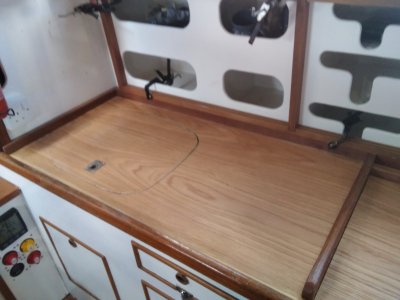
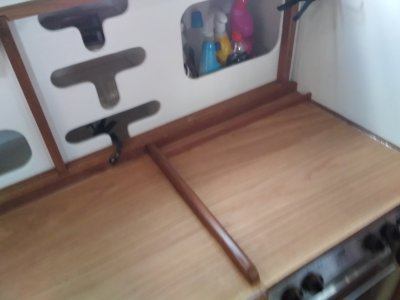
American Oak from The Veneer Hub, but just looked and they don't seem to list it now. 0.6mm so easy to cut and shapes. Comes about 300mm wide and about 2.5m long. If i were doing it again I would not use contact adhesive as 900*300 bits take on a life of their own and you really have only one chance to get it down if doing in situ like I did. However, not too difficult to make good any defects where it did not go down quite flat. Did the galley worktop the other side same way including the sink cut out and matching cover. Finished with an Osma oil same as used on our solid oak worktops at home.
Pleased with the result though as it made the area much lighter and looking more modern.
 

Attachments

  • IMG_20230406_170103.jpg
    IMG_20230406_170103.jpg
    1.9 MB · Views: 14
  • IMG_20230406_170125.jpg
    IMG_20230406_170125.jpg
    1.7 MB · Views: 15
Hi Tranona
Thanks for the information. Had not considered using a veneer, I’ll look on the site and may try useing it in one area. Looks nice.
Steveeasy
 
The only way to substantially lighten the interior is to re veneer with a light coloured timber. The easiest way is to buy very thin veneered ply and glue it on.

A product used for lightening / removing stains from wood is that good old fav : Oxalic Acid.

Yep ...

As regards internal finish ... I'm a great believer in wood stains (available from Clear through to really dark near black). No need to buy Marine based ... plenty of 'Decking ' stains / oils out there. Once applied and dried ... then a lacquer type varnish in matt / semi or full gloss.

I have my SR25 to replace all kitchenette woodwork after keel repairs. It will use 12mm Birch ply for main structure, backed up with 9mm Birch ply doors / extras ... (Birch ply is the only plain wood ply here in waterproof glue version).
It will use Light Oak decking stain - then semi gloss yacht varnish.

Original woodwork that has rotted away at hull joints and round sink :

USOu62Ll.jpg


New facing with stain .. waiting installation and then final finish.

IV23pIYl.jpg
 
Steve, the colour depends on what timber has been used. The Contessa Association should be able to advise what timber was used and what finish was originally applied. Bleaching the wood may lighten the timber slightly. You will need to ensure there is no remaining finish on the wood and to do this wet the timber and see the moisture is absorbed evenly on the wood, if not then some more preparation work is required. If you want to try bleaching a small patch, buy the cheapest supermarket bleach as it is not perfumed, and dilute with 4 parts water to 1 of bleach. Brush on and leave for about 15 minutes, then wash off with fresh water. See if there is a difference in colour, but some timbers will change very little.

I suspect Jeremy Rogers used a laquer not a varnish. The reason is it is very quick drying allowing up to 4 coats a day and is not sticky whilst drying. Where as varnish takes 24 hours between coats and attracts dust until dry, so not really suitable in a building shed.

There are a number of manufacturers suppling lacquers, I have used Morrells. They mainly supply the furniture industry, so are really a trade supplier with a string of branches all over the country. I bought the same lacquer as Westerly used, which is their 450 acid catalyst high build low odour lacquer. It can be from full gloss to fully matt. Westerly used a slight sheen using a 30% mix, i.e. close to fully matt. The smallest quantity they supply is 5 litres, with associated catalyst and 5 litres of thinners. A couple of years ago this was just under £60 including VAT. It is designed to be sprayed, but can be brushed. I applied 3 coats to Concerto's interior and it brought the sapele interior to life.
Morrells | 450 Low Odour High Build Acid-Catalyst Lacquer

This presentation I gave explains it in a lot more detail.
https://wiki.westerly-owners.co.uk/images/2/25/Interior_Woodwork_Concerto_PowerPoint.pdf

This photo shows the difference between the lack lustre port side of the main bilkhead and the refinished starboard side.

View attachment 160375

Edit. It was very late last night and I forgot to include a video of Concerto at the Southampton Boat Show when the interior woodwork had been almost completed.
Forgive me for saying it ... but I prefer the port side ... that refinished stbd side gives me impression of 'false grain lines' or brush strokes ...

It would drag my eyes to it all the time ...

Sorry .
 
Forgive me for saying it ... but I prefer the port side ... that refinished stbd side gives me impression of 'false grain lines' or brush strokes ...

It would drag my eyes to it all the time ...

Sorry .
The bulkhead is finished in sapele, so there are strong grain lines. The lacquer on the port side had gone cloudy and dull, whereas the starboard side is clear. If you had seen it in real life you would never have chosen the port side finish as it looked very tired. The starboard side is also very close to the original colour and finish as was possible after nearly 40 years.
 
The bulkhead is finished in sapele, so there are strong grain lines. The lacquer on the port side had gone cloudy and dull, whereas the starboard side is clear. If you had seen it in real life you would never have chosen the port side finish as it looked very tired. The starboard side is also very close to the original colour and finish as was possible after nearly 40 years.

I use Sapele for covering foam items after hot wire cutting ... so its a well known wood for me. I have to say that the veneer sheets I use never have such strong grain lines as that .... but there ye go.

I understand your comment about 40yrs .... I have two boats ... SR25 from 1973 ... and the Conq38 from 1986.
 
. Any suggestions on types of suitable products
Yes!!!
No painting involved, no scraping or sanding , it shouldnt yellow, flake or crack ?
Vinyl wrap, self adhesive !! You can get a wood effect textured finish. It loves sticking to varnished surfaces.
 
Forgive me for saying it ... but I prefer the port side ... that refinished stbd side gives me impression of 'false grain lines' or brush strokes ...

It would drag my eyes to it all the time ...

Sorry .
The heavy grained Sapele was very popular in the 1980s and still highly prized for foredecks on dinghies such as the Osprey. Also used by Bavaria right up to the early 2000s but with a more matt finish rather than the gloss lacquer. The main bulkheads in my GH from 1979 are Sapele but much more muted and although a bit dull, don't intend doing any stripping and refinishing.
 
The heavy grained Sapele was very popular in the 1980s and still highly prized for foredecks on dinghies such as the Osprey. Also used by Bavaria right up to the early 2000s but with a more matt finish rather than the gloss lacquer. The main bulkheads in my GH from 1979 are Sapele but much more muted and although a bit dull, don't intend doing any stripping and refinishing.

Sapele was popular as a door finishing veneer and could be bought literally in rolls ... or flat sheets. The rolls needed dampening to unroll to avoid splitting ....
 
I'm not going to try to influence the OP, just make a couple of comments.

Le Tokinois is not tung oil as used on Travels with Geordie. It's based on it, but is more like a varnish, but it doesn't lift and trap moisture when damaged like varnish - just rub down and apply a few more coats. As supplied, it has a durable high gloss finish, but you can get a matting additive to get the finish you want, though I've never used that. As you may have gathered, I'm a fan, but I wouldn't bother indoors, just use something like Ronseal Diamond Hard floor varnish in the finish you want.

I've been disappointed with Dulux Satinwood. My painter & decorator son recommended Leyland Trade Satinwood, and it does indeed seem to be tougher. I don't know whether that's the difference between brands or the difference between the clean up with water DIY stuff and the clean up with white spirit trade paint.
 
I'm not going to try to influence the OP, just make a couple of comments.

Le Tokinois is not tung oil as used on Travels with Geordie. It's based on it, but is more like a varnish, but it doesn't lift and trap moisture when damaged like varnish - just rub down and apply a few more coats. As supplied, it has a durable high gloss finish, but you can get a matting additive to get the finish you want, though I've never used that. As you may have gathered, I'm a fan, but I wouldn't bother indoors, just use something like Ronseal Diamond Hard floor varnish in the finish you want.

I've been disappointed with Dulux Satinwood. My painter & decorator son recommended Leyland Trade Satinwood, and it does indeed seem to be tougher. I don't know whether that's the difference between brands or the difference between the clean up with water DIY stuff and the clean up with white spirit trade paint.
How do you stop it skinning over in the tin? Do you decant to plastic to be able to exclude air? Nightmare stuff.
 
Either it goes into a plastic milk container which I squeeze to get as much air out as I can, or I make sure the lid is on properly and store it upside down. That way, the skin is on the bottom. You're right, though. Skinning and dry bits getting on the brush are the worst thing about it, and an inch in the bottom of the tin will be wasted unless used soon. Always best to filter through a retired pair of Madam's tights into a container before using - and filter any excess going back into the tin.
 
Either it goes into a plastic milk container which I squeeze to get as much air out as I can, or I make sure the lid is on properly and store it upside down. That way, the skin is on the bottom. You're right, though. Skinning and dry bits getting on the brush are the worst thing about it, and an inch in the bottom of the tin will be wasted unless used soon. Always best to filter through a retired pair of Madam's tights into a container before using - and filter any excess going back into the tin.
Storing upside down doesn't seem to work for me. Once it's back the right way up it can break through the skin, which leads to a right mess.
 
Top