Antifoul removal

As I said in #13, full face mask and a vacuum cleaner deal with the dust. I have very good reason to take care of my lungs...
'

I don't wish to be difficult and I was perhaps a little unkind earlier in describing people who dry-sand antifoul as "bloody fools and nuisances" but I'd really like to know what precautions do you adopt to take care of other people's lungs? Not only those of people on nearby boats and passers-by but also those of people who are going to have ultimately to deal in some way with the toxic dust you produce.

You claim, I think, that all the dust you produce is collected by your vacuum cleaner.

It must have a very fine filter. What type of vacuum cleaner is it?

How do you safely dispose of the dust you collect in it?

How do you dispose of the dust on your clothing?
 
If you use eroding antifoul, it's easy to remove most of the old stuff with a running hose and a Scotchbrite pad - and no dust to get in to your lungs!

I do use the eroding stuff, and it's very tempting, but there's no catch tank where I lift out and it would all end up in the river.


I don't wish to be difficult and I was perhaps a little unkind earlier in describing people who dry-sand antifoul as "bloody fools and nuisances" but I'd really like to know what precautions do you adopt to take care of other people's lungs? Not only those of people on nearby boats and passers-by but also those of people who are going to have ultimately to deal in some way with the toxic dust you produce.

You claim, I think, that all the dust you produce is collected by your vacuum cleaner.

It must have a very fine filter. What type of vacuum cleaner is it?

How do you safely dispose of the dust you collect in it?

How do you dispose of the dust on your clothing?

It wasn't me that claimed that all the dust was collected by vacuum, but it is surprisingly good at sucking at the tool end (Vax with paper bags btw). If I was sure that it was perfect I wouldn't wear the full face mask - expensive and designed for toxic paint spraying.

I've had the boat for four winters now, and the vac bags are all still in a black bag at the workshop! Any suggestions? As I type I wonder about mixing it with used oil and donating it at the local dump's waste oil tank?

Clothing etc. Overalls, but there's not actually much to see on them other than at the wrists from tool/disc handling. I do blast it off with compressed air before taking off the mask though.

I'm luck enough to have a workshop and space for the boat outside which is about 150m from the one nearby house, and I don't sand (paint or do anything noisy) if the wind is in that direction. The next nearest houses are widely spaced half a mile away.
 
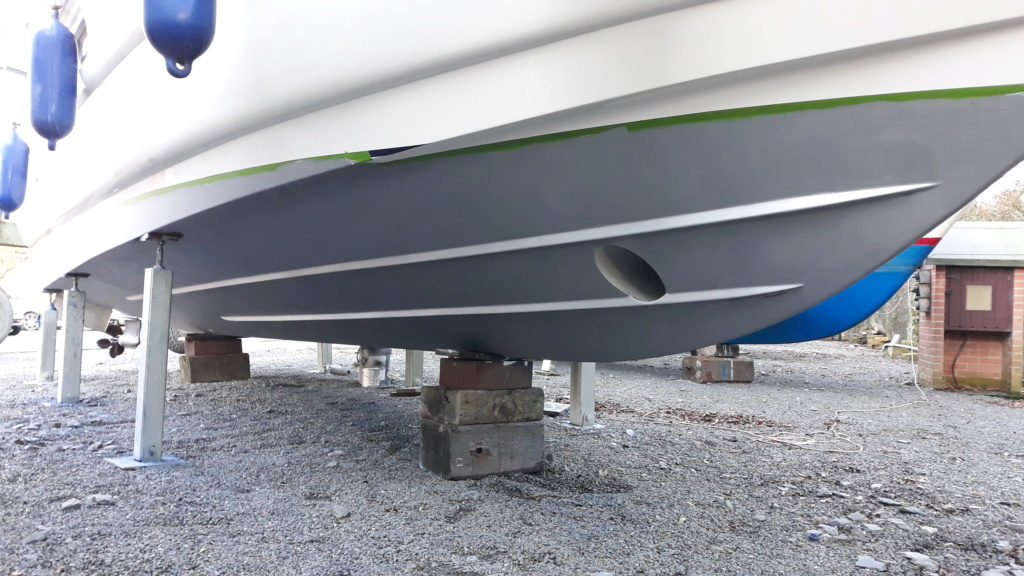
I found wet sanding was quite messy but considerably less so than dry sanding. With suitable protective clothing , gloves and safety glasses I managed to keep most of it from my skin. I didn't attempt to fully remove it - just enough to see the surface was smooth and white gel coat showing through in places . I applied a barrier primer coat prior to the antifouling.
Almost an advantage doing the job in January as thicker clothing made lying under the boat just that little less painful.

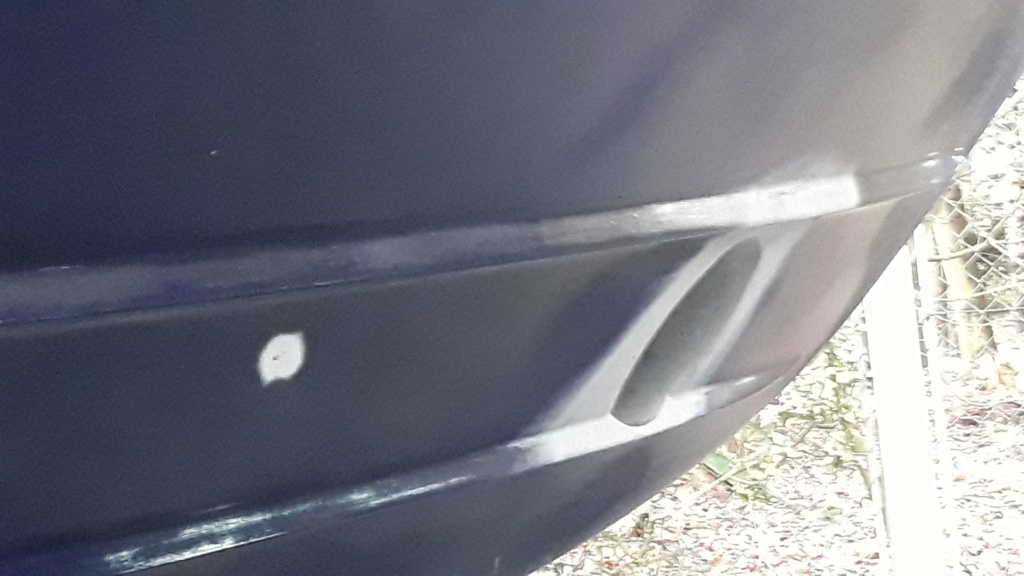
Sanded smooth - gel coat showing in places (thruster tunnel sprayed in trilux)

.
Barrier coat


Antifoul coat
 
Where on earth do you think eroding antifouling goes when you're out on the water?
A. Mainly straight into the digestive system of the lifeforms that are attracted to and thrive on my boat.

B. What's left after a season is rough and doubtless contains little biocide so needs to come off, but there's a lot of it by comparison with what's eroded during the season. I just don't like the idea of putting any more into the river than I need to.
 
A. Mainly straight into the digestive system of the lifeforms that are attracted to and thrive on my boat.

B. What's left after a season is rough and doubtless contains little biocide so needs to come off, but there's a lot of it by comparison with what's eroded during the season. I just don't like the idea of putting any more into the river than I need to.

Why do you think it "contains little biocide"? The biocide is evenly distributed within the paint layer.
 
Umm. Has someone painted a target on me?

1. Because, being a bit of a realist, I assume that the paint and biocide don't actually disappear at exactly the same rate.

2. Maybe it's because the water is warmer or different species are involved, but it certainly doesn't work as well at six months as it does after one.
 
Scraping and a bit of wet sanding to finish off. It's a hard workout but saves going to the gym for a few days. If your fit & well and don't mind a bit of diy then it's OK.
 
I found Peelaway stripper pretty effective on numerous hard (but brittle) layers of antifoul and it allows the dustless debris to be collected on a tarpaulin .
It's worth buying the test kit to see if the effect persuades you on your particular A/F build up.
Certainly saves older arms and can be employed without a great deal of PPE.
 
Having the hull blasted is a great idea.

Trouble is, there is still loads of work to do i.e numerous coats of epoxy,
primers etc . If you live in northern climes, getting the right weather and spare time rarely coincide .

Summer is the best time but eats into sailing . My top tip is to wait until you
retire and carry on antifouling .
 
As Long keeler, - Ok the surface is a little rough but if clean of weed and critters, not a great drag. Unless of course you need to win races against other keen folk. Mind you one bad tack or fouling the Kite drop and you've lost in any case. Some might also ask " Do you really need to feel good about winning?" but that's another thread.
 
HI. I'm considering getting my boatyard to blast the antifouling off my 35 footer. GRP hull, 40 year old boat. Once it's off what do you reckon? I've been advised by a local chanldery to gor this approach considering the age of the boat:

Sanding, 2 coats of epoxy primer, 1 coat hard antifouling then a softer antifoul which will be jet washed and repainted annually.

I read so many conflicting views in so many threads so I thought I would ask as I haven't done this before. The current antifouling is flaking and coming off in a lot of places. The boat is old, (I'm getting on as well) and will be on a pontoon mooring in a tidal estuary. I'm also on a budget since I'm rewiring, new engine parts, new cabin lining etc. Thanks in advance for any advice.
 
Maybe I'm a masochist but I've done it twice by hand on this boat once 10 tears ago to remove 20 years or so buildup and epoxy and again a year ago to remove 10 years after new yard idiot blasted holes in it. Only takes around 3 days on 38 ft boat (allowing for beer breaks) and another day to prime with vinyguard. I'm happier keeping my money for beer.
About the same for me, 18 hours over three visits for my 39 footer. I found a vacuum scraper to be the best tool for the job. Virtually no dust or flakes on the ground afterwards.
 
Now as a crazy aspie ADHD, person I go at it like a bull , 42 ft long keeled, 20 years of anti foul,
Looked like the moon surface.
No problems im game!!!
Let's try stripper , nope waste of money and time.
Scrapping , unless you get the right scraper forget it
Sanding and jet washing , was the best option. Full white suits, x2 mask for fine particles the ability to lie flat comfortably a must .
Still not the best,
I took a grinder to get throught the thickest parts, and the sanded and scraped.
Man hours probably 5 full work days of messy, back breaking , toxic work.
Tried to get it sand blasted,no one available, tried a company , to busy.
Never again, soul destroying work.
In regards to mess I asked the yard to put me by myself, I watered down the area constantly, and used vacuum, I also had sheeting down and swept and cleaned up every day. Which needs to be added on to the work
I am hopefully now in a position when she comes out in November and gets jetted most comes off .
I will scrape and sand again and apply
I hope and pray this is easier than last time or I will cry
 
HI. I'm considering getting my boatyard to blast the antifouling off my 35 footer. GRP hull, 40 year old boat. Once it's off what do you reckon? I've been advised by a local chanldery to gor this approach considering the age of the boat:

Sanding, 2 coats of epoxy primer, 1 coat hard antifouling then a softer antifoul which will be jet washed and repainted annually.

I read so many conflicting views in so many threads so I thought I would ask as I haven't done this before. The current antifouling is flaking and coming off in a lot of places. The boat is old, (I'm getting on as well) and will be on a pontoon mooring in a tidal estuary. I'm also on a budget since I'm rewiring, new engine parts, new cabin lining etc. Thanks in advance for any advice.

You say you're on a budget and "getting on in years" isn't necessarily an excuse for not saving money by scraping. I'm in my 70s and did it a couple of years ago. I wouldn't epoxy unless the hull is very dry, otherwise you will just be sealing moisture in. Prime with Jotun Vinyguard and antifoul.
 
About the same for me, 18 hours over three visits for my 39 footer. I found a vacuum scraper to be the best tool for the job. Virtually no dust or flakes on the ground afterwards.
.

I could do with something like that for scraping off my deck paint but the price, £39.95, is steep for what it is.

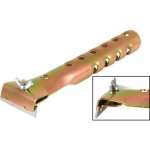
I wonder if one of these with the holes taped up and a hose attached might not work as well. £9.70.

paint_scraper_toolstation.jpg


General Purpose Scraper
 
Top