Anti-fouling DIY or not DIY?

mickyp168

Well-Known Member
Joined
7 Jan 2015
Messages
108
Location
Cannes France
Visit site
Hi
Just done my first antifoul. I put a post on here previously and got some good tips. This forum is a Godsend , plenty of good advice from helpful people who love boats from all around the world . Some people advised paying someone to do it, probably tongue in cheek. I did look into that and for my 23' sloop here in France it would have been 1000 euros. Not an option pour moi so I did it myself which I wanted to do anyway. But doing the job , apart from a good anti foul of 2 coats , I found a few other things that needed sorting. For example a bit a damage to the keel probably from grounding. Could have led eventually to water ingress so I sanded, filled, glassed, gel coated, and AF'd the keel edge. So it's now bon etat. I also applied a bit more AF to the areas that there was the most fouling for reinforcement. Now I am pretty sure that unless you know and trust the person/yard that would do your antifouling for you they wouldn't do that. I think most boaties love their boats. Mine is part of the family. So maybe unless its really not an option we should be doing our own antifouling. You can't generally see what is going on below the water line. Just a thought , and thanks again for the advice I got on this forum;
Mick
 
A danger to applying AF yourself, and it can be a problem of employing someone else to do it also, there is a tendency to apply too thinly (AF is money), eke it out to get maximum coverage not maximum coating thickness. The paint companies have recommendations of coating thickness, for a reason - and its not about them selling more paint!

Its a pleasure to hear you have joined the ranks of those who do their own AF - as you have found out it has some unforseen benefits, its not that difficult anyway and its much cheaper than paying someone to do it.

The only difficult decision is what to apply :(

Jonathan
 
Always do it myself. Part of my committment to touch every part of the boat, inside and out, every year. Means I spot problems when they are still small and cheaper to fix.
 
My antifouling cost less than £100 last year, but at my daily rate would have cost a fortune to apply. Thank goodness I don't charge myself for the work done.
 
I don't think I've ever paid anybody to do anything to my boat!
I've been paid to AF and varnish other people's boats mind...
 
A danger to applying AF yourself, and it can be a problem of employing someone else to do it also, there is a tendency to apply too thinly (AF is money), eke it out to get maximum coverage not maximum coating thickness. The paint companies have recommendations of coating thickness, for a reason - and its not about them selling more paint!

Its a pleasure to hear you have joined the ranks of those who do their own AF - as you have found out it has some unforseen benefits, its not that difficult anyway and its much cheaper than paying someone to do it.

The only difficult decision is what to apply :(

Jonathan
That was part of the advice I got. So a chat with a few of my neighbours in the marina sorted which AF was best suited for where I am. AF best for the northern Med being a warm water is different to what is best suited to a colder climate. But I found local stockists knew this and the stuff they had was what I wanted. But a big super store type place stocked some AF that although much cheaper and therefore very tempting, wasn't really the right stuff. You live and learn.
 
As you have rightly found, antifouling is one of those processes which sucks but has a spin-off advantage of giving the boat a thorough check. Polishing the top sides is another one well worth the effort.

Apart from the added benefits, I suspect that we as owners do a better job than would a commercial enterprise.
 
As you have rightly found, antifouling is one of those processes which sucks but has a spin-off advantage of giving the boat a thorough check. Polishing the top sides is another one well worth the effort.

Apart from the added benefits, I suspect that we as owners do a better job than would a commercial enterprise.

I must be in the minority because I actually enjoy antifouling for the few hours it takes. Like others have said, it gives you the opportunity to inspect the hull etc, but it also gives me the chance to admire her lines when out of the water.
I also polish the hull which also has the desired effect and gratification that comes with knowing she looks at her best.

I must be a bit sad, and wonder if other yacht owners feel the same about their yachts, or is it just a means of pleasurable transport?

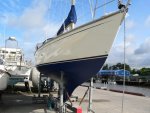
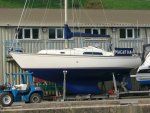
Here is a couple of photos of mine antifouled and polished.

Not bad for a yacht that is one of 40 ever built, and over 41 years old !!
 

Attachments

  • Ashore at Baltic Wharf (74).jpg
    Ashore at Baltic Wharf (74).jpg
    91.9 KB · Views: 2
  • Pre Launch Photos 036.jpg
    Pre Launch Photos 036.jpg
    91.7 KB · Views: 2
  • Pre Launch Photos 014.jpg
    Pre Launch Photos 014.jpg
    94.9 KB · Views: 2
What does "professional" mean in this context?
That the applicator is paid to do it?
That the have a degree in antifouling application?

And what warranty could a yachtsman expect of anti-fouling? With such a huge variation of environments that the paint could be introduced to in the life of the coating, I can't imagine any paint company taking responsibility for anything.
 
There's a certain "repairer" in North Wales who can do a 40ft boat with a litre of antifoul. That must the meaning of professional. It might be matt arcylic emulsion though.
 
It would be advantageous to know which AF company will only warrant the product if professionally applied. Geoff's comment is very valid - I would think that warranty completely worthless and any surface coatings company with that sort of restriction should be viewed questionably. I know this is a policy of Prop Speed, and for that reason I would buy Prop Gold or Velox. Fluoro polymers those high tech silicone coatings used on large commercial vessels probably have this sort of restriction but as the 'paint' is only available in huge drums - it cannot be much of an issue.

So tell us :)

Jonathan
 
Our previous boat was a 60ft ex Scottish Fishing Boat. My wife and I would antifouling her between tides.:disgust:
Now that we have a 36ft ketch, which is antifouled on dry land, antifouling has become a pleasure.;)
 
Our previous boat was a 60ft ex Scottish Fishing Boat. My wife and I would antifouling her between tides.:disgust:
Now that we have a 36ft ketch, which is antifouled on dry land, antifouling has become a pleasure.;)

We used to antifoul our Vega between tides, against a wall. SWMBO would suddenly develop claustrophobia and refuse to do the side against the wall- that was a horrible job.
New boat has legs so AF is quite civilised as there is easy access all round, not even any cradle pads etc to worry about.
 
And what warranty could a yachtsman expect of anti-fouling? With such a huge variation of environments that the paint could be introduced to in the life of the coating, I can't imagine any paint company taking responsibility for anything.

The second photo down https://coxengineering.sharepoint.com/Pages/Legs.aspx was taken many years ago (1995?). Several club members, including ourselves, applied International Micron shortly after it was first introduced. Its performance was atrocious, as the photo shows, not only on our boat but on all the others also. One of us took it up with International, who fairly readily agreed to supply paint for following season FOC. In the next year the A/F performance was a lot better.
 
Top