Anode advice please

Gavin E

Well-Known Member
Joined
7 Sep 2018
Messages
80
Visit site
Hello everyone. This is my first forum post, having lurked in the shadows for a while whilst navigating the process of buying our first boat.

She is a 1990 fairline sedan 36, and has a couple of bits that need sorting, and I’m just weighing up the best plan of attack. She had new anodes fitted 12 months ago ( saltwater ) which need to be changed to fresh, and one of the seacocks will not close, so this needs replacing.

My issue is that here on the Thames I am struggling to find any free space to have her lifted and placed on blocks for the winter while I sort these bits, and the ‘quotes’ I have been able to squeeze from people to do the work have been so vague as to be useless. (Basically they amount to “I’ll have a guess at cost when the boat is out of the water”). The local crane guys seem happy to lift her out for a day while their guys do the work and then put her back in the water, but I’m a little worried about paying for a lift etc without even much of a hint of the likely cost of the job?

I’m reasonably ‘hands on’ with practical stuff, and I can usually sort most bits above the waterline myself, so I was hoping to do the same with the bits of the boat that stay wet too.

So I was wondering how urgent these two jobs are? Bearing in mind that the anodes are still quite new and the boat has not been used, would they do the job until next autumn to give me time to book space in the marina and then organise the work once I can actually see the bits that need sorting, or would this be really stupid? The chaps in the marina seem to be playing down the essential nature of the sea cocks on a river boat, and don’t see much of an issue with one that is locked open.

If they can wait a few more months, I was thinking I could also use this opportunity the re apply the anti foul and get that out of the way too, even though it would be being replaced a little sooner than is absolutely needed.

Like I said, first boat etc etc, so feel free to say if this is a really bad idea.

Thanks. Gavin
 
Welcome to the forums. Some fairly standard new owner problems, and you sound easily capable of solving them .


What sort of % are the anodes worn ? Is the bonding (electrical connections) in good condition. That can be checked with a meter.

If you can't lift he boat for a length of time, then freshwater anodes can be dangled over the side if they are bonded in to the anode circuits.

What does the stuck seacock serve ? Stuck open, or closed ? Many seacocks are serviceable (Blakes are very satisfying to look after :) ) so perhaps it's a question of the usual heat and oil, and a bit of gentle leverage to unstick it. Best done on land in case something breaks and you have to replace it.

Of the antifoul is reasonably OK, then a lift out and severe talking to with a stiff brush may rejuvenate it until autumn, by which time you will have a looooong list of other things that you want to change :), plus you will have found a number of overwinter stops.
 
Last edited:
Welcome to the forum. With the seized seacock, you're gambling on not needing to close the seacock for some reason between now and your proposed future lift; if there's no incident in that time that requires the seacock to be closed then you could get away with this (but if there *is* an incident, you're in trouble). Anodes on the other hand will just fizz away regardless, and I don't think I'd want to wait another six months to change the wrong year-old anodes on the boat. For the avoidance of doubt, 12 months is not 'quite new' for anodes, typically anodes will be mostly wasted after 12 months. In your position, I'd lift the boat now and get these two small jobs done.
 
Welcome to the forum and a very fine craft you have there.

I sold my sedan 36 last summer having totally renovated it. There’s not much I didn’t get into so feel free to ask anything. I have good contacts for parts you may need having done lots of research. Happy to pass anything on.

Anodes have already been covered above. Dangling anodes over the side is a good idea aswell as a galvanic isolator on the shore power. You can buy inline ones for not a lot which should help reduce anode wear.

The sea cock however would give me sleepless nights. You may not be covered by your insurance too if it’s stuck open. If you can’t get a lift, I would buy emergency seacock bungs, have a mains powered pump ready to go, a friend with you and try to give it a good working.

TAMD61a engines?

Best of luck and you have one of the finest vessels there IMHO :D
 
Zinc anodes for salt water will not protect against corrosion in fresh water.
It is difficult to say whether waiting until next autumn to change the anodes will cause any issues.

For the sea cock try repeated application of penetrating spray.
 
I would not unduly worry about the anodes, but would look to replace the dodgy seacock. This could be done between tides or on single lift in about an hour, but book a 2 hour lift.

I would suggest Forespar Marelon then simply grind out the old skin fitting and replace the whole assembly with a new mushroom thru hull with new valve. Seal with Sikaflex 291, and allow ~ 2mm radial clearance between the new fitting and the hole through the hull.

When the boat is lifted you will need immediately available ...

1 240v supply
2 Angle grinder to cut the original skin fitting out
3 Hole saw to suit the new skin fitting diameter + 1-2 mm
4 Mushroom skin fitting and seacock (Forespar Marelon)
5 Sikaflex 291
6 An assistant

Insert the new skin fitting then cut off to suit the sea cock. Load the new fitting with plenty of 291, insert then pull the fitting up so ~ 2mm of filler remains to pull up once the mastic has set off.

The new seacock should be fitted immediately.
 
Which bit of the Thames ? Fresh or Salt.
Probably good idea to go over onto the Thames Forum where you will get chapter and verse on cost of lift outs/anodes and wether to even bother with A/F.
Recent post regards lift out costs at various locations.Sometimes best to consider a location close to home rather than the cheapest.
More likely to find a lift and time ashore above Teddington than below, even if the charges seem eyewatering to those of us boating elsewhere.
Last year one boater was very happy to pay around £1200.00 for Lift /A/F / new Anodes and hull polish on a Broom 36 Sedan.Perhaps a good idea of costs involved.Suspect that the lift is the major expense.
It would appear that the regular annual application of A/F may be waste of time in freshwater, have observed boats which have not been anti-fouled for two or three years, merely needing a jetwash to get the bottom clean again..
Good idea while you are out of the water to check/change the stern gland packing, although this can be done while afloat.
As for raw water intake valve , leave until ashore, then attempt again to move the handle, you may well it find it merely needs a little more force than you are sensibly prepared to use while boat is in the water.Lots of web info as what to look for regards dezincification, but IMHO, the skin fittings on earlier Fairlines and Princesses were pretty good quality and many/most are still floating today with perfectly seviceable original valves.
Once freed, just opening and shutting every now and then will usually prevent from becoming difficult to shift again.
 
Last edited:
Lots of good advice already given. I can understand you wanting to wait and then also renew your antifoul. I would also be tempted to do that, but you need to understand that anodes are there for a reason, and the fact the boat has been virtually unused makes no difference to their wear. And you now need fresh water anodes.

Wrt your seacock, is it below or above the waterline? Wooden bungs have already been mentioned, but they are for emergency use. The problem you have is not knowing if it’s just stuck open, or whether the seacock itself is corroded. If the former, then I personally would leave it till next lift out, but at the same time applying regular lubrication. If the latter, then lift out and replace asap. If you don’t know the answer to this question, then you must assume the worst.

Enjoy your new boat, you’ll almost certainly have lots of other issues arising in the coming months and years, all part and parcel of boat ownership. But you’ll soon forget about them when you’re onboard enjoying yourself!
 
Gavin, since I'm in salt water, I'll leave the others to reflect on the appropriate anodes. In respect of the stuck seacock, it's certainly best done on the hard or in the slings. Not sure of your particular brand, since I have a US manufactured boat with Perko brand, however, my advice would be to research kits/spare parts of the brand you have and have them onhand. Even if you can remove/clean handle spigot/spindle and replace, it's much easier to swap it out so you so can splash the boat in a hour or so, than not have the bit you need. The Perko brand cocks have a large cap nut holding the ball in place with two rings (one each top and bottom of the large ball). The spindle spigot slots into the ball which screws in the side (with 2 O rings to seal the unit. If spares are available, fitting a completely new unit shouldn't be necessary.

You'll be able to transfer to above deck knowledge to the hull once you see what's going on. A lift and pressure wash may be all that's needed to clean up the hull. Have fun.

Cheers
 
Lots of good advice already given. I can understand you wanting to wait and then also renew your antifoul. I would also be tempted to do that, but you need to understand that anodes are there for a reason, and the fact the boat has been virtually unused makes no difference to their wear. And you now need fresh water anodes.

Wrt your seacock, is it below or above the waterline? Wooden bungs have already been mentioned, but they are for emergency use. The problem you have is not knowing if it’s just stuck open, or whether the seacock itself is corroded. If the former, then I personally would leave it till next lift out, but at the same time applying regular lubrication. If the latter, then lift out and replace asap. If you don’t know the answer to this question, then you must assume the worst.

Enjoy your new boat, you’ll almost certainly have lots of other issues arising in the coming months and years, all part and parcel of boat ownership. But you’ll soon forget about them when you’re onboard enjoying yourself!
V.sensible comments, No one wants to #waste# money, but you also have to think of the inconvenient cost in relation to a potential disaster. Sorting out the seacock should solve that one for 5, 10,15 years.
Ones below the waterline are a bit more key than the obligatory replacement of all scatter cushions on a new purchase ;)
 
Hello to all and thanks for so many helpful replies.

I will be heeding the general feeling of all the replies and sorting the repairs in the near future rather than leaving it until next winter.

It is hard for me to judge the current state of the anodes, as the boat survey simply states that they need replacing because they are the wrong type, and does not detail the condition. Having the seacock stuck open has never seemed like a great thing, as I just assumed that a shut off valve to help stop water coming into the boat seems like a good thing to have.

We are based for the moment at Caversham, and had limited options for the the work due to the radar arch being too tall to allow us to get under the bridges either upstream or downstream, but over Christmas I have now managed to remove the arch and cap it, which I hope opens up a whole new list of potential solutions.

I may end up having to simply pay someone else to sort it, but think that my preferred option will still be to find somewhere that is able to accommodate us for a couple of weeks out of the water while I have a look and try to sort as much as I can myself. This isn’t simply to save money, but also because I’m finding that the more I do the more I understand how the boat - and everything on it - works, which can’t be a bad thing.

It is a steep learning curve, so if these are jobs best left to those with more experience just tell me.

Since it seems the local yards are now full for the winter, I can foresee that I might need to wait until the weather gets warmer and everybody else gets back in the water, which will not please my good lady, but we will just have to put up with it.

Thanks again for the replies.

Gavin
 
Gavin, would it be worth buying a little underwater video camera which you could put on a pole and check out the anodes yourself ?

For portable use in the hydro electric station, we have a 'cheapy' one with a light (not the endoscope sort but a proper w/proof video camera) which attaches to a laptop and gives live pics. About the size of a can of gooseberries. It's also been known to be taken to the boat, ahem !, where it is Very Useful. Much better definition and picture than the endoscope types.

Look for "fishing camera underwater " on Amazon or ebay.

If the haul out decision depends on the anode %, a camera will give you the info, and also have good future value inspecting props etc., and making new friends :)
 
Welcome to the forums. Some fairly standard new owner problems, and you sound easily capable of solving them .


What sort of % are the anodes worn ? Is the bonding (electrical connections) in good condition. That can be checked with a meter.

If you can't lift he boat for a length of time, then freshwater anodes can be dangled over the side if they are bonded in to the anode circuits.

What does the stuck seacock serve ? Stuck open, or closed ? Many seacocks are serviceable (Blakes are very satisfying to look after :) ) so perhaps it's a question of the usual heat and oil, and a bit of gentle leverage to unstick it. Best done on land in case something breaks and you have to replace it.

Of the antifoul is reasonably OK, then a lift out and severe talking to with a stiff brush may rejuvenate it until autumn, by which time you will have a looooong list of other things that you want to change :), plus you will have found a number of overwinter stops.
The bit about dangling anodes over the side has got me thinking. Do you tie them to insulated wire or bare wire or string? And how close to the sterngear do they need to be?
 
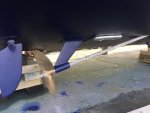
This is where to main hull anodes live. One each side. You should find the studs/bonding inside the lazerette.

From memory 7.25kg bar m16 nuts. https://www.solentanodes.co.uk/collections/zinc-anodes/products/zinc-bar-bolt-on-anode-7-25kg

87A7AF85-FA5B-46BE-927A-4F8C879FCAA3.jpg

Visually inspecting is a good idea however, if you look and they appear new, is that a good thing or are not bonded correctly? I had that on this very boat. One was knackered....one was hardly worn. On checking, the good one had no continuity so was doing nothing.

A diver could change the anodes but again, not sure if you can get submersible volt meters?

Not sure on the dangling anode but it needs to be connected to the bonding circuit I would imagine.
 
Last edited:
Ok. Thanks for loads of really helpful thoughts on my anode issue.

It seems the general opinion is that it’s not a great idea to leave either the anodes or the seacock, so the plan now is to wait a couple of months until I can find some free space on the river bank, then have her taken out for just a few days while I sort things. I want to get everything ready to go, so would rather have everything to hand before she comes out.

As suggested I dug out my GoPro and waved it around under the boat hoping to see what is underneath. It’s an old camera so not great in the gloom, but I did manage to see the bits in the photo helpfully posted by Farsco. So far so good.

I can’t work out how to add a screen shot so you can all see what I see, but it simply looks like a grey version of the anode in the photo posted by Farsco. The one on the other side looks similar - both a bit dull but other than that no real sign of wear as far as I can see. Bearing in mind other comments about lack of wear possibly indicating that they are not correctly wired in, should I be at all concerned and how/what do I test to check?

I assumed that since the wrong anodes will just fizz away quite rapidly I should be seeing anodes in poor condition?

Also, while I’m on anodes, are there any others hiding further forward that I should know about?

Thanks again, and happy new year to you all.
 
Top