Anchoring with a windlass

Stemar

Well-Known Member
Joined
12 Sep 2001
Messages
25,685
Location
Home - Southampton, Boat - Gosport
Visit site
I've never had a windlass before. My normal technique was to lay out the length of rode I wanted and lower it over the front, letting it out as the boat drifted back. I see - and hear - people who just press the down button, which strikes me as a very slow way to do it, especially in a few metres of water, when it seems I'd have drifted away from my chosen spot before then anchor touches down.

How do you do it?
 
I personally use the clutch; others prefer to use the windlass motor as they have a chain counter. Using the windlass motor is also more practical if singlehanded and anchoring to moor stern-to a quay, except if one likes acrobatics :)
 
I've never had a windlass before. My normal technique was to lay out the length of rode I wanted and lower it over the front, letting it out as the boat drifted back. I see - and hear - people who just press the down button, which strikes me as a very slow way to do it, especially in a few metres of water, when it seems I'd have drifted away from my chosen spot before then anchor touches down.

How do you do it?
I use the down button on the windlass. It doesn't have an easy to use clutch and taking the chain off is a pain. Once I have enough chain out I gently 'set' the anchor. Once all done I use a chain hook / snubber to take the load.
 
I use the down button on the windlass. It doesn't have an easy to use clutch and taking the chain off is a pain. Once I have enough chain out I gently 'set' the anchor. Once all done I use a chain hook / snubber to take the load.
+1. I also have very clear markers at 5m intervals so I know exactly how much I have let out. In most situations anchoring in less than 5m the anchor is on or close to, the bottom when the first marker goes over the roller.
 
I lay out enough chain for about 2x depth on the deck, anchor over bow, chain on cleat. I let anchor go and control chain with my foot and then let more out with windlass clutch. Why? I was once caught after a particularly rough passage with the chain jammed - it ran for a short length and then balled up inside the chain locker. I like to make sure that doesn't happen again.
 
If you are anchoring in weed, ribbon grass, you need to be aiming to drop the anchor into the sand patches, which are brighter than the weed. If you drop the anchor in the weed your chances of setting securely are reduced. The sand patches can be quite small, say 3m diameter, and getting the anchor in the right place needs luck or speed - dropping with the clutch off offers the best chance of success.

The rest of the time it is - what is convenient to you. Purists will tell you not to power set - its up to you.

We mark our chain at 10m lengths but mark the first 5m and 5m from the bitter end.

We never lay the chain out - it flows evenly from the locker - but we don't have an issue with the chain towering. If you load the chain originally using the windlass then the chain will be in the locker 'hockle' free - it cannot be 'twisted' by the gypsy unless it towers - so if it loads correctly it will unload correctly. New chain can tower more easily that older chain - because the older chain is smoother (abraded by the seabed). When you lose the galvanised coating the chain tends to be 'sticky' and is more prone to towering. But if you anchor regularly the abrasion removes the worst of corrosion.

You will use 'power' stored electricity if you power set - that might be important to you - but we always anchor with the engine running (and similarly retreive) so we don't use much battery power - we are making it with the alternators. When we set we run the engines to keep our cat 'roughly' stationary (we watch the plot on the chart) and when we retrieve we try to keep the cat moving forward so as not to stress the windlass. We would normally power set at 3: 1 scope - as issues tend to be shown up with a short rode. If the anchor sets and holds at 3:1 it will be fine at 5:1. We power set on the chain but with a short dyneema snubber, once we are happy we then deploy the 'main' snubber (as with you - a bridle)

Jonathan
 
Last edited:
Always lower anchor using the winch in reverse. With experience can generally tell quite well where bows will end up when anchor reaches bottom. If blowing hard keep a bit of forward way on past ideal drop point, so that when boat starts to blow astern it is now over the right spot. If single handed use wireless remote to lower from helm.
Danger of dropping in a single rush is in light winds can just pile on top of the anchor and tangle rather than setting properly, which might only find out later.
 
I guess it depends on the setup and who does it. We always motor ours down using foot buttons on the foredeck because Jill cannot manage the clutch on our vertical windlass. Never a problem lowering it onto sand patches, the Maxwell is fast and I can hold the boat stationary.

When we berth stern-to I control the windlass from the cockpit switch, the greatest aid to this manoeuvre.
 
We free drop our chain. It gets the anchor where you want it quickly. Always handy when the wind is blowing hard.
We generally drop the anchor with about 1kt SOG of forward motion. As soon as the anchor is on the bottom I apply full lock in one direction so the boat turns side on to the wind. This helps the boat to pull the chain out of the locker. Once we have the required scope we add our snubber and gently pull the chain straight. Once tension comes on the snubber I increase engine revs slowly until we are at about 3/4 throttle. Job done. Put the kettle on.
The going forward to drop was copied from a superyacht Captain who said it what they do to reduce the risk of piling chain on top of the anchor on the seabed and fouling your own anchor. It works
 
I've never had a windlass before. My normal technique was to lay out the length of rode I wanted and lower it over the front, letting it out as the boat drifted back. I see - and hear - people who just press the down button, which strikes me as a very slow way to do it, especially in a few metres of water, when it seems I'd have drifted away from my chosen spot before then anchor touches down.

How do you do it?
I motor mine down.

Www.solocoastalsailing.co.uk
 
Powering the chain down or loosening the clutch are both valid techniques. Personally we use either or sometimes both depending on the circumstances.

If you want to hit a very precise spot in clear water, such as small patch of sand in an otherwise weedy area, then powering the anchor down so it sits just above the seabed and then loosen the clutch to rapidly drop the anchor the last few feet is the best technique.

If the wind is very strong it is helpful to use the clutch when laying out the chain, at least initially. If the boat is moving more rapidly than the limited speed available when powering the chain down, there is a risk the anchor will be dragged along the seabed picking up debris at least before a reasonable scope of chain is deployed.

Otherwise it is not too critical. The clutch saves a small amount of power, there is also a theory that when using the clutch and allowing the anchor to free fall this helps break up the seabed and in areas of hard sand this may be beneficial. In clear water, when allowing the anchor the free fall you can see there is rather satisfying mushroom cloud of seabed when the anchor hits, but it is difficult to know if this makes any practical difference.

On the other hand, I can see the chain and anchor (in clear water) better when using the power down feature and the wireless remote. On my boat the anchor locker and windlass is well back from the bow. Excellent for keeping the weight more centrally located, but the view over the bow is less good when operating the clutch.

On some boats when sailing the chain can shift in the anchor locker and as the chain pile falls over the chain can be trapped. When using the clutch it is hard to control the speed of the chain when this happens so powering down the chain may be the best option.
 
Powering the chain down or loosening the clutch are both valid techniques. Personally we use either or sometimes both depending on the circumstances.

If you want to hit a very precise spot in clear water, such as small patch of sand in an otherwise weedy area, then powering the anchor down so it sits just above the seabed and then loosen the clutch to rapidly drop the anchor the last few feet is the best technique.

If the wind is very strong it is helpful to use the clutch when laying out the chain, at least initially. If the boat is moving more rapidly than the limited speed available when powering the chain down, there is a risk the anchor will be dragged along the seabed picking up debris at least before a reasonable scope of chain is deployed.

Otherwise it is not too critical. The clutch saves a small amount of power, there is also a theory that when using the clutch and allowing the anchor to free fall this helps break up the seabed and in areas of hard sand this may be beneficial. In clear water, when allowing the anchor the free fall you can see there is rather satisfying mushroom cloud of seabed when the anchor hits, but it is difficult to know if this makes any practical difference.

On the other hand, I can see the chain and anchor (in clear water) better when using the power down feature and the wireless remote. On my boat the anchor locker and windlass is well back from the bow. Excellent for keeping the weight more centrally located, but the view over the bow is less good when operating the clutch.

On some boats when sailing the chain can shift in the anchor locker and as the chain pile falls over the chain can be trapped. When using the clutch it is hard to control the speed of the chain when this happens so powering down the chain may be the best option.
On rare occasions our chain won't free drop. This is normally after a brisk beat to windward when have had some heel on. The chain topples over in the locker then won't free drop. We then power the chain out.
We have never needed to half drop the chain to hit a spot of sand. We just have the anchor dangling above the water. The speed of drop when you release the clutch is so fast the anchor hits the bottom in no time?
 
My windlass is power up only, so I drop it by gravity controling the speed on the windlass clutch, the chain is marked every 5m.
Once the anchor is on the bottom I adjust the clutch pressure to allow the boat to drift back until the amount of scope I want is out.
I then tighten the clutch and put the lock on the gipsy, then go back to the cockpit and use the engine to ensure the anchor is set.
When I'm happy I go fwd, put on the snubber and let some more chain out until the snubber is taking the strain, then relock the clutch.
 
We have never needed to half drop the chain to hit a spot of sand. We just have the anchor dangling above the water. The speed of drop when you release the clutch is so fast the anchor hits the bottom in no time?
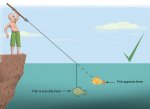
In free fall the anchor drops very rapidly, but diffraction at the water’s surface makes it harder to judge exactly when to drop the anchor.

Diffraction does not apply if your eye line is directly above the drop point, but in most cases you are standing back from the anchor, especially on yachts with a bowsprit.

The other factor is that modern anchors with a large surface area do not always drop straight down. My Mantus M1 actually has a significant “glide ratio” and will land a distance in front of the boat when dropped from the surface.
7E563A38-4973-4670-9594-AA2D12657437.jpeg
The above errors are only problems if you are trying to hit a small target, in clear water. Modern anchors, especially the roll bar models, set very rapidly so even a small clear patch can be utilised. On the rare occasions when this is necessary “dangling” the anchor just above the seabed will significantly improve your accuracy.
 
Last edited:
None of this advice is of a lot of use to East-coasters since the bottom is as mysterious to us as the far side of the moon. My only wish is that the chain shouldn’t fall on top of the anchor in a heap, so I am content to pay out the chain with the down function and let the boat drift slowly astern, or sometimes sideways. Usually this means that my wife lowers the anchor to the surface while I choose the spot, or a little upstream thereof.
 
In free fall the anchor drops very rapidly, but diffraction at the water’s surface makes it harder to judge exactly when to drop the anchor.

Diffraction does not apply if your eye line is directly above the drop point, but in most cases you are standing back from the anchor, especially on yachts with a bowsprit.

The other factor is that modern anchors with a large surface area do not always drop straight down. My Mantus M1 actually has a significant “glide ratio” and will land a distance in front of the boat when dropped from the surface.
View attachment 135057
The above errors are only problems if you are trying to hit a small target, in clear water. Modern anchors, especially the roll bar models, set very rapidly so even a small clear patch can be utilised. On the rare occasions when this is necessary “dangling” the anchor just above the seabed will significantly improve your accuracy.
We have a Spade anchor. In my experience it's performance in grass is unparalleled. You don't need to be trained bomb aimer. It drops vertical with so much lead in the tip. It sets in its own length. Great holding is not monopolised by roll bar anchors.
 
If nothing else it is nice to avoid the environmental damage (and in some areas this is a legal responsibility) so if you are sailing areas with clear water it is worth practicing dropping the anchor on a precise spot on the seabed. It is harder that would be expected.

Like any other sailing skill, having the right technique as well as practice is the key to becoming proficient.

The photo below is an example of a Kobra owner who did not drop in quite the right position. There were some nice patches of clear sand in this anchorage, including one just behind the anchor.

[img] [/img]
 
Top