Anchor warp breaking strain?

10mm is too thin to handle and doesn't have much margin for chafe.

12mm is okay to handle,

14mm is perhaps verging on the overkill, as it will be more expensive and not as 'stretchy' for any given load.

All will be plenty strong enough as you only 'need' to resist about 1000kg of load.

The other way to size it is to make sure it's as strong as the chain part of the rode. 8mm chain is ideal for your Moody.
 
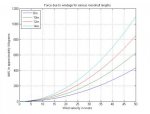
windforce1.jpg

The work to model this was done not by me but by Alain Fraysse, but a few spot measurements I have done are consistent with it, as is the data from the US Yacht Council. It may seem a bit odd that the only dependency is on length, but I suppose that area of hull and of mast and rigging all scale fairly predictably with length.

In case anyone goes on about waves, the force from non breaking waves is small compared to wind so if you design for 50 knots x 4 or 5 that's about right imho. For your boat, that's about 2.5 tonnes BS.
 
Hi does anyone have any idea what breaking strain i need for a anchor warp for a 30ft moody please?:ambivalence:

You will find a guide to chain and warp sizes on the Jimmy Green site. 8mm chain with 12 or 14mm warp spliced to it. Length depending on where you plan to anchor, but 30m Chain and 50m rope is common.
 
Talking anchor warp and considering the conditions that you may have to hand it. For a 30' boat I wouldn't go any smaller than 12 mm and personally would prefer 14mm. I'm thinking about keeping my fingers rather than breaking strain. As Tim says 10 mm wil probably handle the breaking strain but would slice fingers under any serious conditions.
 
It is 4 am, pitch black, raining hard and the wind has just picked up to 40 knots.

At this point no one has ever said " I am glad we bought the lighter anchor/lighter shorter chain/thinner rope rode. "

Yes, you have said so many times. However, having been in that situation many times my 15 kg Rocna and 8 mm chain have always been perfectly adequate. When the wind picks up further I have added my Fortress FX16, which weighs only a couple of kilograms, on a rope warp, and has been good for at least 50 knots. With a fork moor the full force of wind and waves comes onto each anchor at the end of every yaw and neither appears to be inferior to the other. Indeed, when it comes to hauling them up it seems that the lighter gear is more firmly bedded.
 
In case anyone goes on about waves, the force from non breaking waves is small compared to wind so if you design for 50 knots x 4 or 5 that's about right imho. For your boat, that's about 2.5 tonnes BS.

You can estimate the force due to waves by thinking about the size of wave you might be anchored in, and thinking what force does it take to pull the bow down that far.
If there is stretch in the rode, the stretch allows the bow to rise and the force is a lot less.
I did some maths once and seem to recall a peak force of half a ton was not impossible with a stiff rode. That would have been for a 6 ton boat, but you get widely different answers depending on the wave height, rode length, wave frequency and buoyancy of the bow.
So a BS of a couple of tonnes should cover it.
12mm in good condition will be fine.
 
Does breaking strain deteriorate with age, and if so, by how much?
I ask because the warp (nylon, 8-plait about 12 mm) on my boat is now getting on for 15 years old - looks OK apart from being a bit grubby. Some of my mooring ropes (also nylon, 8-plait) are getting a bit stiff and probably at the end of their working lives.
 
Sunshine (UV), excessive heat, acid and overload are the only things that will diminish the life of a nylon rope. Age alone is fine.

I should imagine your mooring lines have been out in the daylight far more than your anchor warp, but stiffness can be washed out if it's only accumulated salt.
 
You can estimate the force due to waves by thinking about the size of wave you might be anchored in, and thinking what force does it take to pull the bow down that far.
If there is stretch in the rode, the stretch allows the bow to rise and the force is a lot less.
I did some maths once and seem to recall a peak force of half a ton was not impossible with a stiff rode. That would have been for a 6 ton boat, but you get widely different answers depending on the wave height, rode length, wave frequency and buoyancy of the bow.
So a BS of a couple of tonnes should cover it.
12mm in good condition will be fine.

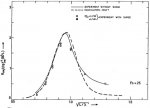
I don't think that this is the way to think about the problem. The bow is not pulled down by the rode, and it's not vertical, so instead (or so I understand: it's quite difficult because the waves are not of fixed wavelength or amplitude) the force depends strongly on the wavelength in relation to the boat's LWL. This graph shows how peaked it is:

gerritsma_graphic2.jpg

These measurements were done to estimate wave induced drag on vessels moving rather than at anchor, but I think the same physics applies even when stationary. The y axis is normalised force and the x axis the (sqrt of the) ratio of LWL and wavelength.
 
Last edited:
If you have a windlass; that will decide the rope diameter for you otherwise I would go for 14 or 16mm diameter.

16mm is too big to splice into 8mm chain and a bit OTT for an all rope rode. 12mm is enough, but 14mm will just about splice, but maaybe won't run through all gypsies.
 
I don't think that this is the way to think about the problem. The bow is not pulled down by the rode, and it's not vertical, so instead (or so I understand: it's quite difficult because the waves are not of fixed wavelength or amplitude) the force depends strongly on the wavelength in relation to the boat's LWL. This graph shows how peaked it is:

View attachment 50496

These measurements were done to estimate wave induced drag on vessels moving rather than at anchor, but I think the same physics applies even when stationary. The y axis is normalised force and the x axis the (sqrt of the) ratio of LWL and wavelength.
Interesting graph.
What's the source of that?
What's the answer in Newtons?

My crude approach was the wave is trying to lift the bow and the anchor is resisting that.
The geometry makes a huge difference, on a long enough rode, the bow can rise without having to move the yacht forwards.
I was originally trying to get my head around the loads in moorings, where the mooring is frequently pulling the yacht into the wave.

Cheers,
 
Hi does anyone have any idea what breaking strain i need for a anchor warp for a 30ft moody please?:ambivalence:
Going to extremes and using figures I have calculated previously, in 60 knots of wind a 35 ft boat will exert a load of 810 kg on the rode and anchor according to the John Knox expression. Information in the nice Liros catalogue that arrived bundled with PBO and YM, shows 10 mm Squareline (octoplait) to have a breaking strength of 2000 kg, 12 mm = 2400 kg and 14 mm = 3800 kg.

Working on a typical safety factor of 4:1 suggests that somewhere between 12 and 14 mm would be ideal but on the assumption that you are unlikely to be anchoring in this wind strength, and that your boat is smaller, it would seem that 10 mm might be theoretically enough. However, in most cases the theoretical figure gives a rope that is too thin to handle well. My kedge warp would almost certainly be OK with 12 mm and definitely with 14 mm but I have 16 mm, which is a joy to handle for manual deployment.
 
Top