
jdc
Well-Known Member
It has worried me for some time that the rules of thumb taught (and even bandied around by more experienced contributors, to PBO or YM for instance) are patently rubbish: such as 3x depth + 10 or 5x depth for rope for instance.
Nor are the rules of thumb consistent across the world: the Americans say 5x depth for chain whereas we tend in the UK to say 3x. A correct relationship between scope (aka rode length) and depth must have at least the following characteristics:
(i) as depth tends to infinity the first derivative of length with respect to depth must tend to 1
(ii)it must be an explicit function of wind force
(iii)it must vary with weight of chain, and proprtion of chain and rope
I have obviously had time on my hands, since I've written an anlysis of the matter - contains maths but that can be ignored or skipped. https://sites.google.com/site/jdcpublic/sailing/Rode.pdf?attredirects=0&d=1
Also a version which can plot the graphs for any other boat and mixture of chain and rope: https://sites.google.com/site/jdcpublic/sailing/AnchorRode.rar?attredirects=0&d=1
One graph (of many) is shown here:
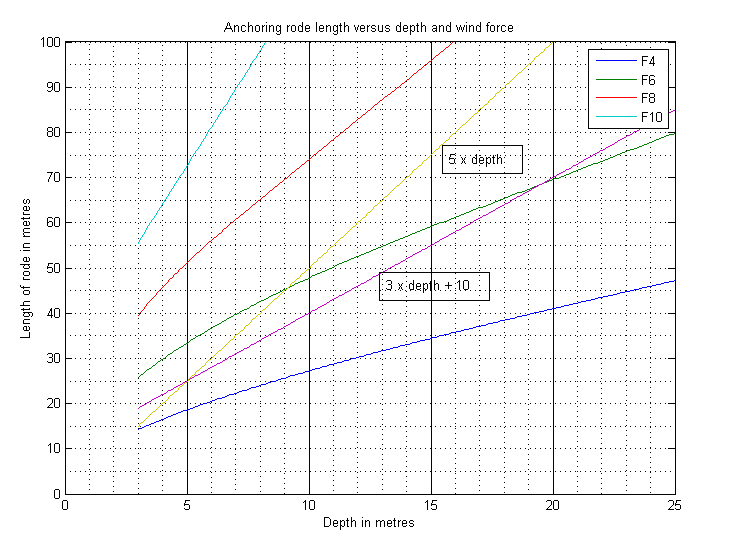
It shows clearly that the rules of thumb are grossly wrong in shallow water, and over pessimistic in deep.
So this is the contentious point: I believe that every experinced sailor actually _does_ pretty much what my graphs suggest, letting out proportionally more scope when in shallow water or high winds, so why do we continue to teach beginners something we don't practice ourselves? Because we think looking at a graph is unmanly? Because of conservatism? Because we suffer from the British distrust of numeracy?
It can hardly be because we have to make split-second decisions about scope, one can always use a simple formula like 3x + 15 then adjust a bit if required. Nor is it justifiable to say that the extra precsion is irrelevant in the mythical 'real world': just look how badly out the 5x rule is.
I'd be very interested if people reckon that the relationship between wind force, depth and scope I have calculated differs widely from what they actually do.
If anyone does persist reading through my maths, there's a result which I believe is new: one can determine whether one's chain is horizontal at the anchor just by knowing the depth and estimating angle of rode at the stem-head - nothing more. this is easy and could be useful.
Nor are the rules of thumb consistent across the world: the Americans say 5x depth for chain whereas we tend in the UK to say 3x. A correct relationship between scope (aka rode length) and depth must have at least the following characteristics:
(i) as depth tends to infinity the first derivative of length with respect to depth must tend to 1
(ii)it must be an explicit function of wind force
(iii)it must vary with weight of chain, and proprtion of chain and rope
I have obviously had time on my hands, since I've written an anlysis of the matter - contains maths but that can be ignored or skipped. https://sites.google.com/site/jdcpublic/sailing/Rode.pdf?attredirects=0&d=1
Also a version which can plot the graphs for any other boat and mixture of chain and rope: https://sites.google.com/site/jdcpublic/sailing/AnchorRode.rar?attredirects=0&d=1
One graph (of many) is shown here:
It shows clearly that the rules of thumb are grossly wrong in shallow water, and over pessimistic in deep.
So this is the contentious point: I believe that every experinced sailor actually _does_ pretty much what my graphs suggest, letting out proportionally more scope when in shallow water or high winds, so why do we continue to teach beginners something we don't practice ourselves? Because we think looking at a graph is unmanly? Because of conservatism? Because we suffer from the British distrust of numeracy?
It can hardly be because we have to make split-second decisions about scope, one can always use a simple formula like 3x + 15 then adjust a bit if required. Nor is it justifiable to say that the extra precsion is irrelevant in the mythical 'real world': just look how badly out the 5x rule is.
I'd be very interested if people reckon that the relationship between wind force, depth and scope I have calculated differs widely from what they actually do.
If anyone does persist reading through my maths, there's a result which I believe is new: one can determine whether one's chain is horizontal at the anchor just by knowing the depth and estimating angle of rode at the stem-head - nothing more. this is easy and could be useful.


