
Anchor scope - why do we teach beginners such rubbish?

  • Thread starter Thread starter jdc
  • Start date Start date

jdc

Well-Known Member
Joined
1 Dec 2007
Messages
2,065
Location
Falmouth
Visit site
It has worried me for some time that the rules of thumb taught (and even bandied around by more experienced contributors, to PBO or YM for instance) are patently rubbish: such as 3x depth + 10 or 5x depth for rope for instance.

Nor are the rules of thumb consistent across the world: the Americans say 5x depth for chain whereas we tend in the UK to say 3x. A correct relationship between scope (aka rode length) and depth must have at least the following characteristics:
(i) as depth tends to infinity the first derivative of length with respect to depth must tend to 1
(ii)it must be an explicit function of wind force
(iii)it must vary with weight of chain, and proprtion of chain and rope

I have obviously had time on my hands, since I've written an anlysis of the matter - contains maths but that can be ignored or skipped. https://sites.google.com/site/jdcpublic/sailing/Rode.pdf?attredirects=0&d=1

Also a version which can plot the graphs for any other boat and mixture of chain and rope: https://sites.google.com/site/jdcpublic/sailing/AnchorRode.rar?attredirects=0&d=1

One graph (of many) is shown here:
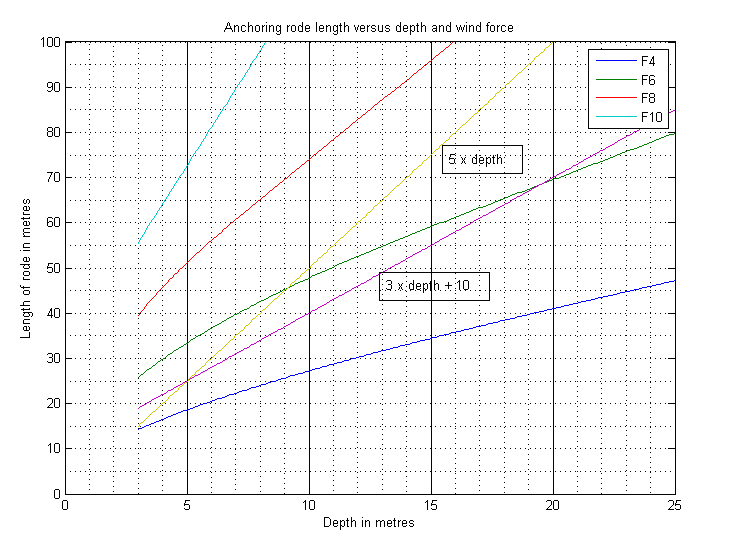
catenary_4.png


It shows clearly that the rules of thumb are grossly wrong in shallow water, and over pessimistic in deep.

So this is the contentious point: I believe that every experinced sailor actually _does_ pretty much what my graphs suggest, letting out proportionally more scope when in shallow water or high winds, so why do we continue to teach beginners something we don't practice ourselves? Because we think looking at a graph is unmanly? Because of conservatism? Because we suffer from the British distrust of numeracy?

It can hardly be because we have to make split-second decisions about scope, one can always use a simple formula like 3x + 15 then adjust a bit if required. Nor is it justifiable to say that the extra precsion is irrelevant in the mythical 'real world': just look how badly out the 5x rule is.

I'd be very interested if people reckon that the relationship between wind force, depth and scope I have calculated differs widely from what they actually do.

If anyone does persist reading through my maths, there's a result which I believe is new: one can determine whether one's chain is horizontal at the anchor just by knowing the depth and estimating angle of rode at the stem-head - nothing more. this is easy and could be useful.
 
hmmm

my anti vir flags up and as I dont do maths not important but im guessing there should be something in about weight of anchor in propportion to the weight of vessel and I suppose also depends on windage of vessel in proportion to depth of keel and also hmmm also there would be tide to consider ...
 
I agree...

...with two things you have said

1. It is Rule of thumb, just that
2. You have had time on your hands

Not taking the P just think it is over complicating things.

Regards
Patrick
 
Looks like good stuff. I have a couple of comments but need some time to digest it all.

Re your request for real data on wind forces. Prof. John Knox has been working with his Anchorwatch load cell for some years. I have written a couple of times in YM about this work. One of the boats that has been monitoring anchor loads for several years now is Westbound Adventurer, a Sigma 33 run by a sea school in Scotland. This graph shows their latest results.

Westboundgraph.jpg
 
It shows clearly that the rules of thumb are grossly wrong in shallow water, and over pessimistic in deep.

It seems to me to show that 3 x depth is pretty good in anything up to F6, and above that (heck, at that) you'd be in "chuck it all out and pray" mode anyway.

Rode lengths don't have to be exactly right, they just have to be good enough. Do we have a major problem with boats dragging because they had 3 x depth out when they should have had 3.653487542 x depth?
 
Sorry, I don't do RAR but I struggle to understand the above graph.


P.S.: missed the pdf in your first link

I also found the PDF in the first link did not work.

I love the idea of a graph, but am unfortunately also struggling to understand it. Any chance of an idiots guide?

How does this relate to the facts that different boats create different forces on their anchors, or is the assumption that the correct size anchor and chain for each Boston creates a level playing field, so to say?
 
rule 1 is the average conditions average depth rule.

I was always taught rule 2 was that shallow water needs more and deeper water can be OK with less

I was also made aware of a number of further 'rules' - but they all basically try to make things more situation specific

personally I can't see much point in marginalising anchoring - ie once I am out in the boat with a specific anchor and rode set up I will make a decision on scope to take into account the relevant factors (and this can include swinging into other boats in a calm anchorage as much as not dragging the gear back into a wreck I am fishing)
 
.pdf should be ok

my anti vir flags up and as I dont do maths not important but im guessing there should be something in about weight of anchor in propportion to the weight of vessel and I suppose also depends on windage of vessel in proportion to depth of keel and also hmmm also there would be tide to consider ...

The first link is to a .pdf; I didn't think these would cause any download issues. It's on googledocs, which strips out any nasty executables anyway, so should be completely safe. The second link is to a .rar file, containing a JavaScript program, so is more for experts I admit. But please do let me know if it causes problems.

The calcs take:

Chain weight,
Chain length
Anchor weight
Anchor style
Horizontal Force on boat Boat due to windage and/or tide

into account - which is why I provided the downloadable calculator so peeps can enter the parameters relevant for their boat.

Tide is rather a weak effect actually, unless horrendously strong (like 5kts +). F4 wind exerts only about 64kg force on my boat, as does a 3kt tide. This can rather easily be verified if you have a swinging mooring: when wind and tide are opposed the boat will always lie to the tide, but will over-ride the buoy when windage exceeds the force due to tide. In my experience my boat over-rides a 2kt tide for any wind of F3 or more.

But the substantive point is that I think people do allow more scope in stronger winds (surely??), so if you were instructing a semi-novice, how would you put this? Mother's recipe - a handful of this and a pinch of that - is not really precise enough for a novice cook.
 
I also found the PDF in the first link did not work.

I'll go try it on another computer with another login and see if I can reproduce the problem - sorry your'e having trouble. Update: tried it on my wife's MAC, with Firefox and with Safari, and it works there ok as well as on my PC with IE, so not sure what the issue can be.

I love the idea of a graph, but am unfortunately also struggling to understand it. Any chance of an idiots guide?

How does this relate to the facts that different boats create different forces on their anchors, or is the assumption that the correct size anchor and chain for each Boston creates a level playing field, so to say?

The graph has on the x axis depth of water, and on the y axis the total scope, all chain or when scope greater than your length of chain then chain + rope.

The many coloured lines represent:

Blue: Wind Force 4
Green: Force 6
Red: Force 8
Cyan: Force 10
Yellow: 5 x depth
Purple: 3x depth + 10m

The first 4 curves show the minumum scope you need to let out to keep the pull at the anchor near horizontal, for each wind force. The yellow and purple ones are overlaid just to show how they depart from the others, and thus aren't really that good rules-of-thumb.

I think you're spot on when you say that there's a level playing field, ie although calculated for my boat it should also apply to yours because you will have the chain size and anchor weight all in proportion. Indeed this is how one works out the proportions since chain is nearly always more than strong enough so it's not strength but weight needed which determines the size you need.
 
Last edited:
Anchor scope - why do we teach beginners such rubbish?

How about because it is simple, easy to remember & works well enough as a basic estimate for average conditions.

Rather like the "rule of twelfths" which I can use to estimate depths (for crossing sandbanks or using swatchways) in my head while steering & looking at a chart.

Or the 2hrs(etc) before/after HW guidelines for harbour entrances & bars given in pilot guides.

They suit me & work well for my purposes. I don't want to be running round trying to find the right graph for each situation to measure my chain to the last foot; especially when I work with 9-13m tidal ranges.
 
I don’t believe you have taken into account the dynamic loads.
The real world observations show that at the sort of wind strength likely to trouble a set anchor the chain entirely lifts off the bottom, with any practical chain length combinations. When the chain is essentially straight, the holding power is directly related to the angle of pull which is can be calculated from the scope ratio.
This is a simple model to a complex problem, but I believe it is more accurate than the model you propose.
.
The fundamental flaw is that you have assumed the weight of the rode is going to keep the pull at the anchor horizontal. If you dive on your anchor the next time there is a strong wind you will see this doesn’t happen.

Sorry to be negative. It looks like lots of work and it is still interesting and useful data.
 
I don’t believe you have taken into account the dynamic loads.

Ages ago I did some work, for fun, on the shape of glider winch launch cables during the launch. It's a similar problem to the anchoring one: although the mass/length of the cable is a lot lower, there's a lot more length for things to happen in.

My conclusion was that simple static calculations (shape of cable vs position and pull at the glider end) were relatively straightforward but also fairly pointless, because the dynamic effects of surges and oscillations were just as important.

I'd expect exactly the same to be true of an anchor cable attached to a boat moving around in choppy conditions. there will be all sorts of waves and transients in the cable.


Put me out of my misery - are you saying that depth X 3 plus a bit for luck is too little or too much?

It's about right, and in conditions where it isn't you'll already have put enough out.

Relax.
 
The type of bottom also needs to be factored in.

I'm more than happy with a 1:3 in somewhere like Puilladobhrain with little fetch, close neighbours and a sticky clay seabed (actually 1:3.2809 as I have my depth sounder that shows feet, so 10 feet depth == 10 metres anchor chain), however in sandy places I allow more chain, and in anchorages such as the Garvellachs where there can be a bit of swell and the bottom is mainly smooth rock then every bit of weight and friction helps.

1:3 is a reasonable rule of thumb, and a good starting point. It's a bit like the stopping distance tables on the back of the highway code, adjust to suit the conditions.

Alisdair
 
Put me out of my misery - are you saying that depth X 3 plus a bit for luck is too little or too much?

He is saying it is about right (depending on the size of your bit for luck).

I think this is an underestimate, for the reasons stated by noelex.

What I don't understand is the undercurrent of hostility to maths that pervades some of the posts. Without maths there would be no engineering (or navigation, for that matter) and our boats would lack much of what we have come to expect.
 
What I don't understand is the undercurrent of hostility to maths that pervades some of the posts. Without maths there would be no engineering (or navigation, for that matter) and our boats would lack much of what we have come to expect.

I'm not hostile to maths at all, myself. I do it for a living.

However, one of the most important things about maths is knowing how and when to apply it. Does anchoring need the degree of precision suggested by some folk (not just the OP)? I don't think it does. Three times depth is just fine for most situations: any fule kno that it's just a minimum, and whack some more out if needed.
 
..., because the dynamic effects of surges and oscillations were just as important.

I'd expect exactly the same to be true of an anchor cable attached to a boat moving around in choppy conditions. there will be all sorts of waves and transients in the cable.

You may be right, but I have a fetish for numbers and was seeking empirical data. When I have measured dynamic forces, and I give a means to do so in the document, as does the load-cell method Viv gave the URL for, I have found that they were really not that much bigger than the static, like 25% or 50% more, not 3x. This surprised the hell out of me, I was expecting greater. Maybe it's because I have a long keel, and a light boat might give biggger variation (but not necessarily bigger maxima). In any case, dynamic effects are hardly likely to lower the maximum pull, and the rules of thumb already suggest far too little chain in shallow water, which is possibly one reason that anchor tests have such poor reproducibility.

But, with respect, most posters have, I think, misunderstood my point: experienced sailors, which is pretty likely to include the vast majority of us on this forum, already do by instinct or experience what's right, so don't need my graphs except maybe for interest. I emphasised this in my first post. Of course I let out about 15m + 3x depth and then adjust a bit when in v deep or in v shallow or the wind is v strong, just like everyone else. Even I - a self confessed mathematican - am not solving differential equations everytime I go for a sail!

But havn't all of us got first hand experience of some boat, frequently a beginner, a mobo or French, dragging down onto us? The point I am trying to make is that the books and courses give a concrete rule which, once we've gained some experience, none of us actually obey. I'm trying to encapsulate in graphical form what we actually do. It would be easy to give this in classes and then discuss its limitations and how one can approximate it over the reduced range of circumstances we normally experience. We're not infants FFS and don't need the O level (ok GCSE) dumbed down version: tell it as it is, _then_ let us decide how we might simplify it in the light of our circumstances.

This is really a rant against dumbing down in general - sorry!
 
I think the OP has thrown some useful light on the subject. The RYA now teach x5 depth for chain which I think is not very useful. In our case, with 90m of chain that unnecessary limits us to less than 18m depth which I think fails to take account of what is happening in the catenary. If the forces are low I am confident that my 90m should get us much more than that. Haven't had to do it much in the recent past, however, in Cyprus and using previous boat once anchored in 35m and was very happy with 60m of chain cable during what was a very quiet night.

Once anchored in Poole harbour during a F8/9 in thick mud and only 3 to 4 m depth. Had the same 60m out and was surprised to see the chain cable becoming less and less vertical. We didn't drag and thanks to the critical angle graph I can now see that I could have slept a bit more soundly than I did at the time. As for snatch loads, they were quite great, dampened by a long snubber, but when I came to lift the anchor, in that mud, I found that the snatching had probably helped dig the anchor in as it was very difficult to break out.

So I'll be printing off a couple of graphs and using them as well as applying a safety fudge factor. Can't have too much information on which to select a course of action.

By the way, the expression "rule of thumb" comes from the law that a man could beat his wife with a stick so long as it was no thicker than his thumb. Thankfully that is one rule of thumb which is now defunct.
 
Last edited:
Top