Anchor scope - why do we teach beginners such rubbish?

  • Thread starter Thread starter jdc
  • Start date Start date
Dropped the hook today, we only have 35m of chain, then another 20m rope.

Depth 9m, SWMBO up front, me on the helm, she asks "how much" quick calc in the head (3x9 is enough) reply "most of it".

A minute later I ask if it has snagged yet, then we hear the sound of the chain taking the load, put a bit more power astern and all OK.

I ask how much chain left, she replies "just a liitle bit".

Fine I say.
 
Not sure why there is any concern over what novices are taught - assuming they are taught correctly.

IIRC The RYA teach 5x depth from anchor roller. I also recall they teach 7x depth or more when it gets windy and choppy. Applying this teaching would suit most conditions, particularly those that novices should find themselves in.

Experience, (or advice from our peers :) ), then teaches us that 3x depth is OK in relatively benign conditions.

In a crowded anchorage, you have to decide whether you are happy with 3x depth, or less in the prevailing conditions, the alternative being to clear off and find somewhere with more room to swing.
 
By the way, the expression "rule of thumb" comes from the law that a man could beat his wife with a stick so long as it was no thicker than his thumb. Thankfully that is one rule of thumb which is now defunct.

And I understood it was because the inch was originally defined by the length of the thumb (the last little bit with the nail on it) so you can make an approximate measurement in inches using the thumb rather than a rule.
 
And I understood it was because the inch was originally defined by the length of the thumb (the last little bit with the nail on it) so you can make an approximate measurement in inches using the thumb rather than a rule.

I like my version more than yours. More info available at http://en.wikipedia.org/wiki/Rule_of_thumb which indicates that you are right and my misconception is common.
 
Last edited:
I think the OP has thrown some useful light on the subject. The RYA now teach x5 depth for chain which I think is not very useful. ...

It's better than the rule they used when I took and subsequently taught the shore-based Day Skipper course twenty years ago. Some horror involving a square root, it was - readers of a mathematical bent will instantly see that it was not dimensionally invariant, giving different lengths of chain/rope depending on what unit you were measuring it in.
 
IIRC The RYA teach 5x depth from anchor roller. I also recall they teach 7x depth or more when it gets windy and choppy.

Bloody hell! Do they really? I hadn't realised that inflation had been so rampant in recent years.

I was taught 3x depth for chain, 5x for warp, for my Yachtmeister theory, but that was in the days when men were men, chain was 'Made in England', and dragging your anchor from time to time was probably thought character building. By the time the First Mate was doing her Yachtmaster theory a couple of years ago it had gone up to 4x for chain. If the RYA is now saying 5 to 7x depth for chain, how much do they expect for warp, for goodness sake?

Doesn't this mean that any small yacht will either have to carry enough chain to sink it, or use warp and only find enough swinging room to anchor in big ship anchorages? I blame the Labour Government (or was it decimalisation?).
 
Anchoring

i didn't understand the graph or the maths however I will continue to teach the 3X for chain and 5X for rope (and some chain).
As I see it is is simply a question of trigonometry and the angle of approach of the rode to the bottom.Horizontal is the aim but some angle up may be acceptable depending on anchor type and bottom.

If you consider that a warp as stretched tight then the depth of water and length of warp dictates the angle of approach at the anchor. (more specifically at the start of the chain or some point along the chain) 2x gives a very poor ie large angle to the sea bed. 3X a lot better 4X better 5X better but 6X not so much better and 7 x not much improvement. So 5 X gives the best angle for the min swinging. Obviously if swinging room was not a consideration and wind was strong then longer is better but not in proportion to the rope put out.

Now obviously the weight of the chain provides a droop or catenary which improves the approach angle to the anchor. If wind was really wild such that the chain is taught then 5X would give a far better angle result than 3X and would be worth putting out. However if wind is not so strong then 3X is fine as chain catenary will bring approach angle down.

Beyond these rules on rode length I think that factors like anchor weight and type and bottom type will have far more significance to the success of the anchoring. olewill (ducking for cover)
 
If anyone does persist reading through my maths, there's a result which I believe is new: one can determine whether one's chain is horizontal at the anchor just by knowing the depth and estimating angle of rode at the stem-head - nothing more. this is easy and could be useful.
In any situation likely to bother the anchor, it very rarely will be. It's not a good idea to focus on this point, as it's just a useful point to measure and doesn't represent anything really very fundamental.

From your document:

The foregoing has assumed that the chain at the anchor has to be horizontal. But actually this isn't quite true: in reality anchors can tolerate some upwards pull, and a heavy anchor obviously more than a lighter
one. An extreme case of a heavy anchor is a mooring, for which clearly one uses a very short scope. The upwards pull on the anchor has to be less than the weight in water of the anchor or it will gradually work out of the bottom; one should think of mud or sand not as a solid but as a very viscous liquid. However most anchors attach the chain to a point well forward of their centre of mass, which acts as a lever and so less upwards pull on the shank than the weight is enough to trip it. There is thus a mathematically unsatisfactory fiddle factor applied, called "Style of Anchor". For most modern designs this is about 0.3, and must always be in the range 0 to 1. A mooring weight is probably 0.7, and an extreme modern type near 0.


All of these points considering upward pull are incorrect. A set anchor, even with an extended shank, can tolerate much more than its own weight in terms of vertical pull on the rode, indefinitely. The anchor orients to the direction of pull and if at least partially set will (or won't) resist, it is not 'aware' of whether that force vector is above horizontal or not. The weight of the anchor is only marginally important during the setting process. An adequately designed anchor in soft substrate will in fact continue to bury, usually until it finds a harder substrate that stops it, in response to continued high loading.

Your points re scope etc are on target, unfortunate as it is that they are wasted on the likes of the poster above, apparently in a position of some authority, who "will continue to teach the 3X for chain and 5X for rope" regardless.

But you want to have a better grip on what the rode is tied to down there on the seabed :)
 
Is no one else concerned at the number of contributors who were unable to understand the graph? How do these people do tidal calculations?

mjcp

This is nothing to do with the inability to read graphs, it is down to the lack of explanation on the graph. The description "Length of rode in metres" is actually meaningless.

Fortunately, the OP had further explained:- "The first 4 curves show the minumum scope you need to let out to keep the pull at the anchor near horizontal, for each wind force."

Sorry I was so slow. During my maths and stats degree I must have been hungover on the day we did clairvoyance.:)
 
In any situation likely to bother the anchor, it very rarely will be. It's not a good idea to focus on this point, as it's just a useful point to measure and doesn't represent anything really very fundamental.

All of these points considering upward pull are incorrect. A set anchor, even with an extended shank, can tolerate much more than its own weight in terms of vertical pull on the rode, indefinitely. The anchor orients to the direction of pull and if at least partially set will (or won't) resist, it is not 'aware' of whether that force vector is above horizontal or not. The weight of the anchor is only marginally important during the setting process. An adequately designed anchor in soft substrate will in fact continue to bury, usually until it finds a harder substrate that stops it, in response to continued high loading.

Your points re scope etc are on target, unfortunate as it is that they are wasted on the likes of the poster above, apparently in a position of some authority, who "will continue to teach the 3X for chain and 5X for rope" regardless.

But you want to have a better grip on what the rode is tied to down there on the seabed :)

Some interesting points. Re. the anchor continuing to bury - a friend sat out a gale for two days in the Ardmore Islands many years ago. He couldn;t get his anchor (a CQR) afterwards. He was a diver, and when he went down to look he found the anchor buried at full arms length in the mud and had to excavate it manuallly before it could be retrieved.

Re. teaching - I am running a Day Skipper course next week and I will teach minimum 3x depth from anchor roller at high water for all chain, 5x if expecting a blow, test holding with plenty of revs astern. It is essential to keep it simple when imparting a lot of information to newcomers to an activity in a short space of time. If this is all they remember there is a good chance that it will be enough to keep them safe in most circumstances.

If they are receptive I will then go into the subject in more detail . . . but to suggest that we start by showing them a complicated graph indicates that while the OP may know a lot about anchoring theory he knows a lot less about teaching.

- W
 
On one boat I sail intermittently, there are two bow(er) anchors fitted, and two chain cables.

The port anchor/chain cable is 73 metres long, and is marked every 10. The starboard anchor/chain cable is 240 feet long and is marked every 30 feet.

The port setup is utilised when there's a metric chart on the table, and the other one when using our old 'fathoms' chart.

I hope that helps....

:D
 
Some interesting points. Re. the anchor continuing to bury - a friend sat out a gale for two days in the Ardmore Islands many years ago. He couldn;t get his anchor (a CQR) afterwards. He was a diver, and when he went down to look he found the anchor buried at full arms length in the mud and had to excavate it manuallly before it could be retrieved.
Arms length? That's nothing. It's not unheard of for anchors to disappear several meters down. And a CQR in mud should pull out easily at that depth, not by windlass maybe but the boat will do the job. Read this extract (Nanaimo Harbor).

Re. teaching - I am running a Day Skipper course next week and I will teach minimum 3x depth from anchor roller at high water for all chain, 5x if expecting a blow, test holding with plenty of revs astern. It is essential to keep it simple when imparting a lot of information to newcomers to an activity in a short space of time.
That's fine although I would make the 5x "as much as practical up to ~10:1" as you will still get distinct benefits from higher scopes beyond 5:1 in a blow as you say. 5:1 is not enough for bad conditions and you don't want people learning it is "the maximum".

What I was having a go at was the "3X for chain and 5X for rope" comment which is demonstrably nonsense, plus the other comments re wind chain and catenary that are just illogical and misleading for the newbies. All this stuff can be kept actually quite simple - scope is all that really matters - it's the misunderstood traditionalism and ill-applied lore that confuses everything.

www.petersmith.net.nz/boat-anchors/catenary.php
 
This is nothing to do with the inability to read graphs, it is down to the lack of explanation on the graph. The description "Length of rode in metres" is actually meaningless.

Fortunately, the OP had further explained:- "The first 4 curves show the minumum scope you need to let out to keep the pull at the anchor near horizontal, for each wind force."

Sorry I was so slow. During my maths and stats degree I must have been hungover on the day we did clairvoyance.:)

From what I understand the graph nicely shows that the minimum scope calculated by rule of thumb isn't identical to what the OP calculated elsewhere. To take this as proof for his claim sounds like circular reasoning to me. "Force 4" isn't a function of depth or length of rode and I can't see anything about an increase in magnitude of force in Kp in relation to length or depth.
 
Some interesting points. Re. the anchor continuing to bury - a friend sat out a gale for two days in the Ardmore Islands many years ago. He couldn;t get his anchor (a CQR) afterwards. He was a diver, and when he went down to look he found the anchor buried at full arms length in the mud and had to excavate it manuallly before it could be retrieved.

Re. teaching - I am running a Day Skipper course next week and I will teach minimum 3x depth from anchor roller at high water for all chain, 5x if expecting a blow, test holding with plenty of revs astern. It is essential to keep it simple when imparting a lot of information to newcomers to an activity in a short space of time. If this is all they remember there is a good chance that it will be enough to keep them safe in most circumstances.

If they are receptive I will then go into the subject in more detail . . . but to suggest that we start by showing them a complicated graph indicates that while the OP may know a lot about anchoring theory he knows a lot less about teaching.

- W

That makes sense to me too as there are so many factors to consider, such as the extra loads of shallow water anchoring, how much swinging room, range of tide, snatch loads in gusts and so on.

In practice if you set 3 x depth from roller height at HW, a lot of the time there will be much more than 3x out depending on the range of tide but it could be 6x at LW even. If you anchor for example in 20ft depth (25ft from roller) at HW, 3x gives 75ft which at LW with a 16ft range will be over 8x scope and 4.4x at half tide.

We always use all chain and our baseline calculation goes from HW depth in feet (our depthsounder set to feet) from the bow roller height x 3 but scope applied in metres (our chain marked in metres), with the anchor well dug in under engine, revs gradually applied and increased to near full astern. Using the hybrid feet/metres means in effect we add 10% extra scope without thinking about it anyway, plus the chain is marked at 5 metre intervals and we always go to the next mark up. This is the 'standard' set up. For strong winds we would use a bigger scope factor, 4x or 5x or even more, chain works in water but not in the anchor locker. We ALWAYS set a snubber line, a nylon line with a rubber mooring compensator wound into it to take out snatch loads from gusts and swinging around and carry two such lines, one reserved for heavy conditions and the other a softer one.

With 10mm chain and a (genuine) 45lb CQR on a W33 Ketch we never dragged at all in 14 years of ownership and lots of anchoring in European waters. We then added 10 more years of anchoring with 10mm chain and a 35lb Delta on a 41ft Sun Legende, same waters, lots of anchoring and again have never dragged. In both cases we have been anchored in bad weather, including gales but in sheltered spots, and many others around us have dragged. We originally intended increasing the Delta to a 45lb one but since we never dragged didn't get round to it and the boat was sold last December.

Prior to that, the last time we went walkabout was in a Liz 30 with mixed chain and rope rode when with wind over tide the rope snagged the keel and we laid side on to the tide and the rope sawed through on the back edge of the keel. The next day we recovered the anchor and the next week installed all chain rode.

The difficulties come with others nearby. Is there enough swinging room if strong winds are expected, do we trust the boat upwind to be properly anchored, are we covered for a change in wind direction etc. The time to make a move is before it goes pear shaped not when it does. Not saying we are super smart but we are defensive anchorers, pick a good spot for the expected winds with room to swing, no dodgy bods ahead, anchor dug hard in under power and always a snubber line added. We would also move if we had to if our space was invaded by a newcomer that might cause us problems.
 
"Force 4" isn't a function of depth or length of rode and I can't see anything about an increase in magnitude of force in Kp in relation to length or depth.
The graph ostensibly gives you the points at which (in Force X weather) the rode will measure a positive angle above horizontal*, for given rode length and depth. There is no "function" of anything, the forces involved are informed by external data.

The increasing forces are evident in the steepness and relative position of the respective curves.

Of course it's particular to the size of chain (can't find that given in the document?) and the conclusions only relevant to the author's boat and willingness to ignore dynamicity (as mentioned above).

* The point at which the rode measures a positive angle is, once again, a nice idea on first impressions but turns out to be really meaningless. The only point of real relevance is the point at which the anchor will drag.

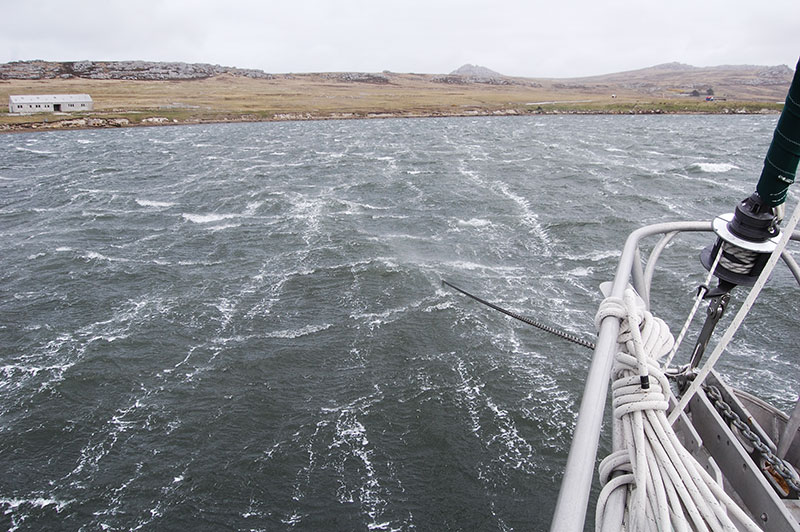
falklands-wind-chain.jpg
 
I recall asking years back something along the lines of "if scope is so important why not let out loads more than advised if space allows". The only answer I ever got was related to variations on "because you have to wind it all back in again".

Anyone able to give a better answer?
 
The OP quotes the diferences between the UK and the US approach to scope without investigating the reason for the difference. Primarily the two approaches are effectively similar - not in the amount of chain, but in the weight of chain.

This is because the US approach is to use a larger anchor and smaller (but stronger for size) chain. Thus to achieve the same catenary on the chain, and thus the same angle of pull on the anchor requires a longer scope for the US approach.

There was a very learned analysis on chain length and effect on the anchor published in PBO well over a decade ago. It started with the premis of 20metres of chain plus a ratio of the depth. This overcomes the problems of the normal rules of thumb not working in shallow depths.

Unfortunately I no longer have a copy of the article, so if any of you do have a copy, I would appreciate an email.
 
What I was having a go at was the "3X for chain and 5X for rope" comment which is demonstrably nonsense...

It's not nonsense: it's perfectly clear. You may think it's wrong, but that's another matter. For all the mathematical worrying that goes on, 3x/5x have been working successfully for many decades and before they get replaced with anything more complicated I would like to see (a) some evidence that there is a problem and (b) a convincing argument that a more sophisticated formula will uindrag more people through accuracy than it drags through confusion.
 
Top