anchor retrieval singlehanded

I used to use this method all the tine when I had mobos, and it even worked well with my little gaffer; the 6HP outboard was plenty to get the anchor up (at 5knts). I can't imagine it will work with a full chain rode, since while the last 12 ft of chain would pass through my ring ok, the weight of a full chain rode would be to heavy for the buoy.
 
Don't think my old Kubota would have the power to do this!

(Ah, didn't see Neil's comment re 6HP motor)

I notice he has his rode/chain shackled to both the end of the stock (as presumably all chains are) AND shackled to the eye at the "diggy-in bit" end.
I've never done this or seen it. Is this a good idea, a bad idea or just a possible elaboration on his part?
I've often had a worry about the shackle/stock failing and leaving the anchor or the bottom. This method would seem to be a fail-safe?

What does the panel think?

JUst seen OceanSprint's post showing the above method bit use of cable ties to the stock so that anchor can be "tripped" by snapping the ties.
Would that hold in a blow?
 
Last edited:
Don't think my old Kubota would have the power to do this!

(Ah, didn't see Neil's comment re 6HP motor)

JUst seen OceanSprint's post showing the above method bit use of cable ties to the stock so that anchor can be "tripped" by snapping the ties.
Would that hold in a blow?

The point of attaching the chain near the head of the anchor, leading the chain along the stock and securing at the end with cable ties, is that when the boat is at anchor, the force is along the length of the anchor, so will hold in any blow. Only when you get stuck, and are pulling the chain away from the anchor, upwards, that the ties then break and you can pull the anchor out of the obstruction backwards.
 
The point of attaching the chain near the head of the anchor, leading the chain along the stock and securing at the end with cable ties, is that when the boat is at anchor, the force is along the length of the anchor, so will hold in any blow. Only when you get stuck, and are pulling the chain away from the anchor, upwards, that the ties then break and you can pull the anchor out of the obstruction backwards.

That's what I hoped I'd be told.
Seems a much better way than setting a "trip line and buoy" (which I can appreciate is a nuisance to other anchorage users!)

Of course, if for some ghastly reason the pull of the boat lifted the stock and snapped the ties, then the anchor would trip and boat drift away (not nice to see from the bar or beach cafe!!!)

Anyone else tried this method?
 
I have the power and now I have the Alderney ring. Also this summer I will try tying back the chain with cable ties to enable a front end snatch. In fact I'll try any idea that will get my anchor out from underneath someone else's.
I'll try the ring and float method next time I get multiple cross overs so I can haul the spaghetti to the surface without knackering my windlass ( again). The joys of med boating and I'll report in the autumn on both methods.
 
Can we just clear up one thing? When several of you refer to the stock, do you actually mean the stock, or possibly the shank?
The clue is in "stockless anchors".
 
Can we just clear up one thing? When several of you refer to the stock, do you actually mean the stock, or possibly the shank?
The clue is in "stockless anchors".

I dunno - the long stick-like bit? :)

Yes, the shank! always an aid to understanding, using the correct terms.

My colleague always uses the term "hard disk" when she actually means, the CPU, optical drive, hard drive and everything in the box under her desk.....
 
Last edited:
I used the tehnique regularly with mobos in up to 30m of water but yet to try with slower sailboat. A friend uses the method with a Moody 30 something, it is normal practice when sea angling in deep water.
 
Can we just clear up one thing? When several of you refer to the stock, do you actually mean the stock, or possibly the shank?
The clue is in "stockless anchors".

Good point.
I was meaning the long-stick-thingy, ie the shank.
Must look-up the correct meaning of stock. Perhaps it refers only to a fisherman's anchor.
 
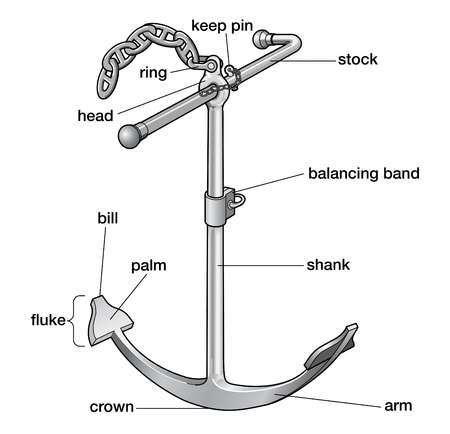
The stock of an anchor is that which makes sure that it turns so that the fluke (pointy bit) can stick in. Started indeed with the Fisherman, or Admiralty Pattern anchors. The Stockless anchor, which tends to be favoured by ships because it stows so well in a hauze pipe, is a derivative of these. The stock is also the long crossbar on the Danforth, which again makes sure that the anchor presents correctly.
The eqivalent on the Manson or R***a type is the curved roll-bar.
 
The stock of an anchor is that which makes sure that it turns so that the fluke (pointy bit) can stick in. Started indeed with the Fisherman, or Admiralty Pattern anchors. The Stockless anchor, which tends to be favoured by ships because it stows so well in a hauze pipe, is a derivative of these. The stock is also the long crossbar on the Danforth, which again makes sure that the anchor presents correctly.
The eqivalent on the Manson or R***a type is the curved roll-bar.

Ta for that. Amazing how much in life there is still to learn :encouragement:
 
The stock of an anchor is that which makes sure that it turns so that the fluke (pointy bit) can stick in. Started indeed with the Fisherman, or Admiralty Pattern anchors. The Stockless anchor, which tends to be favoured by ships because it stows so well in a hauze pipe, is a derivative of these. The stock is also the long crossbar on the Danforth, which again makes sure that the anchor presents correctly.
The eqivalent on the Manson or R***a type is the curved roll-bar.

A picture (source: http://www.illustrationsource.com/stock/image/506568/the-parts-of-a-stock-anchor/)
huge.101.506568.JPG
 
I have used the Alderney method for many years. As has already been said, it is used by most angling boats and often deep water 150 ft plus. The main points are that your length of chain must be heavier than your anchor, the join between rope and chain must be smooth to pass through the ring, the anchor stock also needs to be able to pass throgh the ring (this minimises the chances of it falling back down). I use a bruce anchor and trip it using cable ties. My boat is only 17 ft with 5kg anchor and i have never had a problem with only 2 cable ties. Obviouly the bigger the boat the more cable ties you will use. Many also use a lazy line so that you lanch and retrieve the anchor from the cockpit. This is good if you need to leave in a hurry, you just unclip the lazy line and through all your rope overboard. A stainless triangle is neccessary for this and also keeps the buoy away from the bow when at anchor and makes sure you can see it when moving off to recover. Once your anchor is on the surface just take in the slack rope as you drift back to the buoy. It is very quick and easy method. You must never tie the rope to any point of the boat except the bow when recovering as if the anchor does not pull out it could result in the stern being dragged under in a fast tide. You also must watch the rope carefully when motoring out as running over the rope could be disastrous, keep a good knife to hand. There is a device on the market for tripping your anchor. If you want further info try world sea fishing forum, boat owning, equipment and maintenance forum.
 
Top
