Anchor fixing at deck

stevie69p

Well-Known Member
Joined
7 Nov 2016
Messages
681
Location
Glasgow
Visit site
foredeck.jpganchor U bolt.jpgWorking my way through the list of winter jobs...
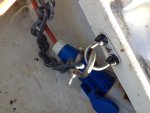
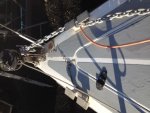
The boat is an MG Spring 25. The anchor is attached to the boat by chain only, and it fixed to the top of the anchor locker with a U-bolt (see attached pic). Silly newbie question... this isn't how it would be held to the boat when anchoring, is it? Assuming that it isn't, since this boat doesn't seem to have any dedicated mooring / anchoring post, what's the best way to anchor? See other attached pic of the foredeck.

Thanks in advance!

(Can't seem to get the pic attachments to show... grrr)

The foredeck basically has a mooring cleat to port and another to starboard.
 
Last edited:
Hi Stevie

You can tie off the chain on the morning cleats you show.

It would be worth getting a length of rope made up with a chain hook on one end. Then tie off the chain on one cleat, take up some slack and use the rope / hook on the other cleat attached to the chain with some slack to prevent too much noise transmission

I would remove that shackle between the u bolt and the chain too and replace it with a section of rope. If ever you get your anchor fouled / have an emergency, you can then simply cut the rope. With the shackle, if it is a little rusty and you can't release it you are stuck!
 
Hi Stevie

You can tie off the chain on the morning cleats you show.

It would be worth getting a length of rope made up with a chain hook on one end. Then tie off the chain on one cleat, take up some slack and use the rope / hook on the other cleat attached to the chain with some slack to prevent too much noise transmission

I would remove that shackle between the u bolt and the chain too and replace it with a section of rope. If ever you get your anchor fouled / have an emergency, you can then simply cut the rope. With the shackle, if it is a little rusty and you can't release it you are stuck!

I agree all of this, exactly as we do.
 
I have done both but find a hook easier. I've never had a hook come off, but don't anchor in challenging conditions.

We do sometimes anchor in what I guess might be called challenging conditions, gale force winds on occasion, lots of wind shifts, gusty anchorages, etc. We have never had a chain hook come off but we have had one fail. It was in Patitiri in the Sporades, berthed stern-to in the harbour for which the pilot warns that there is considerable surge in easterly winds. So of course the wind turned easterly overnight. At the time we had the upper snubber hook shown in the pic, which in the violent surging that occurred bent open and released the chain, upon which the boat lurched backwards, hitting the wall and punching our stern platform through the transom.

We replaced that hook with the one shown below in the photo, a much stronger forged item that shows no sign of deterioration after five years or more.

In the conditions that we are used to I could not even consider using a rolling hitch, or a Dyneema shackle. The great thing about these hooks is that they remain exactly where they are wanted until the chain is hauled in, when they fall off. The only rider to this is that they should be attached at such a length that they cannot touch the bottom, when they might perhaps be dislodged.

snubberhooks.jpg
 
.... replaced that hook with the one shown below in the photo, a much stronger forged item that shows no sign of deterioration after five years or more. ...

I have a similar chain hook as in your lower picture but in plain steel and galvanised. One of my concerns is that the hook might make small marks or nicks in the links which act as stress concentrators and potential weak spots.

Have you ever noticed damaged to links caused by chain hooks?
 
Maybe it's my technique but I moved from a hitched snubber to a chainhook a couple of years ago and had the hook detach twice within a month whilst anchored. I also found it cumbersome to maintain sufficient tension on the snubber during deployment to prevent the hook dropping off. Never had an issue with a rolling hitch. What conditions preclude using a knot?
 
Maybe it's my technique but I moved from a hitched snubber to a chainhook a couple of years ago and had the hook detach twice within a month whilst anchored. I also found it cumbersome to maintain sufficient tension on the snubber during deployment to prevent the hook dropping off. Never had an issue with a rolling hitch. What conditions preclude using a knot?

We also use the same hook as vyv's second one, used quite extensively and never had it drop off in use. Setting just needs a knack of holding a bit of tension on the rope as the last chain is paid out. Then we always ensure another couple of feet of chain hanging loose below the hook to keep in place.

For the OP, second the recommendation to use the snubber and hook - but always ALSO wrap the chain round the cleat in case the rope parts (or if the hook comes off)
 
Have you ever noticed damaged to links caused by chain hooks?

I have a chain hook like Vyv's picture, except mine had a spring clip thing to stop the hook falling off as you lower it down. That is a good thing ..... but means that it's a lot more fiddly to remove when you haul the chain back in.

I've never seen any effect on the links from using the hook which has rounded edges presumably to prevent this very issue.

Richard
 
I use a snubber in nylon too, and a chain hook (galvanized), and even in very challenging conditions never had it come off. But that nylon rope certainly attenuates the snatch motion, and reduces anchor stress.
 
View attachment 62316View attachment 62315Working my way through the list of winter jobs...
The boat is an MG Spring 25. The anchor is attached to the boat by chain only, and it fixed to the top of the anchor locker with a U-bolt (see attached pic). Silly newbie question... this isn't how it would be held to the boat when anchoring, is it? Assuming that it isn't, since this boat doesn't seem to have any dedicated mooring / anchoring post, what's the best way to anchor? See other attached pic of the foredeck.

Thanks in advance!

(Can't seem to get the pic attachments to show... grrr)

The foredeck basically has a mooring cleat to port and another to starboard.

The chain should have a stout lanyard between the u bolt & chain ( The Bitter End ) This allows the anchor chain to be "let go" in extremist with a sharp knife
 
We also use the same hook as vyv's second one, used quite extensively and never had it drop off in use. Setting just needs a knack of holding a bit of tension on the rope as the last chain is paid out. Then we always ensure another couple of feet of chain hanging loose below the hook to keep in place.

For the OP, second the recommendation to use the snubber and hook - but always ALSO wrap the chain round the cleat in case the rope parts (or if the hook comes off)

I cannot think of any circumstances where I would put a chain on a cleat.
 
Maybe it's my technique but I moved from a hitched snubber to a chainhook a couple of years ago and had the hook detach twice within a month whilst anchored. I also found it cumbersome to maintain sufficient tension on the snubber during deployment to prevent the hook dropping off. Never had an issue with a rolling hitch. What conditions preclude using a knot?

Numerous cruiser report them slipping at high load (~ 1000 pounds).

I've done testing that confirms this.

I suppose it depends on the line, how rough the chain is, and how much wind you see. But Every rolling hitch I tied slipped at less then 35% BS.

A camel hitch holds, as well as some other variations.
 
Numerous cruiser report them slipping at high load (~ 1000 pounds).

I've done testing that confirms this.

I suppose it depends on the line, how rough the chain is, and how much wind you see. But Every rolling hitch I tied slipped at less then 35% BS.

A camel hitch holds, as well as some other variations.

Interesting - I moved from rolling hitch to chain hook a couple of years ago but not because of strength. I can't see how a rolling hitch could easily slip provide the rope was not oversized, so that each hitch comes up against the next chain link. However apart from high winds at anchor I did no formal testing so fair enough.

I resisted moving from a rolling hitch to a chain hook for some years despite usually being at anchor in varying conditions as I don't like buying a piece of equipment where a technique can do instead. Also I found the time I spent check the anchor was ok might as well be spent spending a few seconds tying the hitch on.

However getting the rolling hitch off in a hurry, possibly after hours or days of being wet and tightened might take 30 seconds of leaning through the pulpit and that was not good.

Some examples
- anchored against a quay when strong gusts suddenly come in overnight and the stern starts straining against the fenders on the harbour wall instead of being a meter out - need to rapidly take in a few feet and the hitch arrives at the windlass
- in a close anchorage the next person to anchor next to you puts out more scope than you which is fine until the wind changes and his stern is against your bow. You need to let out a few meters quickly and you don't want to tie two ropes together to lengthen the snubber.
- you are tied stern-to on 50 meter plus line to shore with other boats around you and enough cross wind to have a lot of strain on the chain which you don't want to have on the windlass for long at all. So with a chain hook you can deal with the stern, the motor etc. but know you can very quickly start hauling the anchor in with little strain or time for the boat to be blown into boats still moored.

So for me it's speed of recovery rather than the time it takes to put the knot on.
 
Top