
Anchor dragging...

The problem I have with the anchor alarm is that when I deploy the anchor from the bow I have to press a button to mark the position. Being singlehanded this seems difficult to me. Either I have to bring the phone to the bow where i will probably drop it, or I press the button when I'm back in the cockpit and will not have the right position and the anchor alarm would not make alot of sense. Sorry to be so complicated and maybe I'm being too perfectionist. I'm still wrestling with my german heritage.

A decent anchor alarm I feel is one of the most important things to get a good nights sleep and remain safe at anchor. Ours can even monitor the boat when shore and we can see its exact track displayed on another phone.

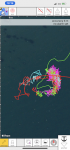
Anyhow, you don't need to drop the anchor on the app in the exact location. It can easily be done afterwards once you have set it. Since the anchor alarm draws a line where you swing then it is quickly apparent where the anchor is. You also don't need to have a circle as you're zone. This is particularly important when you drop you anchor close to a shore where your swing is fine when being blown in the expected wind direction but would mean you'd swing into a reef or the shore if it changed.

See the attached image. This was after 1 night but you can clearly see the arc once it began to blow and therefore when you can adjust the anchor position in the app later if you want to be a real perfectionist. At the end of the day if you're a few meters out because you drop it before you go to the bow, or later on then it doesn't make much difference. The beauty of adjusting the anchor location in the app later on is that you can see your swing profile and adjust your Guard Zone to within just 2m! I.e. it'll let you know if you drag almost immediately.

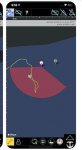
Note also the top bar. It is set to ARC but this can be set to a different shape (second image) if you don't want to swing into a crap pot, reef or fixed mooring nearby. Also the Cloud icon that says Remote. This is where you leave one phone on the boat and take another ashore. It will display the boat and track on the 2nd phone and give you an alarm if it's decided to exit the guard zone.

This specific App is called "Anchor!" by Marie Hullo. I have found it to be the most versatile.
IMG_7276.PNG

IMG_7277.jpg
 
I got a Rocna after some irritating times with a CQR. When it gives problems, there’s always something amiss; thin layer of sand over rock, weed, detritus of some sort (fishing gear and old bike frames seem favourite). I second what GHA said about an anchor app: I use Anchor! on an iPhone. To position the anchor icon, I just take the scope I’ve got out, add 10m for boat length and drop the anchor icon there (the boat icon use the phone compass to orient itself, so simply placing the phone facing the bow get the direction right), then set the alarm radius to suit conditions.
As for a snubber, I use a double legged snubber made of 12mm nylon octoplait: each leg is about 10m long, so effectively it’s 20m of snubber. The problem with polyester is that it doesn’t have much elasticity, so whilst it’ll take the load off the windlass, there not much shock absorption going on. I doubt that your current snubber was to blame for your problem but a “bouncier” one might make life more comfortable.
 
I got a Rocna after some irritating times with a CQR. When it gives problems, there’s always something amiss; thin layer of sand over rock, weed, detritus of some sort (fishing gear and old bike frames seem favourite). I second what GHA said about an anchor app: I use Anchor! on an iPhone. To position the anchor icon, I just take the scope I’ve got out, add 10m for boat length and drop the anchor icon there (the boat icon use the phone compass to orient itself, so simply placing the phone facing the bow get the direction right), then set the alarm radius to suit conditions.
As for a snubber, I use a double legged snubber made of 12mm nylon octoplait: each leg is about 10m long, so effectively it’s 20m of snubber. The problem with polyester is that it doesn’t have much elasticity, so whilst it’ll take the load off the windlass, there not much shock absorption going on. I doubt that your current snubber was to blame for your problem but a “bouncier” one might make life more comfortable.

I will see when I get it up. Thanks for the explanation on the app. That sounds very good. And for the snubber I will go with your advice. Longer and thinner and nylon.
 
If this had been a Delta anchor the owner would have promptly ditched it if it had dragged after 100 successful nights and bought a much bigger Rocna. Then thought the Rocna was responsible for the next 100 successful nights.
 
Last edited:
A decent anchor alarm I feel is one of the most important things to get a good nights sleep and remain safe at anchor. Ours can even monitor the boat when shore and we can see its exact track displayed on another phone.

Anyhow, you don't need to drop the anchor on the app in the exact location. It can easily be done afterwards once you have set it. Since the anchor alarm draws a line where you swing then it is quickly apparent where the anchor is. You also don't need to have a circle as you're zone. This is particularly important when you drop you anchor close to a shore where your swing is fine when being blown in the expected wind direction but would mean you'd swing into a reef or the shore if it changed.

See the attached image. This was after 1 night but you can clearly see the arc once it began to blow and therefore when you can adjust the anchor position in the app later if you want to be a real perfectionist. At the end of the day if you're a few meters out because you drop it before you go to the bow, or later on then it doesn't make much difference. The beauty of adjusting the anchor location in the app later on is that you can see your swing profile and adjust your Guard Zone to within just 2m! I.e. it'll let you know if you drag almost immediately.

Note also the top bar. It is set to ARC but this can be set to a different shape (second image) if you don't want to swing into a crap pot, reef or fixed mooring nearby. Also the Cloud icon that says Remote. This is where you leave one phone on the boat and take another ashore. It will display the boat and track on the 2nd phone and give you an alarm if it's decided to exit the guard zone.

This specific App is called "Anchor!" by Marie Hullo. I have found it to be the most versatile.
View attachment 103374

View attachment 103375
I can’t see how this is relevant to the thread. The OP realised the anchor was dragging as soon as it happened, his question is why it dragged and how to prevent a recurrence, an app wouldn’t have made any difference to his situation.
 
Thanks for the advice Quandary. I will certainly change my snubber setup. I thought this place was secure. Maybe I was pushing it too far. I ... Sorry to be so complicated and maybe I'm being too perfectionist. I'm still wrestling with my german heritage.
Not a problem.
 
If this had been a Delta anchor the owner wouldn’t have promptly ditched it if it had dragged after 100 successful nights and bought a much bigger Rocna. Then thought the Rocna was responsible for the next 100 successful nights.

I see where you're coming from. Fooled into the Rocna cult and the lie of eternal holding power. I still believe its a good anchor, but maybe not for all circumstances. Also I get the point some people made in this thread. Anchoring is not an exact science, there are too many variables. And I guess anyone who searches for absolute safety on the sea is in the wrong place to start with.
 
Lots of good advice above. It sounds to me that you already have a good approach and shouldn't be too hard on yourself.
I also have had a couple of utterly inexplicable anchor drags in hundreds of anchorings (25kg Spade on 10m 7T boat.) And a few that took a bit of looking into to explain (a ball of clay collecting between the shank and fluke in what looked like sand, encountering weed in what I thought was clean sand, a very friable clean sand that wouldn't hold at full revs in reverse though ok while just backing down to dig the anchor in.)
Four tips I will share but forgive me if you know them already:
-reverse to set the anchor and once the boat is held in position set it at full reverse for 20 seconds or more to bury the anchor fully. The videos show next generation anchors burying in 5 seconds or so but longer is a better test of the seabed. Be aware that this probably simulates only 20-25kn wind. I wish I could find again the data on boat windage and engine thrust in reverse that I gained that insight from.
- boats will hold purely on the weight of the unburied anchor and chain to a surprising wind speed. I've seen this in practice on my own boat at 20kn wind speed and swimming or rowing around anchorages observing other boats holding in 20kn winds with anchors not fully set. When the wind gets up the anchor tries to bury itself and then problems with dodgy seabeds can occur.
-sometimes I motor the boat forward along the chain to where I dropped it to set the position on the anchor alarm or to see if I can see it. Just today I renewed white paint on the shank and chain near the shackle and at 5m from the shackle which helps me find the anchor in the clear water of the Med. Usually a bearing on the anchor chain and the amount of chain out tells me where it is, allowing for the depth of water.
-never be afraid of resetting the anchor if you have any doubts. The most resets I've ever done is seven. Night was falling, the seabed was muddy sand and thin weed and the anchor dragged slowly but perceptibly under full reverse for the first six attempts. The forecast was 25kn wind overnight with a gale the next day. I woke up at dawn to see one of the other boats in the anchorage being towed off the beach and moved straight away!
Hope you get your anchor back OK
 
Thanks differentroads, that's very good advice. I remember to have read somewhere that 2000rpm in reverse simulate around 20kn wind. What you say about boats holding only on the weight of chain and anchor I experienced on my first boat a few years ago. It started to drag in 15kn, very slighty, and when I pulled the anchor up (Danforth type) chain was wrapped around it so it could ofcourse not have set. Mind you this was back in the days when I first came across the art of anchoring and didn't even know about going in reverse. I will post a picture when I got the anchor back. If it really caught on to something. Otherwise this will stay one of the many unexplained mysteries of life.
 
Thanks differentroads, that's very good advice. I remember to have read somewhere that 2000rpm in reverse simulate around 20kn wind. What you say about boats holding only on the weight of chain and anchor I experienced on my first boat a few years ago. It started to drag in 15kn, very slighty, and when I pulled the anchor up (Danforth type) chain was wrapped around it so it could ofcourse not have set. Mind you this was back in the days when I first came across the art of anchoring and didn't even know about going in reverse. I will post a picture when I got the anchor back. If it really caught on to something. Otherwise this will stay one of the many unexplained mysteries of life.
Hmm. I just hope the anchor is still on the end of the chain. Just thinking of possibilities..
 
Is the boat jerking the chain?
If so, then you'd suspect a better snubber might help.

Sounds like the anchor actually broke out of the seabed and dragged freely over it, not digging in at all,

I wondered this. 4m of depth perhaps was a bit snatchy in those conditions. Thick gloopy mud might stick to the anchor and perhaps make it hard to re-set. What did the anchor look like when it came up?
 
I had a scary experience in the summer when my anchor dragged during the night. I had taken a transit off the nearby pier and a lamp post and gone to bed as the wind steadily increased. It was blowing sustained 25 kts at that time. I woke up at 3am with a strange bumping noise. I initially thought that the tiller had become untied from the lashings either side of the cockpit. Once my eyes adjusted to the pitch black and rain, I could see that wasn't the case, but then I suddenly was able to focus on the large rock that the stern of the boat was up against and where the banging was coming from. I've never become so awake so quickly. I managed to get the boat moving off the rocks while at the same time retrieving the anchor chain (not easy single handed and hindered by more rocks unseen to starboard). When the anchor finally came up, it had an enormous clump of seaweed attached to the flukes, so it could never have managed to reset itself. When I checked the track that the boat had taken, it turned out we had dragged 1/3rd of a mile, thankfully the boat was still being held head to wind by the time I woke up or it could have been a disaster. I now have a dedicated anchor app on my phone and am more careful about making sure the anchor is set with high revs in astern.
 
What it is to be predictable :) Sorry to be so boring!!

You have all the advice needed in the various posts above and I note you have seen my snubber articles - you are good to go! :)

I test anchors all the time and when testing I can anticipate the sort of ultimate hold I would expect. I tend to test in the intertidal zone as I can test under water and then when the tide goes out - dig the anchor up. Its not perfect but I don't have a better system. Often, or maybe sometimes, the anchor is a disappointment and I know the anchor has not met expectations. When I dig the anchor out I can find a tiny piece of foreign matter impaled on the toe, shell, small bit of water logged wood. When we power set we, those that power set, normally will set to maximum revs which usually is equivalent to about 30 knots of wind. If the wind is more than 30 knots your anchor will set more deep[y and that small piece of contaminant that was 10mm beyond the toe of your anchor when you power set is now in the way - ready to be impailed and to trip your anchor.

So....power setting simply tells you your anchor is set for 'upto' 30 knots plus or minus - beyond 30 knots you are relying on luck (and your anchor alarm). Seabeds are not uniform and the bit of seabed in front of your anchor may offer lower hold - normally your anchor will cope (and simply set more deeply).

Lots of people power set (and many at cruising revs) and have wind develop much greater than the tension developed when power setting - and sleep soundly. For the anchor to catch something in the toe is - bad luck. But it does not take much to move the anchor. Any anchor can get seaweed round the crown (fluke/shank interface) if the anchor is tensioned more than the power set - that seaweed can trip the anchor.

You can reduce the issues by installing a decent snubber - one that is actually elastic. Yours is good for taking the load off the windlass but does absolutely nothing to mitigate snatch loads. When you power set at cruising or maximum revs that is roughly equivalent to 30 knots of wind. If you add an elastic snubber the snubber will absorb some of the impact of veering and tension and now your power set is equivalent to more than 30 knots. So......go off to your local climbing gym, beg one of their discarded ropes (be prepared to contribute to the tea fund). Don't feel bad that your begging - these ropes go to land fill - your are offering a re-cycling service. Dynamic climbing rope is perfect as a snubber, though 12mm might be a bit beefy for your yacht (and climbing gyms don't use smaller than 12mm). Ideally you want length, we are using 30m - and to find a gym needing 30m ropes is not so easy - take what you can. If possible you want to develop a bridle, a bridle reduces yawing. You should get the retired ropes for free (tea fund contribution) take the 12mm and try it - when you are more comfortable go off and buy maybe the size smaller 10mm. We have been using 12mm for years now, 2 as a bridle, we have just bought 2 new ones - but on reflection I think we can still go down is size and have just ordered 2 x 30m x 10mm with sewn loops at the end. I order them specially as I want the sewn loops to be longer than 'normal' (explained in a recent article, see below).

Most modern anchors of the size recommended by anchor makers (no need to go big) will offer enough hold for a 30 knots wind - but anchors do drag (those unknown contaminants in the seabed, incompetence) and yawing and horsing from chop appear to be the main culprits causing dragging. A snubber (and better a bridle) will reduce the forces causing dragging.

Many yachts yaw and reducing yawing will help reduce snatch loads. Sometimes the yawing is caused by your location, not the yacht, you are subject to wind shear - best visual examples - watch aircraft land in gusty conditions and you will see the plane wandering left and right of a straight line. Setting 2 anchors is a good idea - you want to set them so that each is set for the angle of the veer - then each anchor is set to the veer wind direction. A single anchor is constantly pulled side to side - and it does not matter if its a big anchor or the right size - pulling an anchor left and right will reduce the shear strength of the seabed - and the ultimate hold data then becomes academic (and the real hold is lower). This does not work too well if the wind is going to change through 180 or 360 degrees - because your rodes will tangle - but most strong winds in the UK (and Oz) are from predicted directions and you are not subject to cyclonic storms. So be careful and check the forecasts. You are not doubling 'hold' but you are ensuring your anchors are not loaded continuously from left and right.

If you think a big anchor is a panacea to greater security - think again. Hold is a function of tension, the tension is your engine or windage - they are fixed. The big anchor will have the exact same hold as the smaller one - because hold is that 'fixed' tension imposed by yacht or engine. Hold is also a function of buried surface area (and design) a smaller anchor (one the right size) will be buried more deeply than a big one. A big anchor will have more shank exposed and this will have a greater lever effect when loaded side to side, better you can bury your anchor completely and some chain.

Someone will pipe up and say a bigger anchor is better in marginal seabeds, long term liveaboards use bigger anchors and a bigger anchor is better at short scope - there is no data, at all, that has ever been offered to substantiate any of this.

Concave anchors can develop embedded mud in the fluke (there is simply too much evidence underlining this) if the anchor does trip (for whatever reason) then it is very difficult (if not impossible) for the anchor to reset until is has 'self cleaned' and it self cleans as it drags. Many people use Concave anchors and do not find this an issue but there are recommendations to consider a design without this 'weakness' and Spade (which is only shallow concave), Excel (speak to Jimmy Green). Kobra (maybe Epsilon) are alternatives to Rocna and Supreme. The problem might be caused by the juxtaposition of concave and roll bar, not concave alone. Perforations appear to be advantageous, Excel, Viking.

Send me a PM with your email address and I'll forward a pdf which might add to the background.

Jonathan


The art of snubbing, in the nicest possible way - MySailing.com.au
 
Last edited:
I wondered this. 4m of depth perhaps was a bit snatchy in those conditions. Thick gloopy mud might stick to the anchor and perhaps make it hard to re-set. What did the anchor look like when it came up?

So in high winds better to anchor in deeper water? To reduce the snatch produced by the waves? For the anchor I will tell you as soon as I know
 
I can’t see how this is relevant to the thread. The OP realised the anchor was dragging as soon as it happened, his question is why it dragged and how to prevent a recurrence, an app wouldn’t have made any difference to his situation.

He said:
“I live on the boat year round and really would like to get back my confidence in my anchor setup, as this is an important part of this life.“

A decent anchor alarm is part of gaining confidence anchoring. Plus he found it useful.

Perhaps pointing out posts which you don’t find useful isn’t relavent to the thread?
 
Last edited:
OK, I'll bite. Yes Jonathan, hold is the same or a function of tension, but a bigger better anchor has the potential for more hold when the wind gets up. If that wasn't the case we would all just use tiny wee anchors, and have nothing to argue about.
 
So in high winds better to anchor in deeper water? To reduce the snatch produced by the waves? For the anchor I will tell you as soon as I know
Yes, definitely. Deeper water gives your chain something to do, in that it gives catenary. The alternative, strongly recommended by those with lightweight boats, is to rig a cat's cradle of climbing ropes, a bit like anchoring with bungee cord.
 
What it is to be predictable :) Sorry to be so boring!!

You have all the advice needed in the various posts above and I note you have seen my snubber articles - you are good to go! :)

I test anchors all the time and when testing I can anticipate the sort of ultimate hold I would expect. I tend to test in the intertidal zone as I can test under water and then when the tide goes out - dig the anchor up. Its not perfect but I don't have a better system. Often, or maybe sometimes, the anchor is a disappointment and I know the anchor has not met expectations. When I dig the anchor out I can find a tiny piece of foreign matter impaled on the toe, shell, small bit of water logged wood. When we power set we, those that power set, normally will set to maximum revs which usually is equivalent to about 30 knots of wind. If the wind is more than 30 knots your anchor will set more deep[y and that small piece of contaminant that was 10mm beyond the toe of your anchor when you power set is now in the way - ready to be impailed and to trip your anchor.

So....power setting simply tells you your anchor is set for 'upto' 30 knots plus or minus - beyond 30 knots you are relying on luck (and your anchor alarm). Seabeds are not uniform and the bit of seabed in front of your anchor may offer lower hold - normally your anchor will cope (and simply set more deeply).

Lots of people power set (and many at cruising revs) and have wind develop much greater than the tension developed when power setting - and sleep soundly. For the anchor to catch something in the toe is - bad luck. But it does not take much to move the anchor. Any anchor can get seaweed round the crown (fluke/shank interface) if the anchor is tensioned more than the power set - that seaweed can trip the anchor.

You can reduce the issues by installing a decent snubber - one that is actually elastic. Yours is good for taking the load off the windlass but does absolutely nothing to mitigate snatch loads. When you power set at cruising or maximum revs that is roughly equivalent to 30 knots of wind. If you add an elastic snubber the snubber will absorb some of the impact of veering and tension and now your power set is equivalent to more than 30 knots. So......go off to your local climbing gym, beg one of their discarded ropes (be prepared to contribute to the tea fund). Don't feel bad that your begging - these ropes go to land fill - your are offering a re-cycling service. Dynamic climbing rope is perfect as a snubber, though 12mm might be a bit beefy for your yacht (and climbing gyms don't use smaller than 12mm). Ideally you want length, we are using 30m - and to find a gym needing 30m ropes is not so easy - take what you can. If possible you want to develop a bridle, a bridle reduces yawing. You should get the retired ropes for free (tea fund contribution) take the 12mm and try it - when you are more comfortable go off and buy maybe the size smaller 10mm. We have been using 12mm for years now, 2 as a bridle, we have just bought 2 new ones - but on reflection I think we can still go down is size and have just ordered 2 x 30m x 10mm with sewn loops at the end. I order them specially as I want the sewn loops to be longer than 'normal' (explained in a recent article, see below).

Most modern anchors of the size recommended by anchor makers (no need to go big) will offer enough hold for a 30 knots wind - but anchors do drag (those unknown contaminants in the seabed, incompetence) and yawing and horsing from chop appear to be the main culprits causing dragging. A snubber (and better a bridle) will reduce the forces causing dragging.

Many yachts yaw and reducing yawing will help reduce snatch loads. Sometimes the yawing is caused by your location, not the yacht, you are subject to wind shear - best visual examples - watch aircraft land in gusty conditions and you will see the plane wandering left and right of a straight line. Setting 2 anchors is a good idea - you want to set them so that each is set for the angle of the veer - then each anchor is set to the veer wind direction. A single anchor is constantly pulled side to side - and it does not matter if its a big anchor or the right size - pulling an anchor left and right will reduce the shear strength of the seabed - and the ultimate hold data then becomes academic (and the real hold is lower). This does not work too well if the wind is going to change through 180 or 360 degrees - because your rodes will tangle - but most strong winds in the UK (and Oz) are from predicted directions and you are not subject to cyclonic storms. So be careful and check the forecasts. You are not doubling 'hold' but you are ensuring your anchors are not loaded continuously from left and right.

If you think a big anchor is a panacea to greater security - think again. Hold is a function of tension, the tension is your engine or windage - they are fixed. The big anchor will have the exact same hold as the smaller one - because hold is that 'fixed' tension imposed by yacht or engine. Hold is also a function of buried surface area (and design) a smaller anchor (one the right size) will be buried more deeply than a big one. A big anchor will have more shank exposed and this will have a greater lever effect when loaded side to side, better you can bury your anchor completely and some chain.

Someone will pipe up and say a bigger anchor is better in marginal seabeds, long term liveaboards use bigger anchors and a bigger anchor is better at short scope - there is no data, at all, that has ever been offered to substantiate any of this.

Send me a PM with your email address and I'll forward a pdf which might add to the background.

Jonathan

Thanks Neeves for the explanations. Some very good information. That small piece 10mm away makes alot of sense. I like the idea of powersetting with the snubber attached. I used to do it only with chain and rig the snubber later. For the climbing gym that will be difficult with lockdown and being in a foreign country where I'm not yet able to speak the language. Anyways I will change my snubber system, a bridle seems like a good idea. And I suspect climbing rope can be bought online. I don't like the idea of having two anchors out (seems complicated and potentially dangerous) but I understand that one anchor moving from side to side is loosening the seabed around him, so I might have to rethink on that. PM sent.
 
northcave: That's what I think. It was good advice in a broader sense.

NormanS: Ok, so that was a mistake and could have caused the anchor the break out. Will keep that in mind for the next time I will anchor in high winds.
 
Top