anchor drag alarm setting dilemma

catmandoo

Well-Known Member
Joined
21 Aug 2003
Messages
1,803
Location
The Earth but normally in the place of the high st
Visit site
Following on from other post about anchor drag alarm I have a drag out put on my GPS which I have been considering linking to a latching relay and a burglar alarm siren which I wired up but did not use. The reason is that the set point setting puts me in a dilemma . The GPS seems to have a capacity for anything up to a mile or more of drag and with that specification I suppose distances measured in metres might not be very accurate
A boat moves around at anchor swinging within a circle of fixed radius depending on the amount of rode set out however with 20 metres laid an overall movement of say 50 metres taking into account a slip over a full 40 m diameter of swing seems rather small if the drag alarm is not all that accurate at small distances which might be essential in a tight anchorage close to some rocks etc
Even a metre of surreptitious slow slip might be critical taking into account response times etc of the crew . Also it all depends on where the GPS thinks the anchor should be . Difficult when its on the boat and not on the anchor .

Does any one out there consider slip to that accuracy . or even change the slip set point to suit the situation in different anchorages . What do you use as the anchor position etc . I think the set point is the position of the boat when when the anchor drag alarm is set which means that the skipper should be worried if it slips a few meters in one direction when the rode is taught but not so when it moves within the 40 metre or so in the slack direction if there is a wind change over night Getting mind boggling ??

Actually the wind change over night is of more concern !

Any comments
 
I went on the trial and error theory upping the distance until I got a good nights sleep :) I'm sure the GPS was teasing me with false alarms making me haul myself out of a warm bunk only for the alarm to stop when my finger gets within 10cm of the reset button
Mine is set at 42 metres which seems to have stopped the false alarms.

JR
 
I don't tend to use either of the chart plotters for anchor alarms for the issue you raise. i.e. the boat could lay equidistant from the anchor in any direction and not just from where you first set the alarm.

I have however tried out a few anchor alarm Apps for the phone, one of which once anchored allowed you to point the phone in the direction of the anchor, input the distance you think you are from the actual anchor point.. and it centers the alarm at that point.

Others allow you to set the anchor point visually in relation to your actual position.

Perhaps worth checking out phone Apps. Some allow you to change the distance of the alert in various directions even.
 
When at anchor set your chartplotter to track movement. The chartplotter will draw an arc determined by the amount of rode and how the wind veers the yacht. The longer you can leave it the more accurate, or useful, the plot. You can if you need motor to the centre of the circle 'descrbed' by the arc and set the anchor alarm when you reach the centre, which will be where the anchor is. You can then set the alarm to be a bit 'more' than the rode deployed, say an extra 10m. Most modern chartplotters will allow that degree of accuracy and most modern anchors will not move that much (in the seabed) - even in a change of tide. So, find the centre of your swing circle (using my arc plotting method), set the anchor point, add 5 or 10m to the amount of rode deployed, set alarm.

To establish accurate distances we would use radar but appreciate you might not have it - you then need to guess how close (or far) yachts or rocks might be. But again - modern GPS are pretty accurate (though the charts might be less so!) so you might need to do a bit of fudging. In Oz we still have charts with large areas of white and the useful words 'unsurveyed' over the white.

I'm not sure how accurate phone apps are - ??? My phone, is a phone - nothing more (it has a little LED torch)

Jonathan
 
Getting the anchor bedded in securely is the first aim because that jerk and twang you get on the chain when you put the boat in reverse and the anchor bites gives you that initial bit of confidence in the mooring . You then check movement on shore objects to be doubly sure . You then retire to bed when night falls and then the wind increases or changes direction in the wee small hours .
constant pressure on the anchor and chain can be OK for a good overnight hold but in some instances there can be a hidden surprise .
Some types of mud become fluid when subjected to a constant pressure over a couple of hours and the anchor slips with a loud bump wakening up the crew in the middle of the night .

Once bitten twice shy
 
The GPS's uncertainty over a few hours will be order 20m if not using EGNOS/ DGPS, and about 3m if using EGNOS / DGPS: I have posted graphics of experiments I've made on this. Very occasionally it can be much worse, but it's rare. Phone GPS is probably as good as, and in fact probably more modern and so better than, marine ones provided they get a reasonable signal. Inside the cabin of a GRP boat is reasonable (industry / interested party alert). Hence it's unlikely that the GPS alone will give many false alarms, ie the drag alarm threshold depends more on conditions.

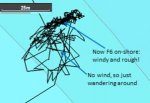
Here are a couple of annotated screen-shots of the plotter during two nights at anchor, which may help. The first was dead calm when we went to bed but it blew up to an (entirely unexpected) onshore F6 at around 2am. We stuck it out 'til about 7am hoping it would die down with the dawn. We had 45m of chain out in 7m of water.

capture_3.jpg

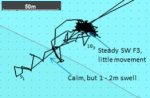
The next night was elsewhere in a bay sheltered from the S and we had steady F3 from the SW followed by dead calm but quite a big swell from the N. We had 50m of chain out in 10m of water.

capture_4.jpg

The message is that one wanders around rather little in a blow, but quite a lot in a calm. FWIW we set the drag threshold to 0.03nm (about 60m).
 
Old fashioned, I suppose, but if conditions are such that anchor dragging is a possibility then I prefer to keep a visual anchor watch. Even though I might have confidence in my anchor, I can't be sure about other people's and I don't want to be woken by the sound of my guardrails being torn off. :(
 
..........
I'm not sure how accurate phone apps are - ??? My phone, is a phone - nothing more (it has a little LED torch)

Jonathan

They're good. All I used on my round trip. Playstore has several freebies. I had them on phone and tablet and they tallied well.

One occasion (Phuldobrain) was slightly puzzling then slightly embarassing. After anchoring overnight I went ashore in the tender. I'd put my phone in plastic in a back pack and hadn't turned off the app. Siren sounding all the way to the beach as I didn't have a free hand-
 
What does an anchor watch app do to battery life?

The GPS on my phone eats the battery. I can get a couple of days light use as a phone + a bit of app use, but my satnav app, Waze, will run the battery down in a couple of hours.
 
What does an anchor watch app do to battery life?

The GPS on my phone eats the battery. I can get a couple of days light use as a phone + a bit of app use, but my satnav app, Waze, will run the battery down in a couple of hours.

It would be irrelevant for me, since I plug my phone in when I go to bed whether on the boat or at home (or anywhere else).

I use the AIS display for an anchor alarm rather than my phone, though. It has a good mode for doing this:

attachment.php


anchor-%20watch-thumb-465x505-3243.png


Every couple of minutes it draws another one-pixel dot in your current position, so the density of those dots in the morning shows how the boat has been moving. Usually there's two blobs, one for each direction of tide, plus a lighter strand between them where the boat swung. You can choose any size of circle you want; if I was able to get the centre point more or less accurate then I generally set the radius to ten metres more than the amount of chain I put out, and don't get false alarms (obviously the actual margin is a little more than 10m due to the angle of the chain). The one problem is that you have to press "Set" at the point where you drop the hook - to begin with I often forgot, and once you're anchored it's too late as there's no way to tell it "the anchor is over there". I usually remember now, but occasionally it doesn't get set at the right moment if some sort of distraction or complication happens during the process. In that case I choose a much wider alert circle that will cover us even after swinging two chain-lengths the other way, and at least get the benefit of the dot patterns showing how we've moved (and warning of a really major drag). If I get up in the night I generally have a peek at the anchor watch display, and it's reassuring to see from a tight blob of dots that we're staying in place.

All that said, I use it because the feature's there on the AIS I have anyway. I don't consider it essential, and before fitting that kit I didn't use a GPS anchor watch even though either my phone or the basic GPS could have done it. Both our boats have had large, reliable ground-tackle, and I sleep quite comfortably at anchor.

I still forget to disable the alarm before departure more often than not :)

Pete
 
What does an anchor watch app do to battery life?

The GPS on my phone eats the battery. I can get a couple of days light use as a phone + a bit of app use, but my satnav app, Waze, will run the battery down in a couple of hours.

I don't have a charging point in the aft cabin, so I will probably just take my 16000m-ah Ravpower recharging store, so that I can be sure of battery lasting the night. I downloaded an App called my Anchor watch (MAW) which looks pretty good but not looked at anything else yet. In the setting you can set the GPS action - default setting is to ping once a minute - that might mean it is not too greedy on power. ( I presume that is what that setting is?)

I will do a test over night from may safe anchorage in Haslemere to see what it does to the battery,making sure that data and wifi etc are off.
 
Getting the anchor bedded in securely is the first aim because that jerk and twang you get on the chain when you put the boat in reverse and the anchor bites gives you that initial bit of confidence in the mooring . You then check movement on shore objects to be doubly sure . You then retire to bed when night falls and then the wind increases or changes direction in the wee small hours .
constant pressure on the anchor and chain can be OK for a good overnight hold but in some instances there can be a hidden surprise .
Some types of mud become fluid when subjected to a constant pressure over a couple of hours and the anchor slips with a loud bump wakening up the crew in the middle of the night .

Once bitten twice shy

Then in that specific situation you should be deploying your Fortress that you keep ready for just that seabed. Anchors are a compromise, even the best struggle in mud.

Deploying a Fortress, by hand, is not as easy as pressing a button but its not that difficult.

If you do not have a Fortress now is a good time, maybe someone will be doing deals at the boat show.

Jonathan
 
Last edited:
As soon as I start to lower the anchor, SWMBO sets the anchor alarm which is usually set to 0.03 NM. Bearing in mind the gps aerial on the taff rail is already 12 metres aft of where the anchor first hit the bottom, this setting allows for us to swing to tide without tripping the alarm. Once I've finished anchoring, I erase the track on the gps and zoom in to max. As said above, this gives me a picture of just what the boat is doing and, in the unlikely event of a drag (rare since binning the cqr) I know at a glance which direction we're headed.
 
I don't have a charging point in the aft cabin, so I will probably just take my 16000m-ah Ravpower recharging store, so that I can be sure of battery lasting the night. I downloaded an App called My Anchor watch (MAW) which looks pretty good but not looked at anything else yet. In the setting you can set the GPS action - default setting is to ping once a minute - that might mean it is not too greedy on power. ( I presume that is what that setting is?)

I will do a test over night from may safe anchorage in Haslemere to see what it does to the battery,making sure that data and wifi etc are off.

I ran the App overnight and 15% of the battery was used. I assume therefore than the once a minute ping to the satellites is fairly important in that lack of consumption.

I had a couple of drags in the night - the phone was in the window in my office down stairs and was obviously not under the best conditions to get a good signal. I was woken up by the alarm (as was nearly killed by SWIMBO) at 1 am and 5 am. I set the drift limit to 300 meter to stop it! So I am confident of hearing it.

The App also has a email and sms facility - which sent a text to my wife's phone - so also useful when going ashore and leaving the boat for a time. Freat little App.My Anchor watch (MAW).
 
Sypathetic to that point of view . Human error, Batteries failing, .All of us who have woken up in pitch darkness to a roaring sound . heavy waves and rocks seemingly a few metres away in the dark could not sleep through the long night hours in peace waiting for bleary eyed daylight reassurance
 
Then in that specific situation you should be deploying your Fortress that you keep ready for just that seabed. Anchors are a compromise, even the best struggle in mud.

Deploying a Fortress, by hand, is not as easy as pressing a button but its not that difficult.

If you do not have a Fortress now is a good time, maybe someone will be doing deals at the boat show.

Jonathan
It was a delta over the stern that slipped . I now use a Rocna and check it is firmly in . I think my boat would sink with the number of different anchors that I have had . Currently currently got 3 , Rocna CQR, Delta and previously a Bruce .. However I think a Fortress would still have struggled in the thixotropic mud at Levkas town quay
 
If I understand correctly - the phone/GPS identified it was dragging but it was actually stationary (in an office, where reception might not be good) Consequently the drag trigger might be a combination of the 1 minute pings, not being sufficiently frequent or the location was not the best for reception.

With apologies to your long suffering wife - but any chance you can better define the parameters?

I'd do it myself, but as mentioned - for phones I'm a complete Luddite, but willing to be convinced that I need to join the masses - but so far I'm not convinced. I would not mind being woken up if the anchor actually dragged but I would mind being woken up if the alarm was insensitive (to my need for sleep).

But then I might have misunderstood your post :(

Jonathan
 
" I assume therefore than the once a minute ping to the satellites is fairly important in that lack of consumption."

Just for the sake of completeness, GPS receivers don't ping satellites, they merely receive the satellite signals and then compute their position from the time difference between the signals from different satellites. I can't imagine your GPS turns itself on and off every minute, so possibly it only compares the positions every minute?

Neil
 
" I assume therefore than the once a minute ping to the satellites is fairly important in that lack of consumption."

Just for the sake of completeness, GPS receivers don't ping satellites, they merely receive the satellite signals and then compute their position from the time difference between the signals from different satellites. I can't imagine your GPS turns itself on and off every minute, so possibly it only compares the positions every minute?

Neil

Agreed - not a ping - I think that in power saving mode on Google maps for example, it only reads the off a new position when you activate the maps again when no longer showing on screen.

This device only reads a position once a minute or what ever you set the parameters to be. Still experimenting with it to understand it more.
 
Top