
Anchor chain

It's all about chain angle to sea bed. What's the chain angle difference between where there is a depth of water of two meters and an anchor attached at the waterline and a boat anchoring with a bow roller of two metres above the waterline? It's double. Of course this is extreme, but there are real examples not so extreme, but significant. I'm sorry, but I think your judgement of the importance of this is completely wrong.

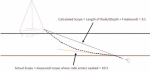
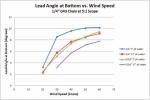
The funny thing about scope and chain is that most often the people who disagree are both right. Chain behaves one way in shallow water with strong wind and high strength chain, and another way in deeper water with heavy chain and moderate wind. I published an article on this, incorporating both testing and theory to fill in the gaps, in PS. There are many variables. The primary thing about chain that is always always true is that it is hard to cut.
p1bt587in319621b4bveui33sq66.png

p1bt58amn499ss921v7m1p6aiu9.png

https://www.practical-sailor.com/issues/37_83/features/Short-Scope-Anchor-Test_12296-1.html
 
One more thing that may shed some light on the scope and catenary debate.

If you run through the math and the experiences, it is not so much the scope or the depth of the water that makes catenary effective, but the amount of chain deployed. Put another way, it takes long scope in shallower water and less scope in deep water to accomplish the same thing; keep the chain near the bottom in high winds. It depends on the boat, but somewhere around 200-300 feet the chain gets really hard to lift, and at 70 feet, it is quite easy. Thus, a guy anchoring in 20 meters may be happy with 5:1 scope, but a guy in 3 meters needs 10:1 scope and a snubber if it really blows. Both are correct.

Another things folks forget, which is a problem in the soft mud here, is that while an anchor may set and hold with engine power at 5:1 scope in 3 meters, the anchor will NOT set deeper at 5:1 scope when a 60 knot gust hits. It will hold what it was set with (perhaps equivalent to 35 knots), but the angle will NOT allow the anchor to dig deeper. And so he is surprised when he drags. This inability to dig deeper at shallow angles is one of the limiting factors at short scope.
 
As comprehension skills, or selective reading may lead to incorrect ideas I repeat:

We deploy 2 anchors not to increase hold, per se, but to reduce veering - as I firmly believe veering (associated with dynamic loads) contributes or is the primary reason for dragging. We have minimised dynamic loads by use of overly long snubbers. We use 2 anchors to reduce veering. Now whether we NEED 2 anchors we don't know. It seems better to be prudent and than have the need to take remedial action at 2am! I understand 2 anchors are onerous - but what else are you doing??

Another, and seldom talked about (or used) mechanism to reduce veering is a riding sail. We have thought about a riding sail - but cannot quite work out we could rig one on a catamaran as we have no backstay and the boom end overhangs the transom of the bridge deck. The hull transoms protrude aft but are not built to be load bearing, for a sail. So for us a riding sail is an option but not realised.

Interestingly we have found that veering has reduced since we increased our snubber length from 10m to 30m (though have never had need to use the full 30m). We don't know if this reduced veering was a weather effect (the wind was not veering) or the specific anchorage, the wind was, again, stable, or whether it has something to do with the long snubbers. Its an effect that intrigues - that we will be looking at, another article to appear in Practical Sailor :)

Because of this effect - last time we were subject to 30 knots average, with stronger gusts, we only had one anchor deployed (with 20m of snubber each side) - contradicting our previous practices. I do confess we had a second anchor on the bow with rode - ready. But this turned out to be unnecessary (and when we retrieved the only anchor deployed it was very well set).

Jonathan
 
Last edited:
Noelex,

And because you constantly belittle and look to mock my prudence

I'll summarise

I use a an alloy equivalent to a 15kg steel anchor, weighing in at 8kgs. We have in the past used 2 alloy anchors. We use 6mm chain, well undersize for the recommendation and snubbers I can extend to 30m. Our cat at 38' has the same windage as a 45' Bav but at 7t is about half the weight. I think your new yacht is 46', I don't know how heavy but I suspect less flighty than a 7t cat. We have no deep keel, we draw 1m, to reduce yawing.

In think you are using a 50kg anchor, maybe more, and I'd guess 8mm chain, maybe 10mm.

You question why I might use 2 anchors - yet you use an anchor over 3 times bigger than ours for a 'similar' yacht. You need a bigger windlass, need heavier cables, need more reinforcing, need a bigger anchor locker (and cannot retrieve by hand should the need arise).

The advantages of smaller anchors, to us, far outweighs the inconvenience of the need to deploy a second anchor - maybe every 15 times we anchor. And our anchor does not detract from sailing to windward.

Now possibly you can elaborate on the advantages of the big anchor.

Jonathan
 

Thanks for the work Thinwater. People focus on scope, but it is the lead angle that is important. Scope is a useful rough quick means of estimating the lead angle (sort of) but it is easy to forget there are other factors, such as the slope of the ground, which can have a very significant impact on this angle. It is nice to quantify the effects of chain weight. More graphs for different scenarios would also also be useful, so if you have any please post them.

The difference in angle is more than I would have expected. For example, in 17 feet of water and 30 knots of wind changing from 1/4 to 5/16 inch chain almost halves the angle, changing the value from around 5.8° to 3°. This is quite a significant change.

Perhaps those who emphasise chain weight do have a point, although we should bear in mind that the 1/4 inch chain would save a great deal of total weight. Adding even a small fraction of this saving to the anchor would more than make up for the loss of performance caused from using the lighter chain and increasing the lead angle.
 
Adding even a small fraction of this saving to the anchor would more than make up for the loss of performance caused from using the lighter chain and increasing the lead angle.

Any data, to support this statement?

It does not matter the scope - within a few degrees, someone can do the maths - apply 400kg of tension the anchor hold, assuming it is not moving, will be 400kg. it will slightly less for a slightly higher angle. But it will be the same whether big or small, anchor.

There is no magic - same rode, same scope same seabed apply the same tension - same hold big or small anchor. In fact as long as the anchors set - then a CQR subject to 400kg will have the same hold as Rocna - on the proviso the CQR sets and holds (and the Rocna sets and holds) (and a lot of people still swear by CQRs)

If you know different explain the magic

Jonathan

edit

And being even more pedantic - weight has nothing to do with it, an alloy Spade or alloy Excel will develop the same hold as their steel counterparts - under the same scope, same seabed same tensions.

close edit
 
Last edited:
The funny thing about scope and chain is that most often the people who disagree are both right. Chain behaves one way in shallow water with strong wind and high strength chain, and another way in deeper water with heavy chain and moderate wind. I published an article on this, incorporating both testing and theory to fill in the gaps, in PS. There are many variables. The primary thing about chain that is always always true is that it is hard to cut.

View attachment 69305

View attachment 69306

https://www.practical-sailor.com/issues/37_83/features/Short-Scope-Anchor-Test_12296-1.html
That’s a very clear and illustrative graph. I don’t believe it is correct though. I think the difference between the chains is too great at moderate winds as Noelex points out and it is not credible that there is even a 1 degree 13% difference at 60 kt. My observation is that is the most you would get at 30 kt, not 60 kt. My chain is typically straight as a rod at 30 kt. No reasonable amount of extra chain weight will increase the catenary.

I expect the figures that you used for drag forces of wind on the hull are too low. Also I wonder if you considered the force at the time of highest load as I think you should, which is when the boat shears, changing direction when sailing the anchor. Loads can nearly double I recall reading when this was once measured. Then somewhat less due to the use of a snubber.
 
Last edited:
Thanks for the work Thinwater. People focus on scope, but it is the lead angle that is important. Scope is a useful rough quick means of estimating the lead angle (sort of) but it is easy to forget there are other factors, such as the slope of the ground, which can have a very significant impact on this angle. It is nice to quantify the effects of chain weight. More graphs for different scenarios would also also be useful, so if you have any please post them.

The difference in angle is more than I would have expected. For example, in 17 feet of water and 30 knots of wind changing from 1/4 to 5/16 inch chain almost halves the angle, changing the value from around 5.8° to 3°. This is quite a significant change.

Perhaps those who emphasise chain weight do have a point, although we should bear in mind that the 1/4 inch chain would save a great deal of total weight. Adding even a small fraction of this saving to the anchor would more than make up for the loss of performance caused from using the lighter chain and increasing the lead angle.


Some of this might be partially correct, most is invalid.

Most anchors when they set bury shackle and chain simultaneously with the fluke. This means the fluke angle to the seabed is about 30 degrees. As the fluke buries it pulls more and more chain with it. Anything in the rode, big shackle, big swivel or big chain resist burying (which is an advantage for small chain and no swivel (shackles used are usually determined by their strength, not size.

Fluke anchors, Danforth and Fortress are slightly different, they bury the fluke at 30 degrees, sometimes more, but the shank buries last.

Chain when it buries develops a reverse catenary and the shackle angle to the seabed increases (the deeper the anchor dives). Its the shackle that transfers tension to the anchor - so it is the angle of the shackle that determined tension angle - NOT scope.

The US Navy and the oil industry have done lots of work on anchors and have neat programme that allows, given certain knowns, to calculate shackle angles.

In a recent test of leisure anchors, ones we actually use, an analysis was made of one anchor type, buried in the seabed, and the analysis produced the following results. The first three results are as a result of high tension, almost 1,000kg and last 2 results are at a much lower tension approx 200kg

Scope Shackle Angle rode seabed angle

5.1:1 49.7 15.2
6.5:1 49.0 11.5
8.1:1 48.5 8.7

5.1:1 35.9 12.1
6.5:1 35.4 9.1

For anchors that bury their shackle (and some chain) the rode angle is irrelevant - and the shackle angle is dependent on how deep the anchor is buried.

The shackle angle is the angles at which the tension is applied to the anchor and even though the angle at 1,000kg of tension is almost 50 degrees - the anchor is still holding.

These angles will vary with anchor design, seabed shear strength, size of chain etc. But to look at scope and say 7:1 is better than 5:1 is only part of the story - it depends on the efficiency of the anchor and to the depth it dives. It also depends on size of chain as a 6mm chain will dive more easily than a 8mm chain - the angle for the small chain will be less attractive - but the anchor will be more deeply set (and deep set means higher shear strength.

For most anchors, Rocna, Kobra, Supreme, Spade, Excel, Ultra they all dive and once dived - the scope becomes less relevant, within limits, as the shackle tension angle will be totally different to the seabed/rode angle.

Jonathan

apologies = the table does not come out to well
 
Top