Anchor chain

I think Cotillion has scarpered.

On chance that he is still reading, I have 45m of 8mm chain on a similar boat. These types are not particularly sensitive to weight, tho you may want to go smaller if you are a racer. I like to mostly anchor to chain except in exceptional circumstances, it's less messy, easier to stow and more durable. The weight of 8mm is useful in busy anchorages and you can be less picky with your procurement.

The death of catenary has been much exaggerated. The various perspectives are often a function of cruising style and range. Depending on weight of boat v/s weight of gear it is generally accepted that it can run out (for practical purposes) at between 20kts (heavy boat - light chain) and 30kts (light boat - heavy chain).

If 25kts is a rough and ready average, that is a lot of wind through a protected anchorage, probably a gale at sea.
In Europe, between Demark and the Spanish border, there are not many places that are more than a few hours away from a protected area with moorings or pontoon berths. That's were I go when a summer gale is forecast.
So anchoring in winds above 30kts is not such a burning issue for many on this forum. If you range wide, are in Antipodes, America, Caribbean your perspectives may well be quite different.
 
It's a pedantic point about depth from bow roller or depth of the water. I do it for depth of water, but only start 'counting' the length of rode from where it just enters the water.
It's all about chain angle to sea bed. What's the chain angle difference between where there is a depth of water of two meters and an anchor attached at the waterline and a boat anchoring with a bow roller of two metres above the waterline? It's double. Of course this is extreme, but there are real examples not so extreme, but significant. I'm sorry, but I think your judgement of the importance of this is completely wrong.
 
[QUOTE


It's a pedantic point about depth from bow roller or depth of the water. I do it for depth of water, but only start 'counting' the length of rode from where it just enters the water.

Interesting reasoning.

It might be pedantic - but why not length of chain from bow roller (and depth from bow roller) - it is so much easier and it does not vary (for the given situation). Whereas as - as thew wind increases the length of chain 'before' the water will increase as wind increases.[/QUOTE]

Must admit I do the same, from the water. Just ended up that way with some basic mental arithmetic which didn't involve adding the bow roller height. How far forward to look comes from the remembering the chain angle at full reverse. Distance after that won't change much no matter what.

And JDC - is there a Y=f(x) equation to describe a catenary in terms of chain weight per metre, horizontal force and horizontal distance from bottom of the curve? Struggling with google , lots of y = a cosh(x/a) but how to get the scaling factor, a?
Ta
 
I think Cotillion has scarpered.

On chance that he is still reading, I have 45m of 8mm chain on a similar boat. These types are not particularly sensitive to weight, tho you may want to go smaller if you are a racer. I like to mostly anchor to chain except in exceptional circumstances, it's less messy, easier to stow and more durable. The weight of 8mm is useful in busy anchorages and you can be less picky with your procurement.

The death of catenary has been much exaggerated. The various perspectives are often a function of cruising style and range. Depending on weight of boat v/s weight of gear it is generally accepted that it can run out (for practical purposes) at between 20kts (heavy boat - light chain) and 30kts (light boat - heavy chain).

If 25kts is a rough and ready average, that is a lot of wind through a protected anchorage, probably a gale at sea.
In Europe, between Demark and the Spanish border, there are not many places that are more than a few hours away from a protected area with moorings or pontoon berths. That's were I go when a summer gale is forecast.
So anchoring in winds above 30kts is not such a burning issue for many on this forum. If you range wide, are in Antipodes, America, Caribbean your perspectives may well be quite different.


Doug,

I think you are correct, your final paragraph, and it not only applies to Europe. I think if bad weather is forecast most people will head for the best shelter available and being subject, directly to 30 knots would be avoided (by not going out that weekend or going somewhere with good shelter).

It would be cavalier and irresponsible to suggest that, for whatever reason, people only made recommendation based on 'best case scenario' so stressing that the concept of catenary has been undermined merits mention and individuals can make up their own mind. I for one had confidence in catenary for years and never used a snubber, now I'd never anchor without a snubber (or bridle)- as I've experienced strong winds with a bit of chop and found catenary 'wanting'. Because of this latter the idea of anchoring safely at short scope, less than 3:1 in less than, say 6m depth (maybe much more), is a piece of romantic nonsense.

Jonathan
 
The death of catenary has been much exaggerated. The various perspectives are often a function of cruising style and range. Depending on weight of boat v/s weight of gear it is generally accepted that it can run out (for practical purposes) at between 20kts (heavy boat - light chain) and 30kts (light boat - heavy chain).

If 25kts is a rough and ready average, that is a lot of wind through a protected anchorage, probably a gale at sea.
In Europe, between Demark and the Spanish border, there are not many places that are more than a few hours away from a protected area with moorings or pontoon berths. That's were I go when a summer gale is forecast.
So anchoring in winds above 30kts is not such a burning issue for many on this forum. If you range wide, are in Antipodes, America, Caribbean your perspectives may well be quite different.

Doug, I think those numbers you quote for "death of catenary" (great term BTW) are about right, perhaps even a little low. It is hard to pin exact numbers as it depends if you are refering to occasionally loosing benefits from significant catenary in the gusts, or a more perminant loss, but I think everyone agrees that catenary is significant at low windspeeds.

If you will be anchoring in a maximum of 25 knots, or perhaps even 30 knots of wind, especially if you will only be in these conditions in anchorages with good holding ground, protected locations and where generous scopes can be used, you can safely ignore most anchor posts.

Forces rise roughly with the square of the windspeed so the equipment and techniques used for stronger wind become quite a bit more critical. The use of a good snubber of reasonable length to provide plenty of elasticity is one example.

Personally, in stronger wind I would prefer to be using my own ground tackle rather than a mooring or even some of the berths in many parts of the world.
 
Last edited:
I think Cotillion has scarpered.

On chance that he is still reading, I have 45m of 8mm chain on a similar boat. These types are not particularly sensitive to weight, tho you may want to go smaller if you are a racer. I like to mostly anchor to chain except in exceptional circumstances, it's less messy, easier to stow and more durable. The weight of 8mm is useful in busy anchorages and you can be less picky with your procurement.

The death of catenary has been much exaggerated. The various perspectives are often a function of cruising style and range. Depending on weight of boat v/s weight of gear it is generally accepted that it can run out (for practical purposes) at between 20kts (heavy boat - light chain) and 30kts (light boat - heavy chain).

If 25kts is a rough and ready average, that is a lot of wind through a protected anchorage, probably a gale at sea.
In Europe, between Demark and the Spanish border, there are not many places that are more than a few hours away from a protected area with moorings or pontoon berths. That's were I go when a summer gale is forecast.
So anchoring in winds above 30kts is not such a burning issue for many on this forum. If you range wide, are in Antipodes, America, Caribbean your perspectives may well be quite different.

Ha Ha. I don't know where you do your sailing, but it obviously isn't on the West Coast of Scotland. :rolleyes:
 
Ha Ha. I don't know where you do your sailing, but it obviously isn't on the West Coast of Scotland. :rolleyes:


39438343375_b530683af0_z.jpg


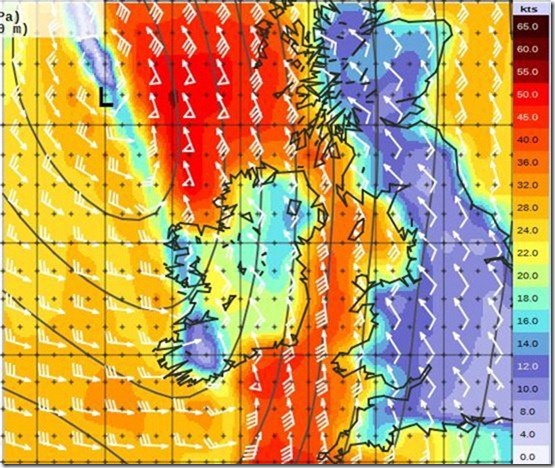
Oban Harbour in a So'westerly.

There's more than a hint of truth there.... think Loch Scresort/Rhum and Scavaig - for violent katabatics - and Puilladhobrain and Inverewe - for ooze the consistency of warm molasses. There are many anchorages well-suited to benign to breezy conditions, but which become challenging when wind and seas grow larger, for longer, than anticipated - and the prospect of shifting becomes even more hazardous than staying.

Consider several favoured spots in the Isles of Scilly, for example, where one might well be anchored and opt to stay put, for the risks of shifting elsewhere, in a rising gale, are considerable ..... The SE corner of Tresco, New Grimsby Sound, St Helens Pool, The Cove.... shallow water and more scope might suffice, but 'what if'? A second anchor deployed? How....?

One needs to have additional tools and lateral thinking, for some places, when nosing up onto the sandy beach to windward might be far preferable to dragging down onto a rocky lee shore. One could then take lines ashore, as advocated by Skip Novak ( and Scandis from Oban to Tromso ) in his Yachting World/Youtube videos.
 
Last edited:
Hi Jonathan, I'm having some first hand experience of the Antipodes right now. :D (In NZ).

You should have stopped here on the way! Our heat wave and drought are going to break tonight - so stay where you are for a few days!

But NZ - like Scotland, only higher - you will be right at home.

Enjoy!

Jonathan
 
39438343375_b530683af0_z.jpg


Oban Harbour in a So'westerly.

Personally I might have hoped I would have regularly listened to the weather forecast and I would have upped sticks, or retrieved the anchor, and done as suggested - and gone elsewhere. I'm a wimp and try not to challenge. But it is possible you cannot move to somewhere tranquil and you do need the gear to accomodate a missed or more optimistic forecast. Its a forecast, they have not reached the point yet of certainty. A generous rode will be valuable as will snubbers (think 10m minimum), if the rode is all chain. An extra anchor and second rode to reduce veering will be advantageous - the idea of one single big anchor sounds great - until you are veering all over the place.

Forget sage advise that short scope can be safe with a good anchor - the anchor might hold but the snatch loads are totally debilitating. The boat might stand it but your marriage might not.

You need to think outside the box, as they say.

Its nice to have the voices of reality (Norman and Zoidberg) and picture to illustrate (and cast a chill over the thread).

Jonathan
 
...And JDC - is there a Y=f(x) equation to describe a catenary in terms of chain weight per metre, horizontal force and horizontal distance from bottom of the curve? Struggling with google , lots of y = a cosh(x/a) but how to get the scaling factor, a?
Ta

The formula for y as a function of x, y being vertical and x being horizontal, assuming the chain is horizontal at the anchor (which is not always the case!) is:

y = lambda * ( cosh(x/lambda) - 1).

lambda as before being the wind force on the boat in kg / weight of chain in kg/metre.

But don't forget that while the catenary curves are facts, undeniable facts, it's also true that that the weight of chain carried by a smallish boat (say <10m LOA) is very rarely sufficient to keep the force at the anchor horizontal in any strong wind. So in a gale one has little option but to let out more scope, and use the best anchor one can. In which case there's less downside to using lighter chain. Paradoxically, the time when heavier chain is more useful is in more moderate conditions where it provides damping and a quieter night!

Edit: not a picture of the conditions, but what would you recommend this night? I went to Pulladobhrain rather than Oban...
jpgk_SpzX9L46.jpg
 
Last edited:
Edit: not a picture of the conditions, but what would you recommend this night? I went to Puilladobhrain rather than Oban...

A wild night, by the looks....

The P'd 'creek' runs NE > SW, as I recall. The low eastern bank is soggy saltmarsh, but with a tree-lined 20-foot ridge about 60 metres or so further inland. Beyond that is the pub....


25475671117_17953d3984_z.jpg


There should be some respite-shelter from the probable violent SE'ly 40-50 knots gusts afforded by the trees/ridge. I'd be tempted to put a secondary anchor out to the west, anticipating the strong veer to come, but also take a substantial plough-anchor and chain ashore to the SE and bury it deep into the saltmarsh, not the ooze of the very well-ploughed bottom of the creek. And when I'd done that, I'd pop into the pub... as you do!
 
To add to jdc's formulaic work:

The myth of the big anchor and short scope.

Proponents of big, monster, anchors and their justification for the recommendation to use tham is that they are 'safe' at short scope.

I did some rode tension vs rode length tests, all reported in Practical Sailor some years ago.

Simplistically I introduced a 2t load cell into our rode and measured increased tensions, maximums for any given gust. I anchored at a bit before high tide and measured for the 2 hours prior and after high tide. I conducted the tests with no snubber and using 8mm chain. Out catamaran has a 7t weight, 38' LOA and 22'6" beam. Our cat has the windage of a 45' Bavaria (I had drawings of our cat and was provided same by the Bav agent in Sydney). A Bav 45 will weigh at about 13-14t. I anchored in the shelter of Barrenjoey Lighthouse headland (check the introduction for Home and Away, in Pittwater). I tested during the development of the NEly seabreeze - which can gust to 35 knots - hardly extreme.

The tests were all conducted using a steel Anchor Right 15kg Excel. I checked the location of the anchor before and after by dropping a steel weight, about 10kg, with float. The anchor did not move, or nothing that could be detected from the surface, maybe 2cm max. I measured wind speed at the masthead, so lower across the decks.

I don't know what 'people' consider as short scope - but for anchoring overnight we would not consider less than 5:1. So 2.75:1 is a short scope, really short. I tested at a variety of scope, same location, similar conditions at different scopes to 7:1.

The depth of water was 3m, we draw 1m, and have 1m between waterline and bow roller. At 2.75:1 we had 11m of chain deployed. At 7:1 we obviously had 28m deployed.

The location is sheltered from developing seas, the headline is a few 100m ahead and offers shelter from NEly. The waves may have been 20/30cm high. There was no swell. The wind was unstable, possibly a function of sea breezes or possibly a function of the headland - but unstable winds are not unusual (in any anchorage). The yacht veered through 75 degrees.

The maximum snatch loads were near 700kg at maximum gust of 35 knots. It was a bit like driving the cat into a brick wall. I terminated the experiment, even in daylight it was debilatating. I was afraid something might break - I don't think anything would break - other than my courage.

This was straight chain. Even if I had employed a snubber - my chain was only 11m long. If the water had been a bit deeper I am sure the loads would have been reduced, at the same scope ratio - but normally people aim to get as close to shore as possible to enjoy maximum shelter - but I'm not sure that deeper water would save a marriage with loads even half the levels I measured. You could use a snubber - but the frequency of the snatch loads would then all be taken by the snubber - and snubber life is a function of cycles under load - so if you were to make a practice of short scope - you would need spare snubbers.

The death of catenary may have been underlined - its about time the armchair advise on use of big anchors at short scope met a similar demise, unless you have an endless supply of snubbers (and wives).

You can extend snubber length, which will ease the situation. We attach our snubbers at the transom and have 10m of snubber along the decks (we use 2 snubbers to make a bridle). We now run the snubbers through a clutch at each transom and can extend ours to 30m, each (provided we have enough chain deployed). In the 2.75:1 scenario we could have deployed 21m of snubber - but then would have had no chain, though chain weight would still have been evident.

But - how many people here even use 10m snubbers? How many people here use snubbers at all, when you look at yachts at anchor - how many snubbers do you actually see - how long are they - as a 2m snubber offers no elasticity, at all.

Based on the work I did you need a scope of 5:1 or more, it has nothing to do with the effectiveness of your anchor but the resilience of your wife and crew (and a good night's sleep).

If something sounds too good to be true - it usually is, ask the questions, think outside the box - and if you do not get answers then it probably is not true.

Jonathan
 
The death of catenary may have been underlined - its about time the armchair advise on use of big anchors at short scope met a similar demise, unless you have an endless supply of snubbers (and wives).

Who's that then?
Outside of your head ;) ;)

Evans & Skip like a biggun for high latitude but for many reasons. Dashew has a monster to help for short scope on a huge boat , no mention of what happens when the wind really gets up. Has anyone anywhere said use a monster anchor for short scope with no snubber?
 
Last edited:
The formula for y as a function of x, y being vertical and x being horizontal, assuming the chain is horizontal at the anchor (which is not always the case!) is:

y = lambda * ( cosh(x/lambda) - 1).

lambda as before being the wind force on the boat in kg / weight of chain in kg/metre.

Thanks. Looks sort of maybe right..though in lower forces the curve will be the distance to the chain sitting on the sea bed rather than the anchor.
http://www.moondogmoving.co.uk/catenary.html


But don't forget that while the catenary curves are facts, undeniable facts, it's also true that that the weight of chain carried by a smallish boat (say <10m LOA) is very rarely sufficient to keep the force at the anchor horizontal in any strong wind. So in a gale one has little option but to let out more scope, and use the best anchor one can.
Good long snubber does help lessen the dynamic loads though.
 
A wild night, by the looks....

The P'd 'creek' runs NE > SW, as I recall. The low eastern bank is soggy saltmarsh, but with a tree-lined 20-foot ridge about 60 metres or so further inland. Beyond that is the pub....


25475671117_17953d3984_z.jpg


There should be some respite-shelter from the probable violent SE'ly 40-50 knots gusts afforded by the trees/ridge. I'd be tempted to put a secondary anchor out to the west, anticipating the strong veer to come, but also take a substantial plough-anchor and chain ashore to the SE and bury it deep into the saltmarsh, not the ooze of the very well-ploughed bottom of the creek. And when I'd done that, I'd pop into the pub... as you do!

If it was the height of summer, with a bad forecast, I'd avoid Puilladobhrain like the plague. It gets far too busy, and swinging room gets restricted. I have been there a few times in bad weather, but off season, and then it's a good safe anchorage.
In bad weather, ie strong winds, give me space to swing and to use plenty of chain.
Must say, I go for gut feeling, and choice of place/bottom, rather than fancy formulae.
 
Who's that then?
Outside of your head ;) ;)

Evans & Skip like a biggun for high latitude but for many reasons. Dashew has a monster to help for short scope on a huge boat , no mention of what happens when the wind really gets up. Has anyone anywhere said use a monster anchor for short scope with no snubber?

But they have not said USE a snubber at short scope, in fact that it is critical and as most people do not use a snubber (at all) or one that is too short, then it is a critical omission. To most a snubber is still an alien concept - until it is more common place there is no reason for the uninitiated to know it is important, the shorter the scope.

As I said - how many people do you know who use a 10m snubber?

If your boat behaves like Dashew's boats - you are in the wrong part of YBW (there is a special section for MoBos and if you go there you will find their ideas of anchoring commonly exclude snubbers.. Most of our boats are small and frisky. The other factor is that Dashews MoBos have sufficient engine power to set an anchor 'overly' large deeply. Our yachts have auxiliary motors which can set our anchors sufficiently deeply. I have seen no information on the performance of a shallow set larger anchor when the parent vessel is subject to severe veering. Neither Evan Strazinger nor Skip Novak suggest short scope and if you look at Skips snubber - its too short, but he uses lots of, heavy, chain. Skip might use a large anchor - but then its a CQR. Maybe if he used a Rocna - he would downsize. Evan rejected a Rocna (he never said why) and used large Bruce. So both are/were using 'oversized' old gen anchors.

Based on the concept that old gen anchors are HHP and new gen anchors are SHHP they would need anchor weight at least twice as much as a new gen anchor - so of course they suggest heavy anchors.

Who's that then, if the cap fits?? Please remember we have to be nice - we should not be too critical of individuals, so no naming of names.

But the short scope mantra keeps being repeated, ad nauseam without any evidence, at all, that the author has tried it. You are correct there is no suggestion a snubber should not be used - but that. to me, is a critical omission. The snubber would need to take constant high loads, near or beyond the WLL - in my test actually well beyond the WLL (our snubber WLL is 500kg) - this will reduce life expectancy considerably. To bring the loads to more manageable levels I'd guess you would need at least a 20m snubber - but then its not short scope but 5:1 - which seems to negate the whole concept.

It dangerous nonsense without the complete story.

You seem to be defending the concept - so please advise where can I find an acceptable snubber that will allow repeated dynamic loads and keep the scope at below 3:1? I do not think you will find an answer - which underlines the nonsense of the concept.

You have the answer your self in your post #56

quote

Good long snubber does help lessen the dynamic loads though.

unquote

Please define 'good' and 'long'


Jonathan

Edit,

For clarification - based on the numbers I have quoted for the test I ran

Using our current snubbers, remembering our snubbers a re bridle, I would need to deploy 14m of snubber, each side, (see below) to accept a 700kg dynamic load and keep it within the WLL of 25%. This means I would need to deploy suffice chain which would be 14m + 10% stretch of the snubber - so 15.4m - giving a scope of 3.85:1 - which I agree is a short scope - but it allows no safety margin, should the wind gust beyond 35 knots. If I stick with 3.85:1 then I still have much elasticity in reserve - so there is a safety margin - but I am reducing snubber life (not critical as we carry spares (but does everyone?). And again I ask the question, now slightly differently - who carries a 14m snubber?

I frankly don't know how a 14m, each side, bridle compares to a single snubber - I suspect the single snubber would need to be longer to produce a similar effect.

Close edit
 
Last edited:
Not at all - but who are all these people you say are "Proponents of big, monster, anchors and their justification for the recommendation to use tham is that they are 'safe' at short scope."

Name one. ;)


I must have misread something.

But you seem to suggest you think the idea, that I obviously dreamt up, that short scope can be safe if you use a big anchor - is a load of nonsense. In fact you seem to suggest that short scope in arduous conditions (whether the anchor is big or small) is a load of nonsense.

Well its nice to know, in this very roundabout way, that you and I agree.

What was interesting in my test was that my Excel seemed fine, and its only 15kg - it was me that chickened out. Since then my confidence has grown - and I use an alloy Excel, or Spade or Fortress which each weighs only 8kgs paired with my 6mm lightweight chain and a recycled dynamic climbing rope. I would not suggest anyone even think about copying my test - the last time we anchored (for 3-4 days) with constant 30 knots winds gusting sometime a bit higher - we deployed 40m in 5m of water (6,66:1) with 20m snubbers. As you aptly said - 'good, long snubbers help lessen dynamic loads' - really good and really long snubbers seem to remove dynamic loads completely and offer confidence with even small lightweight anchors.

This seems to be an unusually pleasant day - I'll break open another bottle of Shiraz and toast 'absent friends'.

Jonathan
 
Top