Anchor chain scope

I wonder if it's the increase in marina based boats. Anchoring is no longer the norm for most cruisers. In the Caribbean you would think that half the people anchoring have never done it before. Thank God for modern anchors. I think they cover the shortfall in crap anchoring techniques for many sailors. Without them, most yachts would have dragged miles

I have been full time cruising for 15 years and I have noticed a significant shift in attitudes towards anchoring. As well as the previously mentioned swing towards greater scopes, there also seems to be a puzzlingly reduction in confidence.

We are currently anchored with two other long distance cruising boats. Great people, but both crews are planning to leave the anchorage tomorrow for the “safety” of a marina because of a modest increase in wind strength.

I would encourage people to be conservative. I would never try to talk people into a situation where they are not comfortable.

However, the goal of anchoring equipment should be to keep boats safe, comfortable and confident. We do not seem to be moving forward on at least some of these aims. We have the technology and knowledge of the correct technique to anchor significantly more securely than our forefathers, but this does not seem to be reflected in the attitude of cruising sailboats.

Why, I am not sure. Perhaps as you suggest, the ready availability of marinas and moorings is a factor. Perhaps the trend to fit light anchor gear has more than eroded the gains in anchor design and improvements in technique (such as nylon snubbers with sufficient stretch).
 
I have been full time cruising for 15 years and I have noticed a significant shift in attitudes towards anchoring. As well as the previously mentioned swing towards greater scopes, there also seems to be a puzzlingly reduction in confidence.

We are currently anchored with two other long distance cruising boats. Great people, but both crews are planning to leave the anchorage tomorrow for the “safety” of a marina because of a modest increase in wind strength.

I would encourage people to be conservative. I would never try to talk people into a situation where they are not comfortable.

However, the goal of anchoring equipment should be to keep boats safe, comfortable and confident. We do not seem to be moving forward on at least some of these aims. We have the technology and knowledge of the correct technique to anchor significantly more securely than our forefathers, but this does not seem to be reflected in the attitude of cruising sailboats.

Why, I am not sure. Perhaps as you suggest, the ready availability of marinas and moorings is a factor. Perhaps the trend to fit light anchor gear has more than eroded the gains in anchor design and improvements in technique (such as nylon snubbers with sufficient stretch).
We were recently anchored in Deshaies in Guadeloupe shortly after Antigua race week. A stunning Swan 65 came in to the anchorage and dropped an incredibly small amount of chain with his Spade anchor. He was moving forward as he dropped. The chain stopped going out and he turned the engine off. The wind was light and eventually the 40t boat laid to the anchor. No attempt to set it. The guy then ferried two dinghy loads of crew ashore, ( ten guys) presumably to catch flights home back to Europe. Next day the skipper left single handed. Clearly loads of racing experience but amongst 11 guys, no knowledge of how to set an anchor in a notoriously bad anchorage where dragging boats is commonplace.
 
I'm not sure about the trend to use of light gear. Many anchors are much bigger than recommended (except on MoBos). People who upgrade from a CQR/Bruce/Delta appear to buy a modern anchor of the next size up. There is no marked trend to using high tensile smaller chain. There is a trend to using higher strength chain, G40 or G43 instead of G30 but not a trend to downsizing. Maybe this is indicative of thinking - as G30 is proving to be totally reliable (despite most of it now coming from China) people seem to want (unnecessary) strength. If you interrogate posters on their chain they are invariably a very conservative choice, usually the next size up. Chain choice is invariably made by the people who build the yacht or do the commissioning - and they tend to stick to the historic spread sheets. Once the windlass is chosen and bolted in position - that determines future chain usage because no-one wants to buy a new gypsy (which are (admittedly) extortionate).

Whilst supply of chain, windlass and anchor is standard - I have yet to see a snubber (long and elastic) being supplied on a newly commissioned yacht.

Multihulls come with a bridle , I think always, but they are always well over strength - and in some cases so strong they can be used to remove the cat from the deck of the delivery container ship (hung from the bow cleats). I have yet to see, standard, multihull bridles that offer any snubbing impact.

I don't see much use of long elastic snubbers - I see short snubbers, protecting the windlass, but not long snubbers offering elasticity.


One reason for some trends is the fear engendered in anchoring threads on forum . It has certainly led to the success of bigger is better. Downsizing chain has been discouraged, best done pre-commissioning or when you need both a new windlass and new chain, despite Dashew's practice, other wise it is expensive. But there are warnings that small chain has a shorter life, without foundation, and changing to a smaller chain without use of matching snubber(s) is a recipe for disaster. It is also difficult to source matching components, compatible to the strength of the HT chain, that actually fit both anchor and chain. There is no point in buying HT chain if you cannot buy, easily, a shackle that fits of a strength higher than the chain.

To me the ground tackle should be supplied as a matching integrated package, anchor, chain, shackles, snubber etc and windlass.


I'm not a commercial ground tackle supplier, I make no money in my involvement, I don't advertise - I have supplied 6 complete high tensile small link rodes. 'My' rodes include all the shackles + spares, chain hook or bridle plate, boomerang instead of a swivel, the rodes come certificated for strength and galvanised coating thickness - the coating thickness is 100 microns (commonly you will be lucky to get 70 micron with HDG and HDG is not as robust as the coating I work with).. Our own rode, 6mm HT chain,, which is now 6 years old (so not old) looks none the worse for wear and in fact looks like black stainless - having self polished in use. My rodes replace the next size up original rodes - primarily 6mm replacing 8mm or 8mm replacing 10mm. Owners have been a mix, new yachts, older yachts needing a new windlass and 2 have bought new gypsies. All have been using either Spade, Rocna or Excel anchors (mostly of the recommended or smaller size). I'm based in Australia so 3 yachts using an Excel is not surprising. The most recent chain, 130m x 8mm has only just been completed and is not yet installed but is being supplied to a UK couple on a circumnavigation who contacted me because they knew of me through YBW. The previous rode I 'made' was to a French couple, also on a circumnavigation who knew of me through the local, now defunct, sailing magazine.

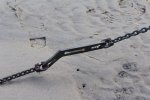
This our chain at about 5 years old, so 12 months ago. This is at 10m. We have beached our cat, we draw 1m. I've deployed the anchor off the bow to seaward, so we beached backwards as its easier to get off the beach going forward. I've deployed 10m of chain - it is also easier to 'unbeach' if we can keep the rode tensioned as we re-float. The 10m mark would normally be on the seabed when anchoring and is thus subject to 'wear' or abrasion. There is no sign of loss of the gal coating - it has in fact polished. The bridle plate is 2205 duplex, painted and with 316 LFRs. The little stainless shackle allow us to clip the bridle and snubbers to the bow when not at anchor.
IMG_4759.jpeg

The bridle, or 2 snubbers, are 10mm climbing rope. We originally used 12mm climbing rope but it did not appear to be sufficiently elastic and we down sized.

I chose 100 micron as my coating thickness having conducted abrasion tests. Wear of galvanising is a function of the hardness of the coating, the coating I use is harder than HDG, and on thickness. So I have a harder and thicker coating. The US Navy, who use the same process I am using have a specification of 80 microns (but they have deeper pockets :). The idea that small chain abrades more quickly than larger chain is a complete phurphy and is part of the fear factor engendered in anchoring. It is based on no data at all. I've compared 12mm, 10mm, 8mm and 6mm chain - the wear of the gal is a function of type of gal and thickness (and maybe quality of the coating - some HDG is questionable)
HDG - Hot Dipped Galvanising.

As said - I don't make any money with 'my' rodes - but I do like my ego to be stroked. Having 5 happy owners suggests acceptance.

I might emphasise - if you down size you must use a snubber, or snubbers - that is elastic.

You can buy G70 HDG chain through Jimmy Green, you may need to search for compatible shackles etc. Longer term you may be able to buy 'my' chain from closer to the UK. You can easily source nylon rope - do not oversize.

Take care, stay safe

Jonathan
 
For completeness:

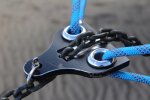
This is my Boomerang, it replaces a swivel. It is attached to the chain with an Omega link, call them enlarged links, at each end. The Omega links are to the same specification as the chain - but when tested have always been stronger than the chain. The hole in the Omega is well large enough to take any shackle you are likely to use with the chain. Omega links are fairly precisely made and only accept the chain for which they are made. A 8mm link will not accept a 6mm or 10mm chain. They commonly, or exclusively, come painted - I have mine galvanised when I coat the chain.

The boomerang is simply cut from Bisplate 80 an 800 MPa steel. The design is such to ensure it is stronger than the rode and on testing has been found to be twice the strength of a conventional rode of the matching size. Boomerangs, slightly different design, are made and available from both Viking and Anchor Right (for the latter see Jimmy Green) for the former - mail order. The dimensions of the Boomerang are available on line - you can make your won, duplex stainless is a good material - if you can source a piece. Cut with an angle grinder and bench drill.

Note how the Boomerang lies vertically - when it is buried it is vertical in the seabed and adds some resistance, every little helps, to yawing
IMG_4758 2.jpeg

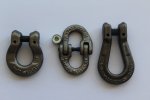
Omega links come in a variety of designs, these (below) are two. The long omega is sometimes called a pear link. The link in the middle, called a hammer lock (named because you hammer the pin in) I have used to attach anchor directly to chain. Their disadvantage is that you need to hemmer the pin to secure the various pieces and hammering on a deck is not for the faint hearted. The Omegas do not need hammering - the clevis fits relatively easily (you might need to tap gently) and is normally secured with hammer in pins that fit in the holes you can see. I replace the hammer in pins (as they are difficult to hammer out) with stainless cotter pins. If you look carefully you can see the cotter pin in one hole only of these links. All of these components come painted, again I have them galvanised, and in this case are all 6mm G100 components.
IMG_4675.jpeg

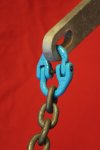
This is just a mock up showing the painted hammer lock used to directly join chain to shank of an appropriately sized anchor.

IMG_4699.jpeg

Some members of YBW, I forget who, use painted hammer locks and when the paint wears off they simply discard the rusting hammerlock and replace with a new one. They, and Omega links, are not particularly expensive. I noticed that Skip Novak on one of his 'storm anchoring' vids uses a chain hook from the lifting industry - also painted and his was looking a bit brownish (but you still see some paint) - I assume he discards when it becomes too unsightly.

If you were having chain galvanised - it would be a good time to consider the 'attachments' and have them all galvanised together.
 
We have the technology and knowledge of the correct technique to anchor significantly more securely than our forefathers, but this does not seem to be reflected in the attitude of cruising sailboats.

Some of the members here have been brought up by their fathers, maybe some were introduced to sailing by their grandfathers. Many, or some, people now are buying 40' yachts as their starter yacht and introduction to sailing. They may be excellent sailors - having been brought up as crew on racing yachts - but as Geem mentioned this does not mean they know how to anchor. If you take part in a round world yacht race - you would know more about sailing than many here and would have a very impressive CV - but you don't anchor very often in a round the world yacht race (nor do you learn how to service an inboard diesel).

Historically I don't recall the mantra of today to power set, I do recall the mantra of trying to ensure the tension was horizontal (leading to regular queries today about kellets).

I do recall the apocryphal story of the examiner and aspiring certificate holder.

Tell me how you would anchor ?....

and what do you do if the wind picks up?

Oh, I'd deploy 5m or 10m more chain (choose your number)

and what do you do if the wind gets stronger?

Oh - I'd deploy 5m or 10m more chain

Where exactly are you getting all this chain from?

The same place you are getting this increased wind

Its not difficult to think people remember the story and conclude - cut out the annoyance - deploy the chain now!

I also recall the mantra - 'chain is of no value in your chain locker', it was quoted recently

Rhetorical question - 'why carry it if you do not use it.......?'

There are whole series of prompts as to why people use a lot of chain - these forum perpetuate some practices.

Jonathan
 
I recall meeting a couple on the pontoon at Douarnenez many years ago. They had sailed out of a marina in Southampton for 10 years and never anchored. "Tried it once, it didn't work, so gave it up".
Like the charter boat phoning back to the base in the middle of their week charter: "We need another anchor please Sir"
Charter base: "Erm, you have three anchors on board..."
"Yes but we have used them all and have none left, we need another one"
 
I recall meeting a couple on the pontoon at Douarnenez many years ago. They had sailed out of a marina in Southampton for 10 years and never anchored. "Tried it once, it didn't work, so gave it up".


I saw a large power boat near to me, trying to anchor. He paid out about the depth of water plus a metre and then smartly reversed, and dragged. Did that about 5 times till he gave up and headed up harbour, I assume to a marina.

I had a dinghy in the water but dishing out advice in the circumstances is not always welcomed with a smile.

.
 
I saw a large power boat near to me, trying to anchor. He paid out about the depth of water plus a metre and then smartly reversed, and dragged. Did that about 5 times till he gave up and headed up harbour, I assume to a marina.

I had a dinghy in the water but dishing out advice in the circumstances is not always welcomed with a smile.

.
We were in Grenada a few years ago anchored in a nice bay with plenty of space. A boat came in and started to drop his anchor. He dropped a small amount of chain, put the engine in reverse and dragged the anchor as you would expect. I watched him do this 13 times in different parts of the bay. Eventually I couldn't stand it any longer. I went over in the dinghy and said to him ' have you never anchored before? He said he had been sailing for years and done over 30,000nm. He might of done but he clearly never learnt to anchor. He said the holding was crap. I told him the holding was perfect He had a Bruce anchor. I told him to drop five times the depth before he pulled with the engine. He did. Never budged.
Not putting out sufficient chain is the single most frequent failure for anchors not to set in my experience of watching a lot of people anchoring.
I see people drop a small amount of chain then pull with the engine. It nearly always drags. If it does by some miracle not drag they then let out more chain out. Why not put out the correct chain for the depth in the first olace then pull with the engine. That way you are pretty certain not to drag unless you have fouled the anchor on the seabed.
 
We were in Grenada a few years ago anchored in a nice bay with plenty of space. A boat came in and started to drop his anchor. He dropped a small amount of chain, put the engine in reverse and dragged the anchor as you would expect. I watched him do this 13 times in different parts of the bay. Eventually I couldn't stand it any longer. I went over in the dinghy and said to him ' have you never anchored before? He said he had been sailing for years and done over 30,000nm. He might of done but he clearly never learnt to anchor. He said the holding was crap. I told him the holding was perfect He had a Bruce anchor. I told him to drop five times the depth before he pulled with the engine. He did. Never budged.
Not putting out sufficient chain is the single most frequent failure for anchors not to set in my experience of watching a lot of people anchoring.
I see people drop a small amount of chain then pull with the engine. It nearly always drags. If it does by some miracle not drag they then let out more chain out. Why not put out the correct chain for the depth in the first olace then pull with the engine. That way you are pretty certain not to drag unless you have fouled the anchor on the seabed.
I had a very similar experience in the Ionian, with a UK crewed charter boat. They were putting out chain equal to the depth. After many attempts I rowed over and advised them how to do it. Once settled the lady skipper asked 'so now do I haul the chain in to the depth?'
 
We were in Grenada a few years ago anchored in a nice bay with plenty of space. A boat came in and started to drop his anchor. He dropped a small amount of chain, put the engine in reverse and dragged the anchor as you would expect. I watched him do this 13 times in different parts of the bay. Eventually I couldn't stand it any longer. I went over in the dinghy and said to him ' have you never anchored before? He said he had been sailing for years and done over 30,000nm. He might of done but he clearly never learnt to anchor. He said the holding was crap. I told him the holding was perfect He had a Bruce anchor. I told him to drop five times the depth before he pulled with the engine. He did. Never budged.
Not putting out sufficient chain is the single most frequent failure for anchors not to set in my experience of watching a lot of people anchoring.
I see people drop a small amount of chain then pull with the engine. It nearly always drags. If it does by some miracle not drag they then let out more chain out. Why not put out the correct chain for the depth in the first olace then pull with the engine. That way you are pretty certain not to drag unless you have fouled the anchor on the seabed.

Do charters boats usually have clear markings on chain? That might be an issue, too.
 
Don't get me started on charter barges?

I find it slightly unfair to criticise the charter party - but I am critical of of the ICC and of the Charter companies.

Its a bit like (and then not at all like) renting a car. If you produce a driving licence there is an expectation you have driven before. The ICC is the equivalent of the Driving Licence, except its not. Equally if a charter company appears satisfied that the charterer knows what he is doing then part of the charter companies expectation should encompass anchoring - what else does the charter company expect the charterer to do overnight. It is not difficult to impart of a charterer that he need deploy, whatever, the correct length of rode to anchor.

Having said that I really do not understand why I see charter boats with CQR, Bruce or Delta on the bow roller - why on earth do they not scrap the lot and supply Rocna, Supreme, Excel, Knox etc. The idea of a charter holiday is that it is a holiday not an event to be recalled for the disasters. If you want repeat business go out of your way to make the holidays as event free as possible.

And if the ICC is the measure of excellence - ensure it covers anchoring.

Jonathan

edit

I obviously do not have an ICC, or I would know - but the ICC seems a pre-requisite for chartering in parts or all of Europe. If the ICC's attention to anchoring is minimal then anyone who has an ICC will think it is not really that important. I do note they seem to pay attention to navigation lights - I can look up nav lights on an A4 piece of paper - anchoring might enjoy a bit more detail than a b it of paper, like part of a practical test. I'm not going to change the ICC - but if the ICC does not show much attention to the practice I fail to see why a novice charter party would not have the same thinking.
 
Last edited:
Top
