Alternator doesn’t start charging...

My 1GM slightly smaller Hitachi alternator failed at about 10 years old and the first symtoms were a need to rev the engine more than usual to start the charging. When I opened it up I found serious corrosion on some brass connecting straps. I cleaned them up and ran solder over them and they have been fine for the last 20 years. Just need to remember that there is a small hole to insert a rod to hold back the brushes when reassembling the alternator. It was a long time ago and I can't remember the details and unfortunately didn't take any photos.
If all external wiring checks out OK then it might be worth getting the alternator to a car electrical specialist or take it apart if you feel confident.
 
If it's the standard bulb which has worked in the past, then the fact that the alternator needs more exciter current is probably caused by the alternator being faulty. Covering up the fault by using a fatter bulb might help diagnosis, but as a permanent fix it's liable to leave you in the lurch if the fault in the alternator gets worse.

Having woken the alternator with a bigger bulb, it would be prudent to at least check the alternator can deliver a proper current and voltage, not just enough volts to put the light out.

I can agree there ... if all worked in the past and cleaning / reconnecting so no resistance at lamp holder and it still needs shorting ... then alternator is as I mentioned long way back - TIRED and should have a day in service hands.

As I said before about starters as well ... we put them in boats in conditions that really are corrosive ... damaging ... and expect them to plug on day after day without complaining. I'm just as guilty as others. When service guy saw my starter motor recently .. he went off muttering !!

TBH - if the lamp setup is of suitable items - then there is no need for any extra wire or supply ... IMHO - that could mask a deterioration in alternator.
My bog standard London Taxi engine / alternator combo - Perkins 4-107 .... has no extra wire for the lamp .. has a standard 12V Piezo buzzer bridges the lamp ... so I have a bright lamp and a loud buzzer tells me when alternator is not charging.
 
So I tried doubling the bulb but still the light ( both of them) stayed on.
Measured the voltage of the Red/black wire at the alternator which measured 9v.
Bulb is 5w, I did come across somewhere that suggested a 3.5w bulb but not sure how much difference that would make since the suggestion is usually to increase the wattage to solve issues .
Does seem to feel the alternator is perhaps the issue. It’s been briefly tested by an auto electrician but he just shorted the terminals to get it charging as I am doing.
I may rig up a wire between the ignition and the R terminal directly, bypassing the wiring harness, and see if it makes any difference.
 
So I tried doubling the bulb but still the light ( both of them) stayed on.
Measured the voltage of the Red/black wire at the alternator which measured 9v.
Bulb is 5w, I did come across somewhere that suggested a 3.5w bulb but not sure how much difference that would make since the suggestion is usually to increase the wattage to solve issues .
Does seem to feel the alternator is perhaps the issue. It’s been briefly tested by an auto electrician but he just shorted the terminals to get it charging as I am doing.
I may rig up a wire between the ignition and the R terminal directly, bypassing the wiring harness, and see if it makes any difference.

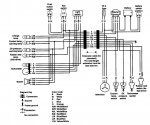
Just incase you find your engine is not wired like the diagram I posted in #8 here is an earlier version. It took me a moment or two to work out just what the light switch did and how it worked
Yanmar GM wiring 2.JPG
 
A quick thought, is the engine wiring loom connected at either or both ends with one of the cursed multi plugs? They are renown for making bad connections or coming apart.
Yes. Both ends. I believe it’s an extension cable to take the wiring up from the engine to the helm.
 
So I tried doubling the bulb but still the light ( both of them) stayed on.
Measured the voltage of the Red/black wire at the alternator which measured 9v.
Bulb is 5w, I did come across somewhere that suggested a 3.5w bulb but not sure how much difference that would make since the suggestion is usually to increase the wattage to solve issues .
Does seem to feel the alternator is perhaps the issue. It’s been briefly tested by an auto electrician but he just shorted the terminals to get it charging as I am doing.
I may rig up a wire between the ignition and the R terminal directly, bypassing the wiring harness, and see if it makes any difference.

I suggest remove alternator ... trot of to car electrical service guy and explain the problem .... then get him to check over your alternator.

If its a good service - they should have a setup to run up the alternator, with display showing output against RPM. He will tell immediately if any good or not.

You will also have peace of mind that alternator is checked / serviced etc. He will advise you what is needed as bulb etc. once he's checked it out.
 
I’ve found the issue. VicS has it right.
I ran a cable from the ignition directly to the R terminal on the alternator bypassing the wiring harness and started the engine. The charge lamp went out just above idle. So looks like the red/black cable is the issue. I’ll need to step through it and find where the issue is and/or run a new cable.Glad I have the answer, now it’s just the tracing and fixing.
Thanks for everyone’s input.
 
I ran a cable from the ignition directly to the R terminal on the alternator bypassing the wiring harness and started the engine. The charge lamp went out just above idle. So looks like the red/black cable is the issue. I’ll need to step through it and find where the issue is and/or run a new cable.Glad I have the answer, now it’s just the tracing and fixing.

Check those connectors on the wiring harness extension
 
I’ve found the issue. VicS has it right.
I ran a cable from the ignition directly to the R terminal on the alternator bypassing the wiring harness and started the engine. The charge lamp went out just above idle. So looks like the red/black cable is the issue. I’ll need to step through it and find where the issue is and/or run a new cable.Glad I have the answer, now it’s just the tracing and fixing.
Thanks for everyone’s input.

Thats marvelous ......

But I'm not trying to rain on the parade - but that still indicates a poor connection.

That R terminal is basically acting as same as your shorting wire to avoid lamp resistance etc. With good connections and power feed - it should not really be necessary - BUT it provides direct unrestricted 12v as items age etc.

VicS reply saying still check harness in effect agrees with that, OK - he says to use an R lead ... which I don't need or have.

Many installations where people do not have wiring looms .... many older boats like mine are not setup like a car with looms .. they are wired up as needed. My lamp is run of the over-ride switch ..

I switch on main power to the boat. When I want engine - I flick an over-ride switch that then connects the start button to the solenoid AND to the lamp which then connects the excite lead. I press start button - solenoid closes and starter kicks in ... engine starts. Lamp stays lit till I hit throttle and give it a bit of stick ... lamp goes out. If I was to switch that over-ride switch off - my alternator diodes would likely blow.

My standard alternator for the 4-107 I have does not have an R lead ... just the single excite lead ... and its main leads of course.
 
I agree with refueler

You need to bridge the harness wire between the alternator side of the indicator bulb and it it works the fault in in your wiring loom.

Otherwise if you bridge the wiring between the ignition switch and the bulb connection on the ignition side. tis means the fault is between the switch and the indicator bulb.
 
On a voltage test of the Bulb connection at the alternator (L connection) I get about 0.5v drop from battery voltage which I put down to the fact it was going through the bulb. So assuming that is the case it suggests the connection from the bulb to the alternator is good. I could check resistance on that line I guess.
If the R connection is not needed a) why is it there and b) is a 0.5v drop enough to stop it working if the R is not connected?
 
But I'm not trying to rain on the parade - but that still indicates a poor connection.


My standard alternator for the 4-107 I have does not have an R lead ... just the single excite lead ... and its main leads of course.

I know
I would not have expected your 4-107 to be any different to how you describe it and had someone asked a similar question about one I would simply have suggested that they checked all the wiring and connections in the warning light circuit.

However I knew about the wiring in the Yanmar GM / Hitachi alternator, in particular later ones, and realised that it should should still excite with a bad connection to the warning light, with an LED as the warning light and probably even without the warning light at all.

Given that the OP had a boat only 18 years old fitted with a Yanmar 2GM20F I deduced that there was probably a bad connection between the ignition switch and the R terminal ... Something which the OP has more or less confirmed to be the case.

I must admit I would have expected a 5 watt bulb to have kicked the alternator into life so there is probably also a bad connection in the light circuit although it does what it should, namely comes on to warn of no output from the alternator.

Had you looked at the wiring diagram for a recent GM series engine yourself , or even looked at it in #8, you might have realised there was more to the warning light/ initial excitation circuit than you have in a 4-107 then you could have based your diagnosis on the wiring of the engine in question rather than on a much older Perkins. Instead you chose not to find out about the engine in question for yourself and to totally ignore #8 and everything I was saying.
 
VicS ... sorry I upset you ...

But as you say yourself - there is still something wrong with the lamp circuit.

Nowhere have I been against your posts in this ... and yes so what if the Perky is older - that fact remains - the lamp circuit itself SHOULD be sufficient ... and I never said IGNORE your suggestions.

Yes I DID study the diagrams you posted ... yes I DID understand them .... Personally I was keeping it simple ...

The actions described were more than enough to identify the mos likely problem. That STILL remains fact.

Sorry I upset the ballgame.
 
But as you say yourself - there is still something wrong with the lamp circuit.

Nowhere have I been against your posts in this ... and yes so what if the Perky is older - that fact remains - the lamp circuit itself SHOULD be sufficient ... and I never said IGNORE your suggestions.

"Probably a bad connection", is what I said. We won't know for sure unless the OP specifically checks it but it will most likely get sorted at the same time as the real cause of the problem

We don't know the power of the original lamp, Being encapsulated it wont be great so may not in fact be enough on its own to provide sufficient current. The separate excitation circuit will actually allow an LED to be used.

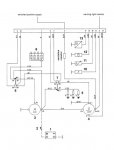
FWIW You will find a similar separate excitation circuit in VP engine wiring after about the mid 1990s, until the MDI system came along. Attached is an annotated diagram for one of the later versions of the MD 2010 series. In this case using an excitation resistor hidden in the engine wiring somewhere. I assume this coincided with the introduction of LED indicators in the electronic module

Beta I think accomplish the same thing with LED indicators by simply fitting a 5 watt 47R resistor in parallel with the LED

VP excitation.JPG
 
"Probably a bad connection", is what I said. We won't know for sure unless the OP specifically checks it but it will most likely get sorted at the same time as the real cause of the problem

We don't know the power of the original lamp, Being encapsulated it wont be great so may not in fact be enough on its own to provide sufficient current. The separate excitation circuit will actually allow an LED to be used.

FWIW You will find a similar separate excitation circuit in VP engine wiring after about the mid 1990s, until the MDI system came along. Attached is an annotated diagram for one of the later versions of the MD 2010 series. In this case using an excitation resistor hidden in the engine wiring somewhere. I assume this coincided with the introduction of LED indicators in the electronic module

Beta I think accomplish the same thing with LED indicators by simply fitting a 5 watt 47R resistor in parallel with the LED

View attachment 91943

I'm not in argument with you .. so fail to understand your effort to seemingly belittle me.

I am aware of later setups ... where basically car style looms etc. are used. I would suggest that the low power lamp and separate lead are likely due to cars and the use of low power ignition lights - you don't want a 5W lamp in your dash !! ... a separate lead would then be advisable to get the least resistance.

I'm wary of it - despite yachts being fitted with them - for a very good reason. As another has highlighted and this OP's situation shows ... a poor connection or worn out alternator is best shown by the lamp being the sole excite circuit.
Basically providing a separate lead is avoiding that indicator and shorting max power (of course as you say Beta and others may have a resistor in series to limit it).

I also seem to recall that OP said it all worked before ? I had the impression that he had no separate lead before ? ... so it is not unreasonable for myself AND OTHERS to go the simple path.

I don't think it necessary to flog this to death - the guy got it working by your advice - great .. I'm happy its working. Fact That I would still investigate state and condition of connections is my thought - something that despite your wish to put me down - seems to be what you consider as well.
 
Top