superheat6k
Well-Known Member
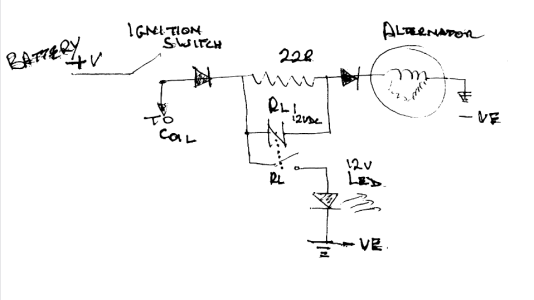
I wish to replace a signal lamp bulb 1.2W 12V incandescent with a super bright LED. The bulb provides the initial excitation current to the associated alternator.
The LED I have chosen draws 20mA at 12v so 0.24 W.
It is safe to use up to 24vdc, although pre-excitation the voltage would be at most ~ 13v, and after excitation no current will flow because the voltage each side of the excitation lamp will equalise. So I do not need to consider the excited voltage.
So if I wire in parallel I work out I need a resistor to dissipate a further ~1 W. so at 12v this 0.08 amps. From Ohm's Law this is 150 ohms
So a 150 ohm resistor will this satisfy the alternator excitation when using the LED instead of the incandescent and a 2w rated resistor will have plenty of spare capacity.
The total power in the alternator circuit for excitation will remain close to 1.2W
Can someone please check my maths and Ohms Law please.
Should I also wire in a Zener Diode to ensure the warning LED turns off once the alternator is excited. I was thinking a 4v Zener. But do I need to account for power loss in the Zener. I intended to try it without the Zener and see if the warning light works without initially.
Thanks.
The LED I have chosen draws 20mA at 12v so 0.24 W.
It is safe to use up to 24vdc, although pre-excitation the voltage would be at most ~ 13v, and after excitation no current will flow because the voltage each side of the excitation lamp will equalise. So I do not need to consider the excited voltage.
So if I wire in parallel I work out I need a resistor to dissipate a further ~1 W. so at 12v this 0.08 amps. From Ohm's Law this is 150 ohms
So a 150 ohm resistor will this satisfy the alternator excitation when using the LED instead of the incandescent and a 2w rated resistor will have plenty of spare capacity.
The total power in the alternator circuit for excitation will remain close to 1.2W
Can someone please check my maths and Ohms Law please.
Should I also wire in a Zener Diode to ensure the warning LED turns off once the alternator is excited. I was thinking a 4v Zener. But do I need to account for power loss in the Zener. I intended to try it without the Zener and see if the warning light works without initially.
Thanks.