
Alternator charge splitter

roaringgirl

Well-Known Member
Joined
1 Nov 2014
Messages
886
Location
Half way around: Wellington, NZ.
bit.ly
We have a box that splits charge from one alternator between the house bank and the windlass bank. It has 3 pins on it, a) connects to the alternator, b) connects to the windlass bank and c) connects to the house bank.

I assume that it just has some big diodes in it. Is there any reason I should find low resistance between a) and b), but a large resistance between b) and c)?

Why do I need this splitter at all - why not connect the windlass bank (which is tiny) to the house bank directly? I would be happy for the windlass to run off the house bank.
 
We have a box that splits charge from one alternator between the house bank and the windlass bank. It has 3 pins on it, a) connects to the alternator, b) connects to the windlass bank and c) connects to the house bank.

I assume that it just has some big diodes in it. Is there any reason I should find low resistance between a) and b), but a large resistance between b) and c)?

Why do I need this splitter at all - why not connect the windlass bank (which is tiny) to the house bank directly? I would be happy for the windlass to run off the house bank.
If it's just two diodes, A>B and A>C, then you'd expect B and C to look isolated either way around, and A to B to look like a diode drop one way and isolated the other. A to C likewise.

If you connect the windlass to the house bank directly then you need suitably fat wire.
 
That's what I thought, in which case, it is broken.
What are you testing it with?

You may be wrong in assuming it is just two diodes.
Are there any other connections, like 0V?
Does it have a name on it?
TBH, the kinds of diodes I'd expect to find in such a splitter are not easy to break. Is it kind of black and crispy looking?

It's alos possible a small DIY multimeter gives some misleading answers with a device intended for 120A or whatever the alternator can put out.
It may leak enough microAmps for your meter to read drivel.
You might do better testing it with a 12V battery + on A, and a bulb connected to (B or C ) and the -ve of the battery

It could also be that what we are calling 'A' might be B or C.....


You said "

I assume that it just has some big diodes in it. Is there any reason I should find low resistance between a) and b), but a large resistance between b) and c)?

That is entirely consistent with what I said two diodes with a common anode (A) should look like.


Is it like this:
Sure Power 702P Battery Isolator

I'm confused now!
 
I suggest starting by measuring the resistance both way, all combinations A-B, B-C, C-A.
Six measurements.

Searching for 'transpo 275' gives bus timetables, alas.

1635020729298.png
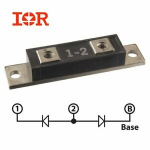
Picture is a smaller common anode diode pair.
Connection 2 would be the alternator, 1 and 3 the batteries.
2>1 and 2>3 low impedance, all other combinations high impedance.
The batteries cannot feed the alternator, or each other.
The current can only follow the arrow of the diodes.
 
Assuming all your measurements are with everything else disconnected one might say it is goosed. Especially if alternator to house is 0 ohms in both directions. if it is goosed to short circuit then the windlass battery would be discharged when the house battery is discharged and also may have been overcharged. (you may not have noticed)
The 25k ohms measured may well indicate OK in that direction if it is very high resistance in the other direction. The diode isolator in the link does not claim to be low loss so is presumably a set of standard silicon high current diodes. These have an inherent .7volt drop in the conducting direction. This almost regardless of current so not a resistance as such but a volt drop. Now a digital volt meter multimeter in ohms scale sets a constant small current through the measured resistance (your diode)
In the case of a resistance being measured the voltage drop across the measured resistance equals ohms. However in measuring a diode the inherent volt drop may well be near half of the supplied voltage so indicates a quite high resistance. Many Digital multimeters have a diode check function where it shows the volt drop so is better at checking diodes. You get something like .7v one way and very high the other way.
Note if the isolator does drop .7 volt then this must be made up to get a full charge from the alternator which might be set to provide 14volts. Battery sensing is often used so alternator senses and rises to 14v at one of the battery terminals. Or alternator regulator is adjusted to provide 14.7 volts. ol'will
 

That is indeed a diode pack.

A more reliable way of testing it is to run the engine and measure the voltage at the three terminals. The alternator terminal should be .5-.7v higher than the two battery terminals (or thereabouts), the two battery terminals should be similar.

You can replace it with a low loss splitter, such as the Victron Argofet, or you may be able to remove it. Removal will depend on the thickness of the existing cables, too thin and they'll need replacing, plus you will need to fit fuses/thermal breakers at both ends of the interconnecting positive cable.
 
Top