Alternator and engine HP

Gixer

Well-Known Member
Joined
29 Nov 2015
Messages
1,119
Visit site
Hello,
I'm conscious that I've been asking a lot of questions recently so apologise but promise this will be the last for a while.

When my little 1GM10 (9hp) engine is running and I move my electrical switch to both there is a distinct change in engine note and I guess this is the alternator working harder and therefor putting more strain on the engine. I'm sure I read somewhere that the alternator can cause a drop on HP, or did I make this up?

At the moment I never use the both switch and switch directly from engine to domestic battery so its not really an issue. If I do away with the both switch and add a VSR will the affect on the engine HP like using the both switch all the time? my 1GM is only just powerful enough for the boat and I can't afford to loose any HP :)

Thanks
 
The alternator will give a burst of current as the battery is connected, unless you are running a big alternator and big batteries, this current will soon fall.
Your 1GM is only 8 or 10HP, and only that at full revs. At lower revs, taking say 50A out could become an issue, if the boat is marginally over propped, the engine is down on power at all or if it's struggling due to a headwind.
A very big modern alternator can even cause starting issues, as they can give a lot of power at close to tickover.
You could always put a switch in the -ve line of the VSR to disable it.
Main thing is to be sure the emgine is giving its best, clean exhaust elbow, clean prop etc.
 
The alternator has a field winding. The alternator output is controlled by passing more or less current through this winding, which produces a magnetic field. The more current in the field coil, the more output from the alternator.

This magnetic field has a strong resistance to being rotated, hence the change in engine note and drop in RPM. A large Lucas alternator working ALL a Jaguar cars electrics would take 4-5 BHP to rotate. From testing on a rolling road dynomometer.

Many modern motorcycle and small car alternators use a permanant magnet. This means the resistance to rotation is always the same.

Our larger Yanmar engine is fitted with a Balmar 110AH alternator and Balmar smart regulator.

This has a 'soft start' so the magnetism in the field coil increases slowly. The red charge light on the panel can take twenty seconds to go out.

Without this feature the drive belts wear very quickly and can squeal and slip.

Your issue is common with the low powered 1GM10.
 
As above.
Assumingthe standard 35A alternator It could take up to around 1/2 hp
Hello,
I'm conscious that I've been asking a lot of questions recently so apologise but promise this will be the last for a while.

When my little 1GM10 (9hp) engine is running and I move my electrical switch to both there is a distinct change in engine note and I guess this is the alternator working harder and therefor putting more strain on the engine. I'm sure I read somewhere that the alternator can cause a drop on HP, or did I make this up?

At the moment I never use the both switch and switch directly from engine to domestic battery so its not really an issue. If I do away with the both switch and add a VSR will the affect on the engine HP like using the both switch all the time? my 1GM is only just powerful enough for the boat and I can't afford to loose any HP :)

Thanks
In theory the standard 35 amp alternator could take somewhat more than 1/2 hp if it was 100% efficient, but its not so the power taken could be more. Not sure if it will be as much as Rappey suggests though

As suggested in #3 a switch in the negative connection of the VSR will allow you to disable it when necessary
 
Awesome responses guys, thank you very much.

Great explanation of how the alternator works Rotrax, very useful.

I've just seen this passage in the instructions for a Victron VSR. When a Cyrix senses that the starter battery has reached its connect voltage it will engage, to allow for parallel charging of the other batteries. This sounds like it will charge one battery and then the other rather than charging both batteries at the same time. I guess this could be different to the both switch giving all the power to two batteries at the same time.

This will mean I only need a one output 240v charger instead of the dual output I was looking at....

Great idea on the switch in the negative!
 
I've just seen this passage in the instructions for a Victron VSR. When a Cyrix senses that the starter battery has reached its connect voltage it will engage, to allow for parallel charging of the other batteries. This sounds like it will charge one battery and then the other rather than charging both batteries at the same time. I guess this could be different to the both switch giving all the power to two batteries at the same time.

Parallel charging means both at the same time - just the same as a manual switch.
 
Awesome responses guys, thank you very much.

Great explanation of how the alternator works Rotrax, very useful.

I've just seen this passage in the instructions for a Victron VSR. When a Cyrix senses that the starter battery has reached its connect voltage it will engage, to allow for parallel charging of the other batteries. This sounds like it will charge one battery and then the other rather than charging both batteries at the same time. I guess this could be different to the both switch giving all the power to two batteries at the same time.

The connect voltage will be sensed shortly after the alternator starts to charge, not when the battery reaches full charge. So when you start the engine it will be charging the engine battery, then after a short while the VSR will close and charge both batteries, the same as your 1-2-B switch. I wouldn't worry unduly about this as the alternator output will fall as the batteries charge, until a point where the alternator is having little to no effect on the engine output.

This will mean I only need a one output 240v charger instead of the dual output I was looking at....

Yes, pretty sure i said this in one of your other threads.

Great idea on the switch in the negative!

It's an OK idea if you really need to have it but i'd try without first, giving the engine time to put some charge into the batteries. Remember, if the domestic battery is reasonably well charged (which it should be when you leave the marina, having been on shore power|) there will be little to no difference to the alternator output, it only imposes a load on the engine when it's charging. There may be a momentary change in engine note as the alternator senses the other battery, but if it's charged it will quickly revert to it's previous state.

I'd avoid having a switch that has to be fiddled around with to charge both batteries, you may as well stay with the 1-2-B switch otherwise.
 
Last edited:
A HP is about 741W. An alternator is in the region of 60% efficient, some are better. Some may be worse, perhaps at low RPM?
10A at charging volts of 14.4 is 144W, 240W of engine power because of the efficiency, or ~1/3HP
So, typically once charging has been going for 10 minutes, I doubt you'll be losing more than 1HP, and if that's ruining your day, then it's really a case of the engine not being big enough.

But bear in mind, a tired 10HP engine with a choked-up exhaust elbow might have lost a HP or three.
A dirty prop might be losing more, as might the wrong prop.
And at 2000 RPM, how many HP is it supposed to be? 6 maybe?
 
Thanks,

Paul, it was your comment about using a VSR to dual charge which got me thinking about this question.

looking forward to this project!
 
A HP is about 741W. An alternator is in the region of 60% efficient, some are better. Some may be worse, perhaps at low RPM?
10A at charging volts of 14.4 is 144W, 240W of engine power because of the efficiency, or ~1/3HP
So, typically once charging has been going for 10 minutes, I doubt you'll be losing more than 1HP, and if that's ruining your day, then it's really a case of the engine not being big enough.
But bear in mind, a tired 10HP engine with a choked-up exhaust elbow might have lost a HP or three.
A dirty prop might be losing more, as might the wrong prop.

And at 2000 RPM, how many HP is it supposed to be? 6 maybe?

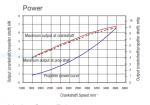
About 4.7 ho at 2000rpm according to the power curve

1608043546312.png
 
About 4.7 ho at 2000rpm according to the power curve

View attachment 104943
I think that shows why a big alternator might stop a small engine from picking up revs. A battery can pull a lot of amps for a few seconds, to get from 11.9 to 14.4 for example. A smart alternator controller can ramp it up sensibly and avoid shredding the belt.
 
I think that shows why a big alternator might stop a small engine from picking up revs. A battery can pull a lot of amps for a few seconds, to get from 11.9 to 14.4 for example. A smart alternator controller can ramp it up sensibly and avoid shredding the belt.

Most small engines aren't fitted with big alternators though.
 
Hi Gixer. I have a 1GM10 powering a 27’ boat. Under engine it feels comfortable at 5 knots at about two thirds throttle and 6-6.5 knots at full (straining) throttle and trying to push against a howling flood tide. After starting on one battery I select both after a couple of minutes. The revs do drop a little but not enough to cause concern. I have an ammeter and can see the charge current going into the leisure battery. As others have stated, the charge current drops quite quickly. I suggest you keep it simple and leave things as they are. If you need maximum power after ten minutes or so, if your batteries are in a decent state, you should not be held back by the alternator. If you need maximum power the moment you leave your mooring then either depart with just your engine battery selected for a while or warm up your engine and depart charging both batteries. Engines are all about peace of mind - anxiety is normal until you’ve made a fair few outings at the start of each season :)
 
Thank you for taking the time to write your response LiftyK. I get the same speeds from the 1GM10 in my 27f yacht.

What you do is exactly what I do now. It’s just remembering to switch from both to domestic when stoping the engine. I will go to two switches soon as I’ve been thinking about it for a while.

I’ve been out of the water for a year now, going back in next week hopefully. Anxiety is driving me nuts at the moment...
 
Dear Anxious Gixer,
I share your anxiety - so consider it halved already :) . Battery 1-2-Both switches are very much frowned upon in this forum. If mine ever dies I will consider an automated arrangement. Until then it works fine. My tip to ensure you set the switch correctly is, at least for your home port, to associate the changeover with a fixed point en route. For example, for me: depart berth and head down river on engine battery; switch to both when passing Marina X, switch to leisure-only at river mouth. And everywhere “engine off, switch to leisure battery only”. Your subconscious keeps you out of trouble once routine is established. If you are venturing afar, consider borrowing your li-ion jump starter from your car to join you on your holiday. They’re not very big and are affordable and bring even more peace of mind. That said, I’ve never needed to use one.
 
I find I do it when I go below and turn the key off for the engine.
I bought a Tacklife power bank for emergencies from a recommendation on here, it’s amazing. Never used it on the boat but always carry it, just in case, lol.
Anyone else want some anxiety? I need it get it down a little bit more ?
 
If OP had an amp meter on the alternator he could see how the charging is going. Yes at initial switch to charging second battery there is going to be a high current load on alternator hence drop in engine RPM. I think however that fairly quickly charge load will reduce and engine RPM will recover gradually so he won't notice it. So don't worry about the rev drop. If alternator load is a real problem for boat speed then try disconnecting alternator. (take off belt) Be carefull not to run alternator with no load as it may be damaged however. ol'will
 
Top