Alternatives to crimp eyes

robertager1962

Well-Known Member
Joined
4 Jul 2013
Messages
180
Location
Cruising
www.sailing-south.com
Currently in lock down in Northern Spain I have been working on some projects, one of which is the re-wiring of the instrument panel. I am planning on using buzz bars for both negative and positive supplies but wonder if there is an alternative to crimping eyes onto the cable. Googling this just seems to bring up crimping. As usual any thoughts gratefully received.
 
Currently in lock down in Northern Spain I have been working on some projects, one of which is the re-wiring of the instrument panel. I am planning on using buzz bars for both negative and positive supplies but wonder if there is an alternative to crimping eyes onto the cable. Googling this just seems to bring up crimping. As usual any thoughts gratefully received.
Mainly because most crimped connectors are very cheaply made.(even the expensive ones) The metal they use seems to be Mickey mouse and also on a buzz bar there is not a great deal of space between cables and the plastic neck of the crimp bulks it out so that they are pushing against each other. I bought some cable solder connectors and these are amazing. I just wondered if anyone knew of something like that for eyes or Lucas.
 
Currently in lock down in Northern Spain I have been working on some projects, one of which is the re-wiring of the instrument panel. I am planning on using buzz bars for both negative and positive supplies but wonder if there is an alternative to crimping eyes onto the cable. Googling this just seems to bring up crimping. As usual any thoughts gratefully received.
You could use soldered connectors. Some will disagree but I have used them for 30 years and never had a failure.
Example Brass Tinned Ring Terminals Wire Connectors Crimp Electrical Lug CableTerminal | eBay then a piece of heat-shrink over the soldered piece.

Www.solocoastalsailing.co.uk
 
Last edited:
You could use something like this:
https://uk.farnell.com/c/connectors/crimp-terminals-solder-terminals-splices/ground-lug-terminals
These are sold for earth connections, but you could use them for anything and would work on a busbar.
I'm not sure I'd recommend them on a boat, there's no strain relief for the cable, so you may get a fatigue problem where the solder loaded wire ends.
They are also uninsulated, but that may not be a problem on a busbar, where everything is at the same voltage, you'd have to provide some overall protection to prevent accidental contact, but you'd have to do that for a busbar anyway.
 
Make sure you get tin plated copper type. Some are nickel plated which is not so good in a humid environment.

In general the heatshrink insulated type from any source seem to be better quality that the standard ones.

You can get uninsulated terminals and use adhesive-lined heatshrink over. Some people prefer this so they can be sure the crimp has been made properly. Needs a different crimp tool to that for insulated type.

I suspect the main difference between quality and cheap terminals is the thickness of plating but of course no-one tells you that unless you're NASA. Maybe some of the cheap ones use aluminium?

Threads ad nauseum here on the whole topic!
 
Used crimp connectors for years in applications like this on offshore oil and gas platforms. Buy the right ones and the metal is not poor quality. Buy cheap and it may be. They are not good in damp atmospheres as corrosion takes place in the crimped socket and eventually caused failure/bad connection. Its very difficult to seal them and stop this.
Almost any connector will ultimately fail in damp conditions if left un-maintained. One good thing is that they are quick and easy to make off and do not require soldering iron etc and heat guns for shrink wrap.
By the way, shrink wrapping terminals can make the corrosion effect worse as it traps any moisture in there and does not allow it to dry off. It also hides any corrosion from the eye so problems cannot be pre-empted.
My answer would be to make sure the busbars are in a "dry" place and use crimps. If the bulk of the connector insulation is causing problems then it probably means you've got too many connections made off and you need a bigger bus to spread them out.
 
Mainly because most crimped connectors are very cheaply made.(even the expensive ones) The metal they use seems to be Mickey mouse

You are either mistaken, or using cheap and nasty connectors. Nothing at all wrong with good quality crimps connectors, fitted with proper ratchet crimping tools.

and also on a buzz bar there is not a great deal of space between cables and the plastic neck of the crimp bulks it out so that they are pushing against each other. I bought some cable solder connectors and these are amazing. I just wondered if anyone knew of something like that for eyes or Lucas.

If there is not enough room between the connecting screws and the terminals, you are using the wrong parts. Can you post links to the busbar you are using and the terminals ?
 
Decent crimps and a decent crimp 'gun', the ratchet type is a good way to go. Blue sea do very nice buzz bars, nicely spaced connecting terminals and cover. I suspect that there are other makes available and 12 volt planet is a good place to start, but based in UK.
 
The only real alternatives to crimping are clamp screw bus bars or solder tags.
Either of which might be better than bad crimping.
 
Currently in lock down in Northern Spain I have been working on some projects, one of which is the re-wiring of the instrument panel. I am planning on using buzz bars for both negative and positive supplies but wonder if there is an alternative to crimping eyes onto the cable. Googling this just seems to bring up crimping. As usual any thoughts gratefully received.
What sort of current? Wago do lots of very nice kit but probably only suitable for lower current. Or with some research you could make your own PCBs cheap and solder on terminal connectors at jlcpcb.com.
 
Just use a big bolt, nut, washer, wrap, washer, nut. It'll be fine, what could go wrong.
You can even wrap the whole thing in insulating tape.
 
Thanks all. Yes I think my crimps are probably the cheap ones. The metal is not too bad but the insulating collars (that get crimped) squeeze out and just take up a lot of room. Trouble is that I have found that Spain is a funny old place for spares and it is not so much a case of buying good quality it is more a case of what you can get. Thanks for the links. It is a minefield trying to buy "good quality" crimps as they all tell you that they are god quality. I bought mine from RS components in the UK (before I left) and they are OK but still Chinese and cheap.
Sorry it was me that called it a buzz bar, should have been bus bar.
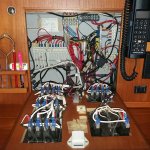
The only other liveaboard here here has a rather lovely Victoria 38. This boats previous owner was a millionaire and everything was commissioned and installed by professionals. On opening up his switch panel I got wiring envy and want to emulate what his boat has. Mine is an elderly Southerly that has (what can be best described as ) an organically grown wiring system so I am trying to do the best I can with what I have although I have heard that we may be coming out of lockdown quite shortly, so hopefully will be able to access some supplies.
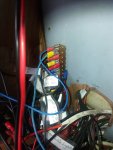
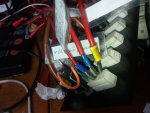
Attached is the picture of the Victoria switch panel and also of the current bus bar with squashed crimps and also all positives hanging of the switches. I am planning to change these all to single wires and a hinged panel.
God the marina is rolly tonight!!
 

Attachments

  • Bus-Bar.jpg
    Bus-Bar.jpg
    136.9 KB · Views: 72
  • Terminals.jpg
    Terminals.jpg
    118.4 KB · Views: 86
  • Victoria-38.jpg
    Victoria-38.jpg
    189.9 KB · Views: 88
Oh dear :(

The image of the Vic panel doesn't fill me with desire. Lots of nasty chocolate block connectors, a mix of glass and blade fuses and some dodgy looking crimp terminals.

As for the other two pics, it doesn't help that the crimp terminals are a bit random. Some yellow crimps where blue, or even red, would have been suitable and some blue where yellow should have been used. You really do need to use the correct size terminals. Also, the cable insulation should be crimped inside the terminal insulation, no bare conductor should be visible. A lot of part insulated terminals, where fully insulated could be used.

Those spade terminal bus bars are not pretty. This type of busbar would, in that particular installation, be much neater VTE Bus Bar, Red Power Distribution Point, 240 Amp, 12 Point
 
Oh dear :(

The image of the Vic panel doesn't fill me with desire. Lots of nasty chocolate block connectors, a mix of glass and blade fuses and some dodgy looking crimp terminals.

As for the other two pics, it doesn't help that the crimp terminals are a bit random. Some yellow crimps where blue, or even red, would have been suitable and some blue where yellow should have been used. You really do need to use the correct size terminals. Also, the cable insulation should be crimped inside the terminal insulation, no bare conductor should be visible. A lot of part insulated terminals, where fully insulated could be used.

Those spade terminal bus bars are not pretty. This type of busbar would, in that particular installation, be much neater VTE Bus Bar, Red Power Distribution Point, 240 Amp, 12 Point
I do like these bus bars. If only I could get ASAP
Oh dear :(

The image of the Vic panel doesn't fill me with desire. Lots of nasty chocolate block connectors, a mix of glass and blade fuses and some dodgy looking crimp terminals.

As for the other two pics, it doesn't help that the crimp terminals are a bit random. Some yellow crimps where blue, or even red, would have been suitable and some blue where yellow should have been used. You really do need to use the correct size terminals. Also, the cable insulation should be crimped inside the terminal insulation, no bare conductor should be visible. A lot of part insulated terminals, where fully insulated could be used.

Those spade terminal bus bars are not pretty. This type of busbar would, in that particular installation, be much neater VTE Bus Bar, Red Power Distribution Point, 240 Amp, 12 Point
I do like this bus bar and this is the sort of thing I would like to install. I might get these sent from ASAP (just an issue with postage at the moment)
Just one question, if not chock boxes then how would you terminate individual cables before patching them onto the switch panel as I want to avoid having cable runs being terminated onto the switch panel (in a similar manner to the Victoria idea)
I agree about the crimp colours but these are inherited and are temporary to give enough electrics to live with. My plan is to shorten the wires and terminate onto a bus bar with eyes. I just wanted to avoid the oversized insulation rings which distort when crimped and flatten and then won't fit with the other cables on the bus bar.
 
I do like these bus bars. If only I could get ASAP

I do like this bus bar and this is the sort of thing I would like to install. I might get these sent from ASAP (just an issue with postage at the moment)
Just one question, if not chock boxes then how would you terminate individual cables before patching them onto the switch panel as I want to avoid having cable runs being terminated onto the switch panel (in a similar manner to the Victoria idea)
I agree about the crimp colours but these are inherited and are temporary to give enough electrics to live with. My plan is to shorten the wires and terminate onto a bus bar with eyes. I just wanted to avoid the oversized insulation rings which distort when crimped and flatten and then won't fit with the other cables on the bus bar.

Rather than chock blocks, this style of connector is better ;

Bluesea Systems 20A Terminal Blocks | 12 Volt Planet

Available in 20a and 30a (if you need to use bigger crimps). Other makes and suppliers are available.

I see there are piggy back spade terminals on some of your switches, i'm not a fan of those, they look untidy and they are not fully insulated. Rather than use those, there are at least a couple of better methods ;

1) Use a fully insulated spade on a short cable going to a terminal on the connector strip above. Then use a terminal jumper (shown on the link above) to allow you to connect two cables, you can bridge as many connections as you need to, subject to the rating of the connector strip.

2) Use a fully insulated spade on a short cable going to a 221 series Wago connector, available in 2, 3 or 5 way. Fit the other cables in the connector. You can make a very neat installation with these connectors, by fixing them in a row with some fast drying epoxy (Rapid Araldite or a clone thereof).
 
Top